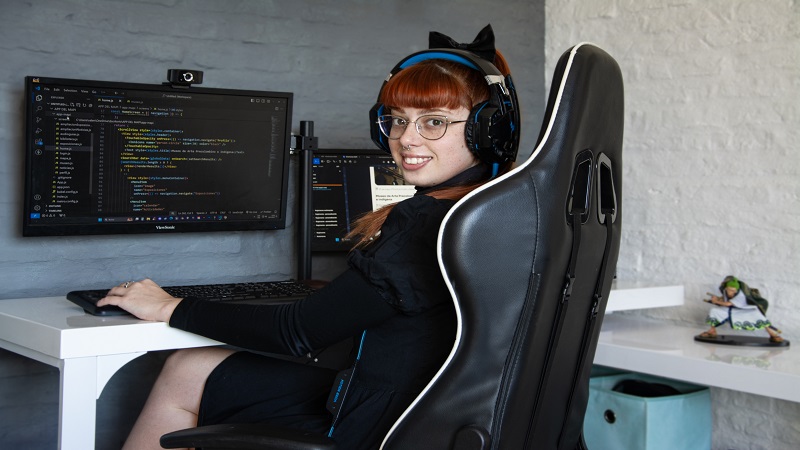
As part of his senior project, Golubei took on the challenge of collaborating with an organization to solve a design problem that spanned various fields or disciplines.
With a strong interest in audiovisual media and virtual reality, Valentina set out to find an organization that could benefit from her innovative approach.
“I started by researching which museums there were and what their social media accounts and websites were like, with the aim of identifying opportunities to contribute based on my background,” he said.
“After sending several proposals, MAPI responded with interest. We organized a meeting, and that’s how this joint project came about,” he added.
This ambitious project is part of his final thesis and represents a unique collaboration between academia and a cultural institution.
What Is the Metaverse?
The Metaverse is a three-dimensional virtual environment where users can interact with each other and their surroundings in real time, using avatars and digital tools.
Essentially, it is a digital universe where real-world experiences can be recreated, but with the flexibility and creativity that the virtual world offers.
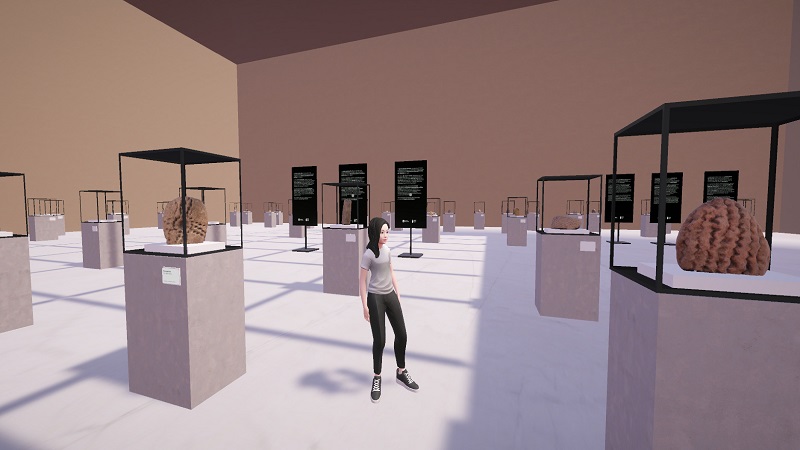
Complement and expand MAPI
The purpose of modeling the museum in the Metaverse was not to replace MAPI, but to complement it and expand its reach.
“We set out to solve a problem common to all museums: only about 15% of their collections are on public display, whether due to a lack of space or the need for special care for the artifacts,” he explained.
To bring the 3D universe to life in the Metaverse, Valentina conducted extensive research that included studying the architecture of the MAPI—both exterior and interior—and a detailed analysis of the various exhibitions, from their design to the history behind them.
He used digital tools such as Spatial.io to create the Metaverse and Luma AI, an application that processes photographic and audiovisual records of the pieces using artificial intelligence.
Innovation and Digital Transformation
On July 31, MAPI presented six digital projects at its café, three of which were developed by Valentina Golubei: the redesign of the museum’s website, the creation of its mobile app, and the construction of the museum in the Metaverse.
In addition, Golubei oversaw a photo shoot for the catalogs featuring the pieces, the production of a Metaverse trailer, and the creation of content for MAPI’s social media channels.
MAPI's International Reach
Among the other digital projects presented, the partnership with Red Tickets for the sale of tickets and museum merchandise stood out, as did the collaboration with Volarte, which allows MAPI’s content to reach more than 500 million people passing through airports in Latin America.