The contest invited students from various countries to submit a video—no longer than two minutes—presenting a biotechnology solution to an environmental problem with real-world impact.
Students from Europe, Asia, Africa, and the Americas participated, with two separate award categories: one for European institutions and another for institutions outside the continent.
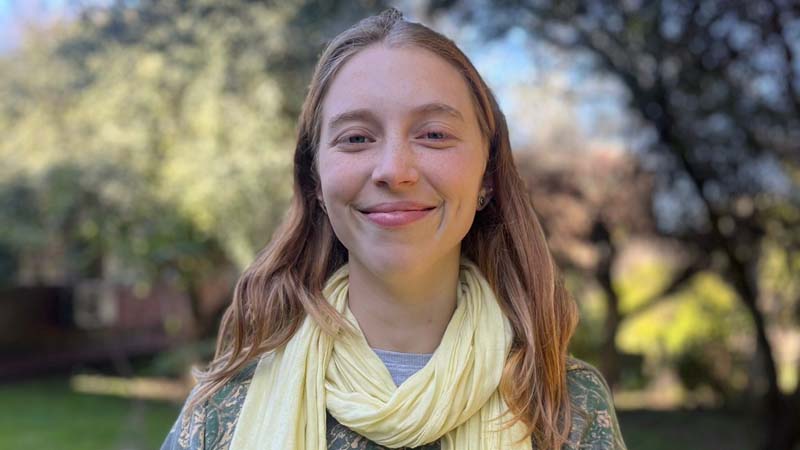
Bárbara took second place in the "Outside Europe" category, which recognizes entries from countries such as South Africa, India, Mexico, Brazil, and Uruguay.
The problem: biofouling on ship hulls
Uruguay is a coastal country with a bustling maritime industry: the port of Montevideo receives more than 3,000 cargo ships a year, as well as over 200 cruise ships, carrying thousands of tourists and—almost without us noticing— invasive species that travel attached to the hulls.
The phenomenon begins when microorganisms form a bacterial biofilm, which then allows algae, mollusks, and other marine organisms to attach themselves to it.
Over time, this creates thick layers that:
- Ships slow down, increasing fuel consumption.
- CO₂ emissions are on the rise.
- They contribute to the global spread of invasive species.
- They increase corrosion on boats.
Current solutions rely on toxic antifouling paints, some of which contain compounds such as tributyltin—a substance banned by the International Maritime Organization—that may still be found in certain products.
Other paints release microplastics, which are ingested by marine organisms and enter the food chain.
The solution: polyphenols from the native arazá fruit
Bárbara's proposal is based on harnessing the high polyphenol content of the arazá, a native Uruguayan fruit with antibiofilm properties supported by scientific literature.
Their approach combines:
- Extraction of polyphenols from arazá.
- Encapsulation in biopolymers, enabling controlled release.
- Long-lasting, eco-friendly antifouling effect, without the use of toxic substances.
Polyphenols possess biological mechanisms capable of inhibiting biofilm formation:
- Microbial anti-adhesion.
- Inhibition of quorum sensing (cell-to-cell communication).
- Decrease in the production of extracellular polymeric substances (EPS).
- Mechanisms for breaking down biofilm.
This approach aims to protect vessels while reducing fuel consumption, emissions, and environmental risk by integrating science and sustainability.
An idea that came to him while he was working on his thesis
The inspiration came to Barbara while she was working on her thesis at the Clemente Estable Institute for Biological Research (IIBCE), in the Microbial Biofilms Laboratory of the Department of Microbiology, where she studies the interactions and dynamics of these systems. There, she sought to link her research with a real-world environmental challenge:
“I wanted to work in a biofilm lab, but on a project that would have an environmental impact. When I discovered that the arazá fruit had a high concentration of polyphenols, everything fell into place.”
He also explored other native fruits, such as the local guava, which has documented antibiofilm properties.
The creative process: science, publishing, and the Port of Montevideo
The contest called for a clear, visually appealing video. To film it, Bárbara explored the port of Montevideo with a friend, Emilia Foderé, a communications student:
“I wanted to showcase maritime activity and explain why this issue matters in Uruguay. It took me a while to film it and even longer to edit it, but I’m proud of the result.”
The piece incorporates local imagery, maritime traffic data, and an original soundtrack composed by Juan Luis Villar, inspired by a distinctly Uruguayan aesthetic.
https://youtu.be/esVJKv7CXD4
ORT Training: Creativity and Scientific Rigor
The student emphasizes that her time at the School of Engineering was crucial:
“In this program, you learn to see how something living—a bacterium, a plant, a fungus—can have properties that can be applied to real-world problems. That really opens your mind.”
He also emphasizes the importance of rigorous research and the use of academic papers, a practice he applied when designing the solution.
Biotechnology to Transform Realities
Reflecting on the potential of the discipline, Barbara says:
The possibilities are endless. Every organism has something to contribute. Biotechnology is a broad field: you can work in everything from bioremediation to cosmetics or bioinformatics. That’s what I like best.
Learn more about Biotechnology Engineering