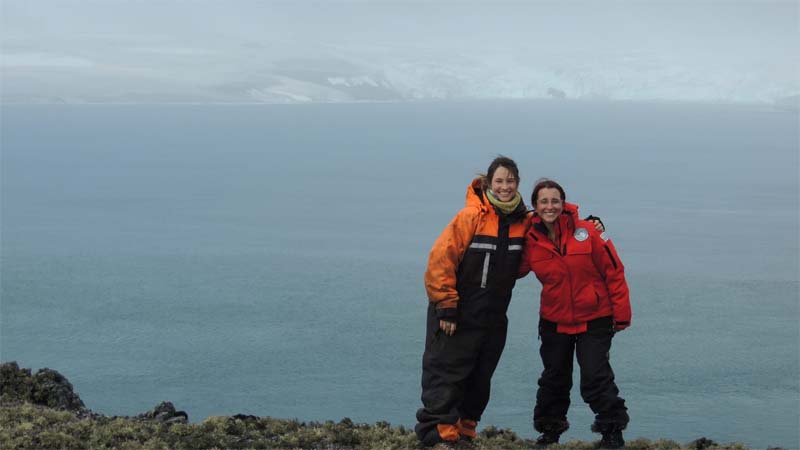
How did the opportunity to travel to Antarctica come about?
We both completed our theses at the Clemente Estable Institute for Biological Research (IIBCE), in the Biogem department, in the Molecular Microbiology laboratory with the team led by Silvia Batista and Matías Giménez, where we met María Morel (research associate), who involved us in this global project, called SoilBon, based at Leipzig University in Germany, in collaboration with the IIBCE and the Faculty of Sciences.
What kind of research are you conducting?
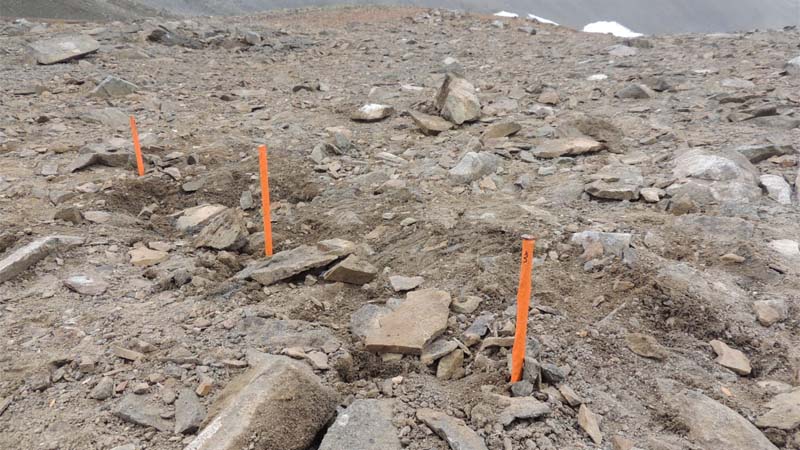
Essentially, the project aims to study the Earth’s biodiversity on a global scale and generate spatially and temporally standardized data, without an industrial focus. For this reason, samples are taken from both preserved regions and disturbed areas, where both fresh and dry soil is collected, and tea bags are buried to be retrieved the following year.
Why are tea bags buried?
It is based on a method called the Tea Bags Index, which involves burying standardized organic material—green tea and rooibos tea bags with different compositions—to calculate the decomposition rate and the stabilization factor. A globally available tea brand is also selected to ensure that the sampling is standardized.
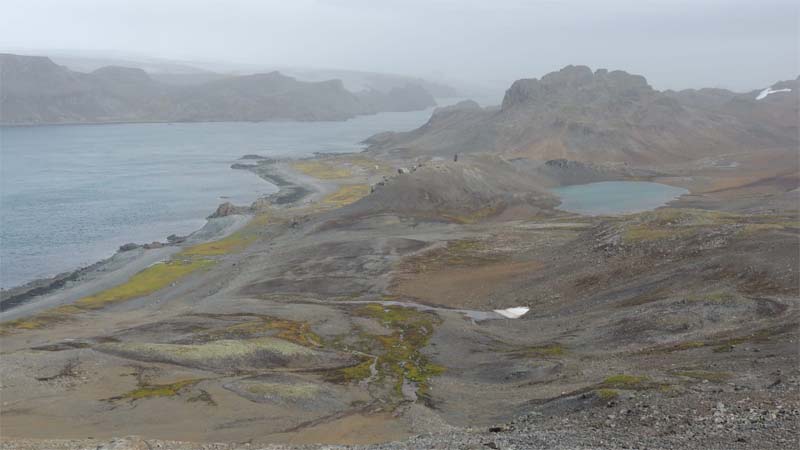
It took them four days to reach Artigas Base aboard the ROU 04 Gral. Artigas. What was the experience like?
The boat trip was an adventure that felt like a world of its own because it was so different. The synergy between the sailors and the scientists was truly enjoyable; we learned from one another, and we were treated with great hospitality and respect. We know that to accomplish what we came here to do, we need to work as a team. It was hard to get used to the rocking of the boat, especially in the Drake Passage (the stormiest waters on the planet), but it was still worthwhile because of the incredible views and the wildlife that came close.
However, one of the most intense emotions we scientists felt was when we woke up, went out on deck, and saw the research station. Fortunately, our connection to the ship didn’t end there, as we took part in loading and unloading operations over the next few days.
How long will they be in Antarctica?
We’re leaving on Sunday, January 22, on a commercial flight, then boarding the ROU 04 in Punta Arenas, and we’ll return on February 14 aboard the Uruguayan Air Force’s Hercules, arriving in Montevideo on the 15th. Although in Antarctica, the weather determines everything.
What is your daily routine like?
On the days we go out to collect samples, we pack our backpacks early in the morning with coats, radios, food, and everything else we need for the sampling. We usually walk to our destination, and we coordinate our trips with other scientific groups at the base who are heading to the same place or nearby. After each trip, we spend some time in the lab organizing the samples.
On days when we don't go out, we eat with everyone at the base at set times, and every few days it's our turn to serve as helpers, which means setting the table, washing dishes, and cleaning to make life more pleasant for everyone. We also do computer work, like reading papers, go to the gym some days, and we have free time, during which we play cards, board games, and ping pong, watch movies together, and, of course, watch soccer.
How do you relate this experience to your studies in biotechnology?
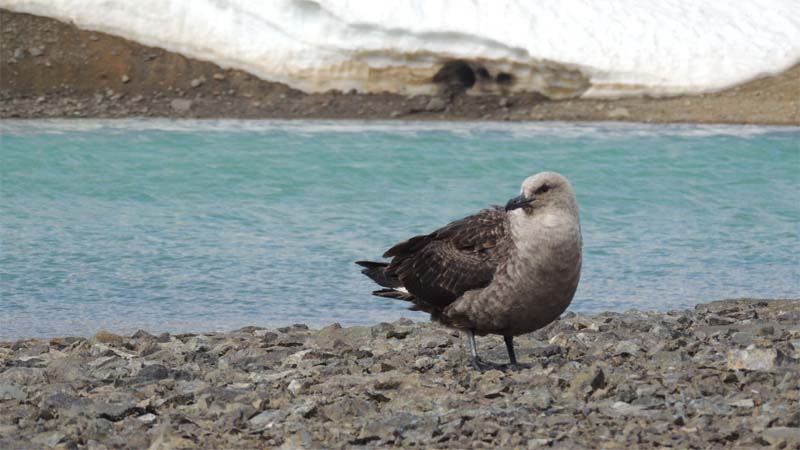
The program involves a lot of teamwork, which is actually quite similar to real life, since without cooperation among us, conducting the sampling would be difficult. This is especially true when sampling in cold conditions—sometimes in snow and rain—with skuas (large, aggressive birds) trying to steal our equipment. It also gives us the opportunity to interpret the findings of other scientific projects and engage in constructive discussions.
Do you feel that your studies in biotechnology have helped you in this experience?
The work in the lab gave us the confidence to feel capable of carrying out this task, because even though the work here isn't very complex, it comes with a great deal of responsibility.