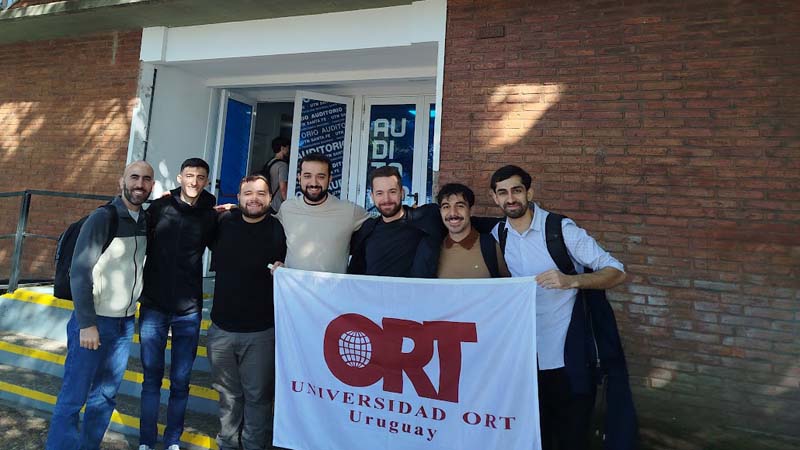
The 2025 Latin American Regional of the ICPC (International Collegiate Programming Contest) took place on November 8 and brought together institutions from across Latin America. Universidad ORT Uruguay in the Argentine regional, held at the Technological University of Santa Fe, and took the top two spots in the competition.
The performance of Team 1—composed of Systems Engineering students Joaquín Bonora, Nahuel Merlo, and Juan Duarte, with Rafael Fernández as their coach—marked a significant improvement over 2024, when the same students had placed 100th. This improvement allowed them to qualify once again for Programadores de América 2026, the continental competition to be held in March in Chile.
A 25-year tradition
The faculty’s involvement in the ICPC dates back more than a quarter of a century. For Dr. Inés Kereki, professor of Computer Science, this track record is only possible thanks to a“very solid institutional support ecosystem” that involves multiple departments:
“The ORT Programming Contest is celebrating its 25th anniversary. Its continued success is made possible by institutional support, the collaboration of faculty members, sponsors, teaching assistants, coordinators, lab assistants, graduate student coordinators, and many others who, year after year, help the event grow.”
Kereki also served on the judging panel and proposed one of the exercises used in the regional competition.
Intensive preparation: workshops, drills, and ongoing training
The results obtained reflect a program that has become increasingly professional over time. In recent years, the faculty has incorporated the Competitive Programming Workshop, coordinated by Rafael Fernández, a lecturer in the Programming Department, which has gradually adapted its format and content.
“The workshop provides a theoretical and practical foundation, advanced tools, and, above all, a structured framework for training. It fosters both teamwork and individual development,” Kereki noted.
In addition, practice sessions were held to prepare students under conditions similar to those of the competition—lasting five hours, with a single computer and multiple exercises—led by Andrés de Sosa, academic coordinator of the Software Analyst and Information Technology Analyst programs and a faculty member in the department.
This combination of events allowed the teams to gain experience, improve their speed, develop problem-solving strategies, and learn to handle pressure—all key elements for a competition like the ICPC.
Student engagement
For Kereki, the team's success is a direct result of the students' dedication:
“This result demonstrates the students’ dedication and commitment, as they participate in a variety of educational programs and strive to improve year after year.”
Participating in the ICPC develops transferable skills that are highly valued in the tech industry:
- teamwork
- effective communication
- planning
- critical thinking
- solving complex problems under pressure
“Companies highly value this experience. It demonstrates discipline, motivation, a grasp of fundamental concepts, and the ability to work under real-world constraints.”
Looking ahead
Now that we've qualified for the continental stage, the goal is to keep improving.
“I hope they continue to train hard and enjoy the experience. That balance is essential,” says Kereki.
His message to those thinking about joining the workshop or competing in future editions is simple and inspiring:
“What matters most is curiosity, a desire to learn, and perseverance. Entering the contest opens doors.”