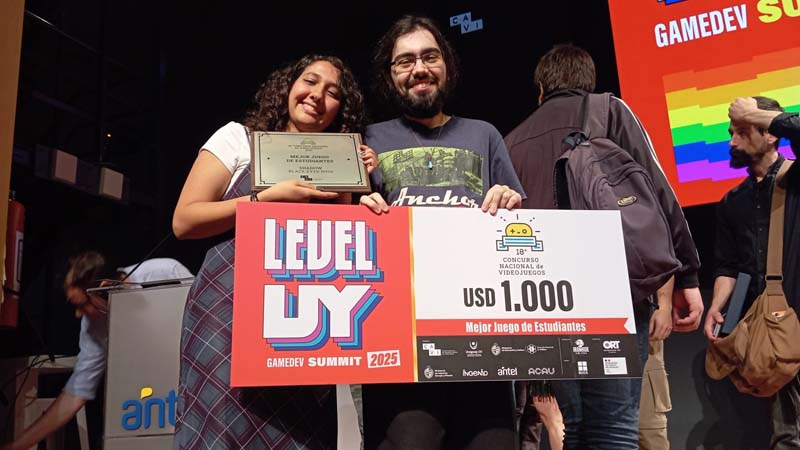
The video game, titled Shadow, originated as a prototype developed in the Video Game Development 2 course. Based on that initial work, the project sparked interest and was continued as a thesis.
“The prototype attracted attention for its potential and led to the first collaborative project between the Systems Engineering program and the Bachelor’s program in Animation and Video Games, in the form of a thesis,” Giuliano said.
The goal was to move toward a prototype: a playable version that would clearly demonstrate the game's concept.
A world of light and shadow
Shadow is a free-roaming platformer. The story takes place in a Victorian-style world overrun by shadows that come to life. The protagonist must navigate the world using light as her primary tool.
Flashlights, light bars, and light bridges help players overcome obstacles, while the setting is inspired by a steampunk universe where steam power replaces electricity. Trains, rails, steam, and objects inspired by that era are all part of the environment.
The game is designed for sessions ranging from 30 minutes to an hour and a half and is aimed at both experienced players and those new to this type of game.
https://www.youtube.com/watch?v=IcMRB8CNblU&t=4s
Clearly defined roles
The project was developed by a small team. Ailin was responsible for the visual design, overall aesthetics, and level layout. Giuliano took on the role of programmer: character movement, game logic, enemies, interactions, and level assembly.
To coordinate their work, they used shared repositories on GitHub, which allowed them to integrate changes between the art and programming in real time.
Learning to work across disciplines
Interdisciplinary work was one of the main challenges of the process. Unlike other academic projects, this time each member was completely dependent on the work of the others.
“I can’t draw, and she doesn’t code. That really forces you to coordinate. We had a lot of back-and-forth about the animations, the reference points, and how every detail affected the technical side of things,” Giuliano explained.
This back-and-forth allowed us to streamline processes and speed up development once the visual and technical languages were aligned.
The Road to the Prize
After completing their thesis project, the School of Design encouraged them to enter the National Video Game Competition. The team worked on a second phase of development, adding new features and concepts, and submitted the game.
A few days later, the nomination came in, and finally, the recognition: Shadow was named Best Student Game.
The monetary prize is important, but above all, it is a tremendous recognition of the work and the quality of the project.
What stage is the video game at today?
Currently, Shadow has fully playable level that showcases all of its core mechanics. The project is still in development, with plans to expand the map, add more content, and deepen the narrative.
“We’ve built a solid foundation, and now the plan is to expand that world,” he explained.
From the classroom to the entrepreneurial ecosystem
Giuliano and Ailin recently began their program at the Center for Innovation and Entrepreneurship (CIE), where they are seeking support to develop the video game from a business, communications, and marketing perspective.
Although development is currently on hold due to academic and personal commitments, both plan to resume the project and work toward a more complete version.
Find out more about Systems Engineering