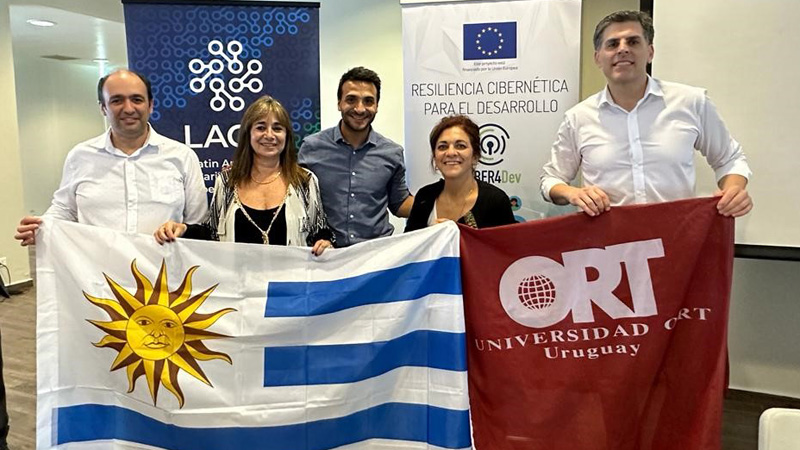
The participants were Andrea López, Daniel del Monte (a student in the 2022 cohort of the Diploma program), Marcelo Sniadover, and Germán Martínez (students in the 2023 cohort). During the challenge in Santo Domingo, they were accompanied by Ethel Kornecki, an instructor in the Specialization Diploma in Cybersecurity and an assistant to the academic coordinator of the Cybersecurity program.
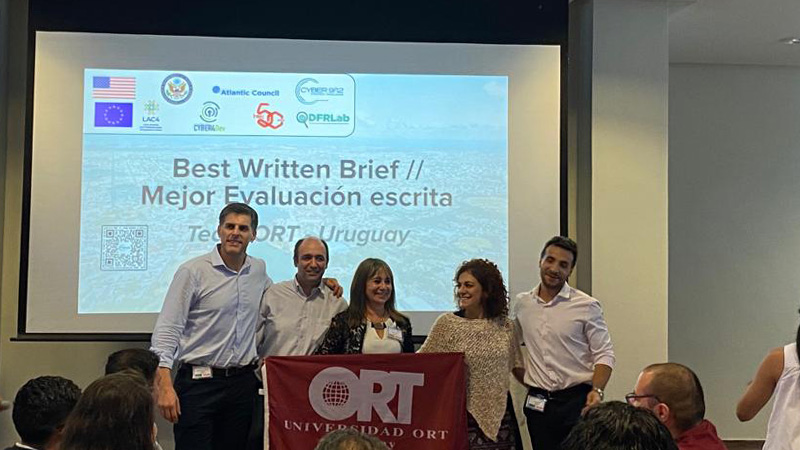
During the event, in which 14 teams competed, the group received an award for the best written evaluation of the report they submitted, earning excellent feedback from the international judges. However, the overall prize went to the team from Ecuador.
In this interview, Kornecki talks about what the challenge entailed, how they experienced it, and what they took away from the experience.
What did the challenge involve?
The competition focused on a cybersecurity scenario involving data exfiltration caused by malware within the Ministry of Defense. As a result, situations began to arise that compromised national security and critical infrastructure, such as the energy sector in El Salvador.
From there, each team had to understand the timeline of the threats, conduct a risk analysis, mitigate those risks, and develop a short-, medium-, and long-term action plan.
The incident involved several countries; it was initially believed to have originated in El Salvador, but it later emerged that the malware, which was used to eavesdrop on conversations, was linked to the Colombian government.
At the same time, power outages began to occur in Costa Rica, and a social uprising began in response to everything that was happening—as a demonstration of discontent with the wiretapping, compounded by the power outages.
On the second day, we were given another assignment in which the situation gets worse and we find ourselves in a crisis. For that, we had to prepare a report to present the following day.
What was the competition like?
We really threw ourselves into the challenge because, once we submitted the first part of the assignment, we had a 10-minute presentation, for which we received an award.
We learned a lot, and the students’ commitment was incredible. We worked very hard; it was a huge effort, and there was tremendous dedication from both the students and the faculty as a whole.
What do these types of opportunities offer Diploma students?
This adds a lot of value to the diploma program—first and foremost, everything related to international relations, the legal aspects, how to address issues at the government level, and the courses of action. In addition, we build relationships with other universities.
It was an enriching experience, and we came away with many valuable connections that will benefit the university and help us continue to grow.
These types of events are a perfect complement to graduate studies, which is why we believe we must continue to forge partnerships and participate in national and international events so that these experiences can continue to be replicated.
Of course, we would like to thank Universidad ORT Uruguay us the opportunity to take on this challenge, the organizer who selected us to come, and the country that welcomed us so warmly.
I want to emphasize that, although the work and the challenge fell to us, the participants, we always had the support of the faculty, who were available to help us with any doubts or questions, and especially Roberto Ambrosoni, our team captain.