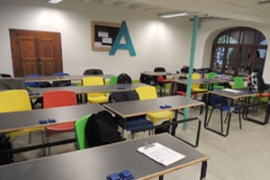
 Students in the Workshop 6 course of the Bachelor’s Degree in Interior Design carried out a comprehensive project for the Ánima technical high school, which opened its doors in March 2016 and serves young people living in socially vulnerable circumstances. The project was executed by Estudio Gómez-Platero. In this interview, we spoke with Workshop 6 instructor, Flavio Morán.
-How did the collaboration between Taller 6 and Ánima come about?
For the past six years, Workshop 6 has been a university extension course featuring real-world cases and clients.
Each year, in consultation with the academic coordinator, Architect Ricardo Chelle, we reach out to various institutions with ongoing projects that allow us to support both their goals and our own, particularly in addressing the interior spatial layout of a program designed for diverse audiences within a limited floor area.
In the case of Ánima, we were in contact with its principal, Ms. Ximena Sommer, with whom we met over the course of a year. This allowed us to gain a deeper understanding of every stage of the project’s development and to learn about this new privately managed school offering free tuition.
Ánima opened its doors in March 2016 with an innovative educational program for the upper secondary cycle (10th, 11th, and 12th grades), offering two tracks within the Technical Baccalaureate: Administration and Information and Communication Technology (ICT), both accredited by UTU-CETP (Council for Technical and Vocational Education of the National Public Education Administration), which takes place in various learning environments: the classroom, companies, and digital labs.
-What exactly did the project entail?
- Comprehensive renovation and interior refurbishment of the basement at Conventuales.
- Identification of priority needs and development of the interior design plan.
- Agreement on a master action plan to maximize the use of resources.
- Preliminary design proposal and definition of the corresponding final design.
-What kinds of challenges did the students in the workshop face?
Getting an up-close look at a real-life case—a client with a specific name, a corporate identity, and urgent needs.
They also had to contend with a complex existing space. The project was set up in the basement of Conventuales, where we began our survey of the unused space, which had been closed for a long time.
They should have understood the proposal for vocational training aimed at young people living in socially vulnerable situations, which employs an innovative educational strategy that incorporates various components of the dual training system, thereby bridging the gap between education and the workforce to address the skills gap that exists today and meet the needs and interests of young people.
They had to design a program tailored to the client’s needs and the project’s academic requirements, and ultimately developed a project based on a real-world scenario.
-What is the importance of connecting students’ work in this way with outreach activities at other educational centers such as Ánima?
This is of the utmost importance. A primary goal of the degree program is to develop the skills of future interior designers.
The connection to a real-world case study is unique; it places us within a contemporary design project, allowing us to creatively visualize every stage of the process.
Working with clients brings us face-to-face with the variables inherent in every project; we are tasked with developing a compelling proposal and its technical implementation, all while taking economic considerations into account. We engage in dialogue and negotiate opportunities in interior design by working in multidisciplinary teams.
-How do you evaluate the final result of the design created by the team and the realization of that design in what is now Ánima?
This is a great achievement, as—following consistent work in Workshop 6—this marks the first time the group’s proposals have been successfully brought to fruition, even if only partially, with a selection of designs from various teams that remain true to the designers’ vision and feature high-quality projects and details.
Visiting Ánima and seeing young people studying in spaces designed by very young designers is exciting.