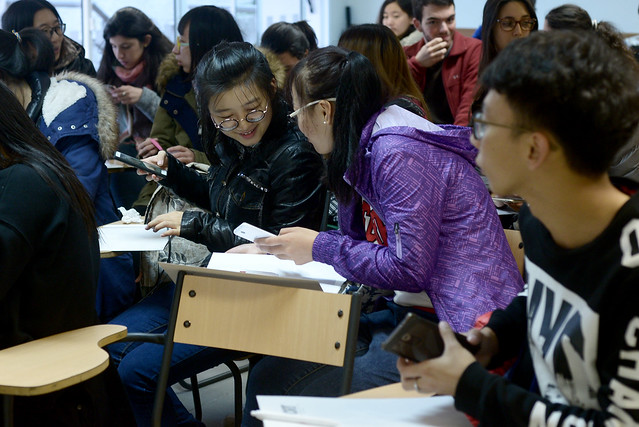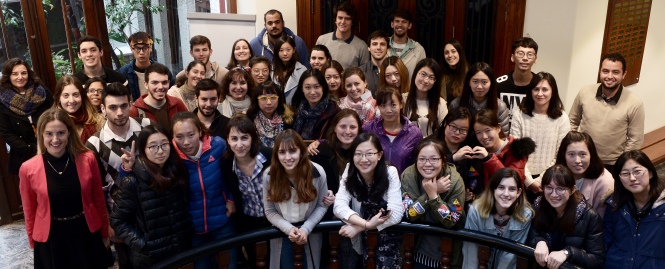
Sofía is a 21-year-old Chinese student who has just arrived in Uruguay. She will be staying in the country for about a year to study Spanish, more than 18,700 kilometers from home. She will learn new words and improve her command of the language; she will experience a culture completely different from her own, perhaps drink mate and try asado; she will meet many people and may make lifelong friends.
Like her, 16 other Chinese students arrived in Uruguay to study Spanish as part of the fifth edition of the joint program between Harbin Normal University and Universidad ORT Uruguay.
What is it about?
Students in the Spanish Language Bachelor's program at Harbin Normal University study Spanish for two years in China. In their third year, they go to a Spanish-speaking country. After completing that period, they return to their home country, study for one more year, and graduate.
Uruguay, through Universidad ORT Uruguay, is one of the travel options available to them, explained María Azpiroz, coordinator of the Joint Program. In the first semester, they take courses that are part of their degree program and share classes with other international students. In the second semester, those with good grades attend classes alongside other Uruguayan students in the university’s regular courses.
“What’s interesting about the program,” Azpiroz noted, “is that it has not only given Chinese students the chance to get to know another country, but has also provided many Uruguayans with the opportunity to experience a completely different way of life and interact with Chinese university students and young people. ‘Something that isn’t very common,’ he said.”
Two different cultures
Azpiroz, who lived in China for four years, listed the differences between the two countries. For example, Chinese students usually have lunch at 11:30 a.m. and dinner at 5:00 p.m.; the lights in their dorm rooms are turned off at 11:00 p.m.
In China, students live on campus, have many classes, a heavy course load, and work from a textbook that is followed in a linear fashion. In contrast, in Uruguay there is a required reading list and a supplementary reading list, and students must consult a variety of information sources.
Harbin Normal University has more than 30,000 students, and Harbin—the capital and largest city of Heilongjiang Province, located in northeastern China—is home to approximately 10 million people.
The teacher-student relationship is also different. In China, the bond is very close, and it’s easy to learn about the teacher’s personal life. He also noted that Spanish classes are mostly taught in Chinese and that students rarely work in groups.
Azpiroz said that the Chinese are excellent cooks and that, for them, going out to eat and sharing a table “is even more important than a pre-dinner drink in Uruguay.”
While cultural differences can sometimes lead to conflicts, they also offer opportunities for learning. For example, he pointed out that there are interests that some people share while others do not. Uruguayans like to go out dancing and stay up late; the Chinese prefer to go to bed early and enjoy singing karaoke.
Finally, he said that students like many things about Uruguay: the lifestyle, the peace and quiet, the fresh air, the blue sky, the university, and the way classes are taught. “Overall, they have a great time,” said Azpiroz.
Welcome
“It’s wonderful and truly heartwarming for us to see a new generation arriving,” said Julio Fernández—academic vice president of Universidad ORT Uruguayat the welcome ceremony for the Chinese students. “Not only will they learn Spanish, but we also learn a great deal about their country and their customs,” he added.
The event, held on Monday, August 29, at the School of Business and Social Sciences, was attended by Zhang Wenwei, political counselor at the Embassy of the People’s Republic of China in Uruguay, who addressed the students. The counselor spoke about the importance of education, China’s relations with Uruguay and Latin America, and told them that they are China’s representatives in Uruguay.
Then, each Chinese student came to the front and introduced themselves briefly.
"Hi everyone, my name is Fabiana, I'm 20 years old, and I hope we can all become friends," said a student.
-My name is Marcela. It's nice to meet you all. I hope we can help each other in life and in our studies.
"Hi everyone, my name is Fabio, and I'm the only guy here. I'm glad to be here in Montevideo to study Spanish. It's going to be an unforgettable experience," said the last person to introduce himself.
Gabriela, a Chinese student from the class of 2015, shared her experience with the new students and their mentors—who were also present at the event. She said that Uruguay is a country with “a very different culture,” and that students will encounter many difficulties—for example, with something as simple as depositing money—but that “that’s not what matters”: “What matters is having a good time in Montevideo.”
“They’ll learn how to be adults without their parents’ help,” said Valentina, a member of the 2013 class of Chinese students, who returned to Uruguay after graduating to pursue a master’s degree in education at Universidad ORT Uruguay. In her view, the students will learn how to communicate with people and solve problems. “Make the most of this experience and have a great time.”
Of course, neither Sofía, Fabiana, Marcela, Fabio, Gabriela, nor Valentina are their real names; but all students are given a Spanish name when they start their degree program.
A unique experience
“Studying in Uruguay is a wonderful experience. Uruguay is so far away from China, so it wouldn’t have been easy to get to know this country without this opportunity,” said Sofía, one of the Chinese students from the class of 2016.
When asked about her first few days in Uruguay, she said she found the classes interesting, as they differed from the ones she had in China in terms of content and organization.
She also emphasized that the teachers and mentors have been very kind and have helped her a great deal. Looking ahead, Sofía hopes to get to know Uruguay in depth by traveling and interacting with Uruguayans.
A mutual learning experience
“Teaching students who come from such a different culture isn’t easy,” said Professor Andrés Bancalari. However, the associate academic coordinator of International Studies and instructor of Fundamentals of International Trade emphasized that “learning is, without a doubt, a two-way street. They are two very different realities, and that’s what makes it so appealing.”
Bancalari said that once Chinese students feel confident in their language skills: “Their contributions are valuable and offer a very different perspective on the world.”
He added, “The exchange with Uruguayan students has been very positive. There is a lot of interest among local students in learning more about China and Harbin.”
“It’s important to keep in mind that students in the Bachelor’s program in International Studies have a genuine interest in different cultures, and that undoubtedly makes the exchange go smoothly.”
A friendship for life
“The role of the mentor is key,” said Santiago Patrón di Rende, a corporate communications student and mentor to Chinese students since 2013. The reason is that if strong bonds and friendships are formed, “everything about life in Uruguay becomes easier.”
During the first few days, the mentors help the Chinese students buy SIM cards for their cell phones, open a bank account, and take the bus. They explore Montevideo together, and little by little, they introduce them to the country’s unique character. According to Patrón, over the years, he has tried to ensure that they leave with “a fairly broad understanding of what life is like outside of China.”
“I try to show them the good and the bad of a system like ours—the customs, habits, and ways of life. I try to introduce them to all the neighborhoods, the countryside, cumbia, rock, murga, schools, families, festivals, religions, and everything that, to some extent, forms part of that great mosaic that makes us Uruguayan,” he explained.
For Patrón, the experience of being a mentor has been “one of the best things” he has ever done. What has stayed with him most about the Chinese students is “their meals, their composure, their loyalty, and their gratitude for having been part of this experience, which has undoubtedly changed their lives.”
“I’ve met people with whom I’ve formed friendships that I’m sure will last for the rest of my life,” he emphasized. He even mentioned that he remains in touch with several students from the first cohort, despite the distance and the passage of time.
The godfather recalled that when he met María Azpiroz, she said something to him that stuck with him and that he has since found to be true: “If you earn the friendship of a Chinese person, you gain a friend for life.”
Photo gallery: