Architect Pamela Thomasset and Architect Roxana Giovine, both graduates of the School of Architecture, and architect Fernando Chebataroff, a former professor, make up the firm Chebataroff-Thomasset Arquitectos, which this year launched its new website to “spread knowledge on important topics related to construction,” “in addition to the firm’s natural promotion,” they said.
When was the firm founded?
The firm has been in operation for many years, at times consisting solely of architect Fernando Chebataroff, though most of the time in partnership with another professional.
For example, between 1997 and 2002, most of the projects were carried out in collaboration with architect Eduardo Sarser, who retired from the profession toward the end of that period.
Subsequently, the firm began working with other professionals as consultants on a project-by-project basis.
We would like to highlight our collaboration with architect Sebastián Golembiewski on the supervision of renovation work on high-rise buildings in 2011–2012.
 What led you to decide to start an architecture firm from scratch?
The Chebataroff–Thomasset architectural firm emerged naturally as a result of Pamela’s steady professional growth over the nearly four years she has worked there, having joined the firm while she was a senior student at Architecture at the School of Architecture at Universidad ORT Uruguay.
Given the diverse experience he had gained—in addition to his personal qualities and solid academic background—it was only natural that we would work together.
What did you set out to achieve with the firm from the very beginning? What was the company’s initial direction?
To target potential market niches where architects are not typically called upon due to potential clients’ lack of awareness that certain issues are best resolved through professional consultation—obviously, provided that the professional specializes in the areas in which they are consulted.
This is nothing new, since for nearly 20 years the firm’s most recurring types of projects have been the following:
A) Renovation of buildings under horizontal property division. The firm’s consulting services typically comprise three stages: diagnosis and corrective report; comparative analysis of bids from construction companies; and construction supervision.
B) Expert reports. Fernando is a forensic expert and is listed with the Judiciary (first-class certification) and the Society of Architects of Uruguay. This type of assignment, largely obtained through judges, constitutes a very interesting experience due to the variety of issues to be investigated in resolving conflicts related to architecture and construction.
C) Real estate appraisals. Just over 500 appraisals have been conducted since 1997.
D) Calculation of shared walls resulting from the construction of new buildings adjacent to existing ones. This is a task that must be carried out with absolute precision using documentation to minimize the usual disputes regarding the amount to be paid. In this context, the firm has occasionally collaborated with attorneys representing clients, notably Dr. Eduardo Graiño, a professor of Professional Practice at the Faculty of Architecture of Universidad ORT Uruguay.
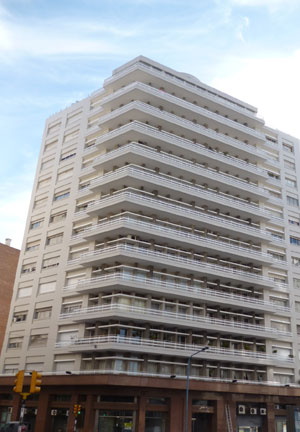
E) New buildings. Phases of feasibility study, preliminary design, design, construction drawings, and contractor selection. The most recent project was the Torre de las Instrucciones building, which comprises a basement, ground floor, and 15 upper floors with 89 apartments and 84 parking spaces, located on 18 de Julio Avenue on a lot adjacent to the Ministry of Public Health headquarters. Architect Sebastián Golembiewski is overseeing the construction phase. In the previous phases, he served as an associate to Architect Fernando Chebataroff.
We are open to taking on other types of projects (in fact, we do) as long as they are of professional interest to us, since we have a very high demand for the types of work described.
How has it developed over the years? What stages have you gone through?
The first stage was to demonstrate to property owners that it is worthwhile to take steps to ensure their properties remain in good condition through periodic renovation processes that offer a good balance of price, quality, and durability.
Helping clients understand that they are not simply spending money but rather making an investment that enhances their assets, particularly when it comes to properties located in areas with high real estate value.
Having successfully completed projects of this type, as well as others, has led to a steady increase in similar projects in other buildings. The primary means of promoting our work has been through property management companies and clients who were satisfied with our work and recommended us to others involved with buildings requiring a renovation process to once again satisfactorily meet the expectations of their users.
Another means of promotion comes from the construction companies themselves. In some cases, before beginning work, they recommend that management companies obtain a diagnostic assessment and baseline report, as it is not uncommon for a building renovation to fail in certain respects because companies are naturally able to eliminate the apparent defects but not their underlying causes, which are sometimes hidden and compromise the results.
What stage are you at today? What are the firm’s current goals?
The firm is composed of two architects, Fernando Chebataroff and Pamela Thomasset, while Pilar Rodríguez handles public relations, administration, and accounting.
For projects in the Maldonado department, we work in partnership with architect Roxana Giovine, also a graduate of the ORT University School of Architecture, who is based in Punta Fría (Piriápolis). We have worked with her on the restoration of the facades of the Le Jardin Residence building and on the preparation of assessments and reports for the restoration of the facades of the Opus Alpha (this did not include construction supervision).
This year, we have prepared the design specifications for the renovation of the facades of the Palm Beach building and the Golden Gate parking garages.
What architectural approaches do you typically use when developing projects?
Our interventions—whether involving corrective or preventive work on existing buildings or new construction—aim to achieve an optimal balance of price, quality, and durability in the final product.
As a distinguishing factor, we follow a methodical procedure for preparing our construction reports, which typically include: consulting international and national standards on the topics under investigation; consulting specialized publications (we have a very extensive library on architecture and, in particular, construction pathologies); consultations with specialists for projects that warrant it, carefully evaluating the opinions obtained, which are sometimes divergent; and conducting on-site tests to determine the causes of hidden problems.
For example: in the case of water barrier failures, inspections and sample collection, water tightness tests (water level tests), applying pressurized water at critical points, hydraulic tests on pipes using inflatable plugs, and the occasional use of methylene blue, as well as the use of a hygrometer or a telescopic camera with a light and screen, etc.
We are committed to instilling a culture of maintenance in our clients and moving away from the notion that these types of interventions are merely expenses.
To that end, we follow established procedures that are continually reviewed and updated based on our experience and the latest procedures and techniques used around the world.
The largest expense a person typically incurs (assuming they have the necessary resources) is the purchase of a home or a business premises. Maintaining it in optimal—or at least good—condition is usually a very profitable investment if done wisely and at the right time.