The starting point
“My concern for learning has been with me ever since I became a teacher,” said Zorrilla de San Martín. When she completed her final thesis for her Master’s degree in Education —which she titled Web 2.0 within the framework of the Ceibal Plan—she was left with several questions. She observed that technology went beyond the use of devices and that teaching was being challenged by learning. And those ideas became the starting point for her to continue her education and research.
How do students learn? How are they assessed? How do assessment designs extend beyond the classroom? Is it possible to develop an analytical model that can characterize these assessment designs? These were just some of the questions addressed in his doctoral dissertation The Design of Learning Assessment in Primary Education Over the Last Twenty-Five Years: Definitions and Decisions. Uruguay’s Uniqueness in an International Context.
Zorrilla de San Martín set out to identify, describe, and categorize the various approaches to learning assessment, with the ultimate goal of developing an analytical model. The scope of the research was at the system level rather than the classroom level. The student conducted an in-depth study of learning assessment designs in Uruguay’s primary education system over the past 25 years, from 1995 to 2020.
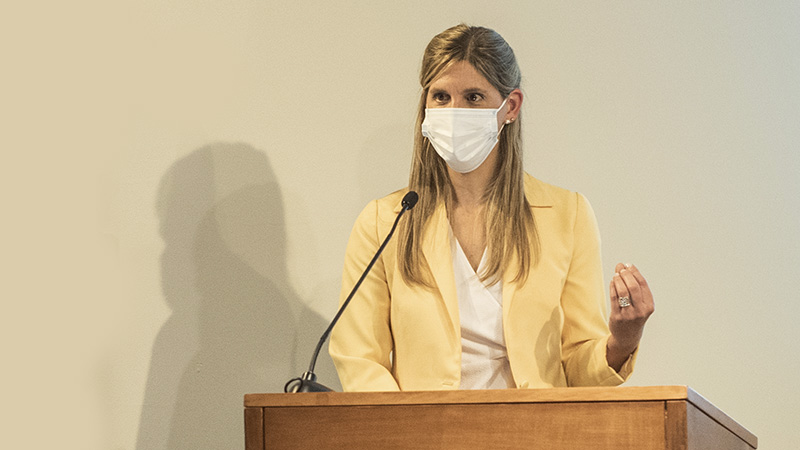
And, as he explained during his doctoral defense—which took place on Wednesday, October 20, 2021, in the auditorium of Universidad ORT UruguayDowntown Campus Universidad ORT Uruguayhis research process consisted of several phases. First, he analyzed three key milestones in learning assessment within the contemporary history of Uruguay’s public education system, using documents and interviews with experts: the National Assessments, the Online Assessments, and the Global Learning Network Assessments.
In a second phase, he developed an interpretive framework for reflection and academic debate on the characteristics of learning assessment designs. Finally, he validated this framework based on two projects in the region: Learning One to One (Colombia) and Aprender (Argentina).
For this research, Zorrilla de San Martín employed a qualitative methodology aligned with the interpretive paradigm. As a method, she conducted a case study and utilized research techniques such as in-depth interviews, semi-structured interviews, and document analysis.
https://youtu.be/2XNgO1PYQKE
Three milestones in Uruguayan assessments
The concept of assessment has evolved over time. In fact, as Zorrilla de San Martín pointed out, it has become increasingly complex. Although she conducted an in-depth analysis in her doctoral dissertation, during her defense she identified two main perspectives. On the one hand, there is a behaviorist perspective, in which assessment and measurement were closely linked by theoretical frameworks. On the other hand, a cognitive and sociocultural perspective, in which assessment involved evaluating teaching and learning processes.
But what characterizes student assessment in Uruguay? “In terms of student learning assessment systems, Uruguay had no prior experience and was one of the last countries to join the regional process that had been underway since the 1990s,” he explained, emphasizing the contextual framework of the Uruguayan education system since, in his words, “it defines assessment designs at the national level.”
In 1995, the National Public Education Administration (ANEP) established the Educational Outcomes Measurement Unit to carry out the National Assessment of Learning. 1995 thus marked the beginning of the period examined by the student and the first milestone in her research.
The second milestone was the introduction of online assessments. The key feature of this phase was the centralization of assessments by ANEP’s Directorate of Research, Evaluation, and Statistics in 2006, followed by their implementation starting in 2009, using XO devices as the platform.
Starting in 2015, a new assessment model began to be implemented in schools across the country as a result of the international partnership between ANEP and Plan Ceibal: New Pedagogies for Deep Learning (known in Uruguay as the Global Learning Network). Finally, this was the third milestone identified by the graduate of the Doctorate in Education, who added that they do not arise in “isolation”: “Each one emerges in a specific context, to address a need or circumstance of the moment.”
Bringing together the academy and the school
One of the most significant findings in Zorrilla de San Martín’s dissertation was that, at the macro level, the three assessment milestones shared common elements: they were formative assessments with an emphasis on providing feedback to teachers.
He also identified two broad categories of assessment designs: one focused primarily on standardized assessments, and the other centered on process-based assessments. “This suggests that we could develop a typology of assessment designs,” he noted.
Furthermore, in addition to validating the Nodal Evaluation Matrix—as she called it—the student found that the proposed analytical tools were “useful for applying to different cases.”
And, in that regard, he quoted a statement by educational innovation expert Carlos Magro, with which he agrees: “To assess is to learn.”

“We can’t just stick to theory,” Zorrilla de Martín stated, reflecting on the significance of her findings and results. Currently, there is “much more input” from theory than from practice. But—as she explained—that fact, given her role and workplace, “challenges” her, “encourages” her, and “provides her with input” to keep trying to bridge the gap between academia and schools.
In his view, it is essential to showcase the results generated by research and to pave the way forward because, as he pointed out, there are “resources and mechanisms for generating practical support, as well as teachers eager to try new approaches.”
“We need to keep building bridges and creating opportunities. To me, that is one of the key elements needed to transform education,” he concluded.
The court's comments
“This is not a project that took the easy way out,” said Dr. Carina Lion, a professor at the University of Buenos Aires. According to Zorrilla de San Martín’s thesis advisor, the research was “innovative not only in its approach but also in its methodology,” because the matrix is a framework that can be applied to the analysis of various assessments in different parts of the world. And that, in her words, is an “impressive contribution to a thesis.”
Dr. Rosanna Forestello, a professor at the National University of Córdoba and an external member of the committee, congratulated the doctoral candidate on her methodological approach and ability to synthesize her research: “It’s not easy to summarize all the work you’ve done in 40 minutes, especially given the contribution of your theoretical framework.”
“This dissertation achieves what a doctoral dissertation is intended to do: generate genuine knowledge that did not previously exist,” stated Dr. María Ester Mancebo, a member of the examining committee and a researcher at the University of the Republic. In addition to serving as an “inspirational framework” for analyzing other educational policies—such as the design of teacher training—she highlighted Zorrilla de San Martín’s understanding of how context influences the development of educational policy.
For Dr. Mariela Questa-Torterolo, chair of the panel and associate academic coordinator of the Master’s in Educational Management and the Master’s in Trainer Development, the research was a “significant contribution” to the field: “It is highly relevant because it is not complacent. It offers a highly analytical critique of the assessment models that have been implemented in the country.”
Finally, the panel’s report concluded that the thesis represented “an important contribution to our understanding of learning assessment,” that the findings constituted “original knowledge,” and that the research paper addressed “the complexity of the topic of learning assessment in a comprehensive, rigorous, and methodologically sound manner.”