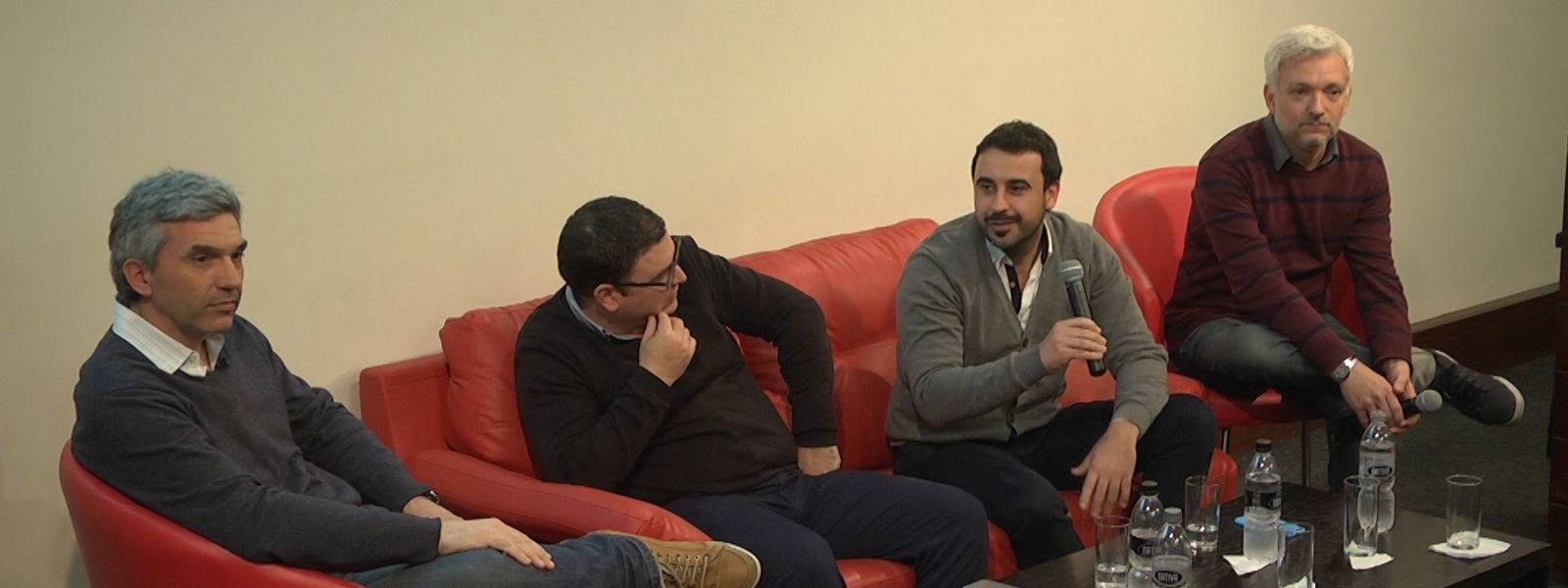
There used to be a dividing line between the physical and the digital worlds, but now that line no longer exists. “The digital realm is just another facet of the customer experience,” said Fernando Alvaro at the conference titled “Digital or Mobile: The Only Thing That Matters Is the Customer.”
The event, which took place on August 30, 2018, in the Auditorium of the Pocitos Campus at Universidad ORT Uruguay, was part of the Living Marketing series. The speakers were Claudio Darin and Fernando Álvaro, consulting partners at Marketdynamo - Business and Marketing Strategy, and visiting professors in the Digital Marketing Refresher Program at Universidad ORT Uruguay.
Darin also holds a Master's degree in Business Administration and serves as director of the Bachelor of Business Administration program at the University of San Andrés, while Álvaro holds a Bachelor's degree in Marketing and serves as academic director of the MBA program at the University of Palermo.
The panelists at the event were ORT faculty members Martín Núñez, who holds a bachelor’s degree in Advertising and is Managing Director at MediaCom, and Carlos Pignataro, a Certified Public Accountant with a master’s degree from the Complutense University of Madrid and Commercial Manager at Montevideo Portal.
Complexity in the purchasing process
The speakers emphasized the importance of creating positive shopping experiences. “The brand and the customer matter. If we don’t nurture that relationship through our daily actions, it will surely be lost at some point,” said Álvaro. The experts recommended developing a customer segmentation model that focuses not on hard variables like age, but on interests and attitudes, in order to reach the right audience.
The experts recommended developing a customer segmentation model that focuses on interests and attitudes rather than age, in order to reach the right audience.
The challenge of changing habits
“It’s very hard to imagine a disruptive future,” Darin said. “We build on what we know. There’s a reason why there are only two or three inventors, not millions. It’s difficult to envision breaking away from all existing paradigms, throwing everything out, and starting over,” Álvaro said.
"Since brands take some time to adapt, 'they aren't forced to disrupt the market all the time. Maintaining technology that contributes to and adds value for the customer generates profitability,'" Darin added.
“Every purchasing process has its obstacles and uncertainties,” said Álvaro. “The good news is that these are reduced in the digital format.” Waiting times are shorter. You don’t have to get ready, go out, figure out which mode of transportation to use, or socialize along the way just to make a purchase.
As for changes in consumer habits, they cited Amazon’s acquisition of the U.S. supermarket chain Whole Foods Market (whose stock price had fallen) as an example. According to Álvaro, Amazon did this to ensure that consumers shift from buying perishable foods the traditional way to purchasing them online, since perishables are seen as the category most difficult to transition to digital shopping.
Álvaro also pointed out the irony of people who are unwilling to shop online but will give out their credit card security code in a physical store. He concluded that this is because it is very difficult to change habits.
https://www.youtube.com/watch?v=yMWD9W_RpTA