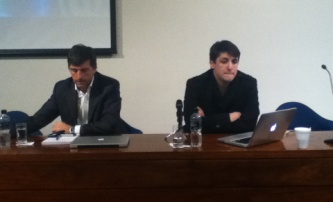
 In today's world, mastering technology is essential for growth and for better understanding the world around us. In advertising, for example, it is crucial for bringing brands closer to consumers, who are increasingly focused on technological advancements. That is why two experts visited the School of Business and Social Sciences at Universidad ORT Uruguay a lecture aimed at approaching advertising from a new perspective.
“Mobile Device Adoption and Usage Around the World... And in Uruguay?” was the title of the lecture given by Pablo Márquez, CEO of Punto Ogilvy, and Nicolás Ovalle, Head of Digital at the same advertising agency—or “communications agency,” as they prefer to call themselves—on June 20, 2013, at the university.
Punto Ogilvy is an agency that will celebrate its 50th anniversary next year and, for that reason, must evolve in order to adapt and remain among the country’s leading agencies. “Being in the market for so long forces you to constantly stay up to date,” said Márquez, adding: “Connecting brands with people means much more than writing a 30-second TV commercial; it’s a far greater challenge.”
The CEO described Punto’s experience, which began with a dedicated digital department, until he realized that this meant “isolating the digital side from the rest.” “Today we’re talking about integrating these disciplines, and that integration is what works best,” he said.
Márquez noted that this is a generation of “generalists and specialists.” And while there was a time when great importance was placed on specialized professionals, “today everyone is looking for a primary care physician… who also has a specialty.”
The advertising executive also spoke of a world of two “H”s: homologous and holistic. This, he asserted, is a world of holistic actions that are interwoven. “The homologous aspect is defined by strategy. If we don’t have a good strategy, the world won’t work,” he said.
Advertising is about connecting brands with people, but “it’s no longer just about connecting.” “Brands have to be relevant. It’s not enough to simply reach people. That’s no longer enough. The real secret is reaching them in that state of mind that allows us to connect,” he said. “We used to amplify ideas through the media. Now, relevant ideas are amplified by people,” Márquez added.
Ovalle, for his part, highlighted a reality that many are already aware of: the trend is toward an increasing number of mobile devices compared to other screens. In early 2013, Uruguay had a smartphone penetration rate of 22%, a very significant figure when compared to other countries.
“New platforms are being created to consume what already exists,” said Ovalle, adding, “The audience is there, but it’s not paying 100% attention. It’s there, but it’s divided.” It is this attention that needs to be increased through multi-screen viewing.
Using examples of foreign advertisements, the experts highlighted the importance of understanding that different applications are suited to different occasions.
Márquez illustrated the “big idea” using a Brazilian campaign as an example. The “Recife” brand—the soccer team—highlighted a cultural tension: the need for people to donate organs. The campaign, which won the Cannes Grand Prix, didn’t invest much in television, but it was well managed in the press and on social media. Thus, fans agreed (through a symbolic card indicating to their families that they wanted to donate) that their hearts would continue beating in other people. They agreed to remain fans even after death.
“Brands are beginning to communicate through ideals rather than rational concepts,” explains Márquez.
Ovalle, for his part, presented the concept behind Greentizen, a Uruguayan digital platform that aims to “coordinate small sustainable actions and generate a big impact.” With this “green” app for Android smartphones, people can join in and bring about meaningful change in the world, leading to a better quality of life.
These are just a few examples of how advertising agencies have adapted to changing audience behaviors. The widespread adoption of the internet—available 24/7—does not mean the end of other channels. It has all come together. And the way brands project their image across different screens is what will determine their advertising success.