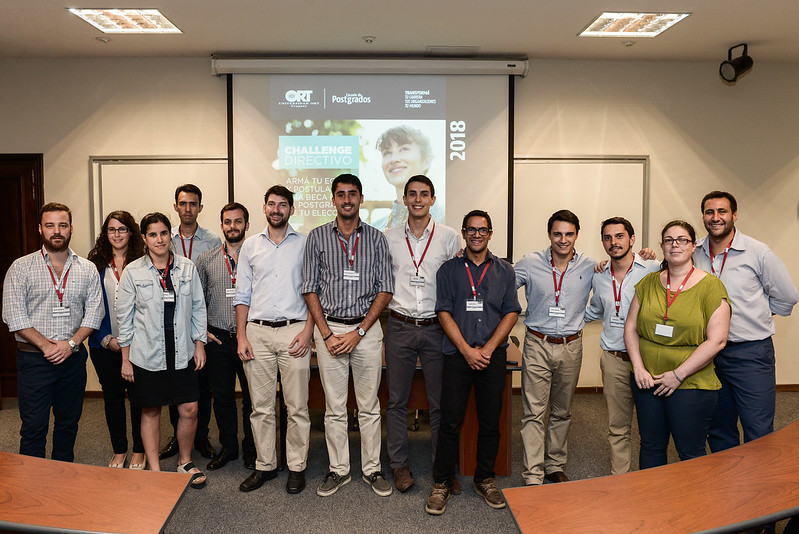
On Tuesday, February 27, shortly after 9 p.m., five young men looked tired and nervous. They had been working hard for more than seven hours—or, in reality, much longer. A week earlier, they had begun participating in the Universidad ORT Uruguay Management Challenge, a competition that tested their leadership skills, their analytical abilities, and their capacity to diagnose problems that arise within organizations.
The participants included professionals with diverse educational backgrounds: certified public accountants, computer engineers, industrial engineers, and biotechnology engineers, as well as graduates in human resources, information systems, communication, design, and management.
In addition to the experience of navigating a real-world business scenario, receiving training, and presenting to a panel of experts, competitors could win scholarships covering 40% of tuition for members of the first-place team and 30% for those on the second-place team.
On February 20, the teams gathered at the School of Management and Social Sciences for the competition’s kickoff. There, they received training in problem-solving and persuasive communication. They were also given the case study they were to review over the course of the week: that of Verdeagua, a startup at a critical juncture in determining its future.
A week later, at 2 p.m., the teams were briefed on the case: the startup needed to grow as much as possible while strengthening its identity, thereby developing the capacity to take advantage of larger opportunities in the future.
There were many ways to go about it. How should they put the puzzle together? What was the best sequence of steps? These were some of the questions the contestants had to answer.
To explore the various courses of action, for over an hour, the challenge participants asked questions about the business model, legal matters, operations, and business growth to Sebastián Figuerón and Juan Herrera, founding partners of Verdeagua; Diego Giay, the company’s new partner; and Fiorella Polcaro, a biotechnology engineering student who has worked on research projects related to the company.
Then, with nothing but the assignment, their notes, and whatever information they could recall about the sector, they began preparing their presentations. During that time, they were unable to access the internet or communicate with anyone.
The challenge was organized similarly to international case competitions. The teams were divided into two groups and gave their presentations to panels of judges composed of faculty members from the Graduate School.
“This type of work pushes them to their limits, putting pressure on them in terms of both time and skills,” said Dr. Luis Silva, academic coordinator of the Master of Business Administration (MBA) program, adding: “We are not rewarding prior knowledge; what we are looking for, assessing, and rewarding are certain cross-functional leadership skills, particularly structured and logical problem-solving and persuasive communication.”
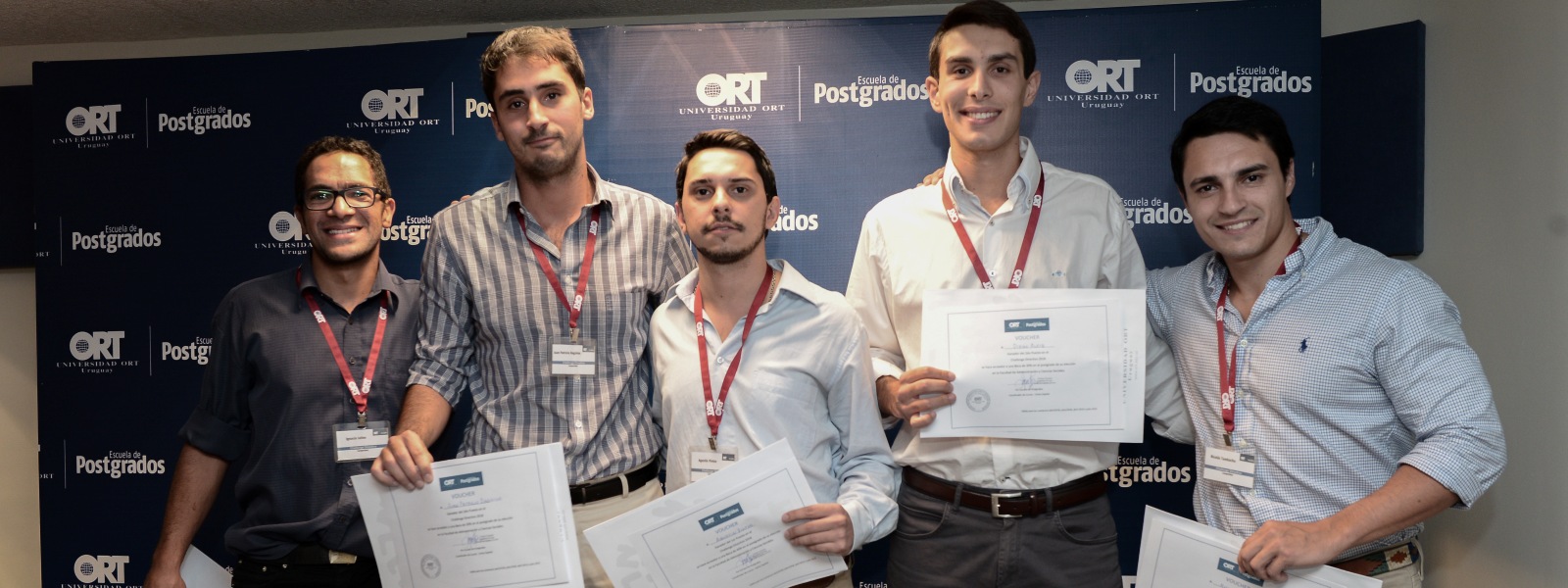
Shortly thereafter, the jury selected the finalist teams. These were, on the one hand, accountants Juan Patricio Dagnino and Diego Alfie, and, on the other,biotechnology engineers Nicolás Tambucho and Agustín Pintos, along with Diego Leites, who holds a bachelor’s degree in computer science.
Both groups received feedback from the panel on how to improve their presentations and immediately got to work. They had only half an hour to make the changes. Their nerves and adrenaline made up for the day’s exhaustion. When they were done, everyone looked satisfied. The intellectual challenge had pushed them to their limits.
Shortly after 9 p.m., all that remained was to hear the final decision. The five young people were standing before the jury. “Both performances were very good and evenly matched,” they remarked.
“They chose a central theme—such as sales—and stayed focused on it,” said Professor Enrique Kramer, a professor of Strategic Management, to Dagnino and Alfie’s group.
“They really improved on the previous presentation, and it was great that they stayed true to the company’s philosophy,” said Professor Alejandro Moreno, a professor of corporate finance, to Tambucho, Pintos, and Leites.
The chamber fell silent. Some of the other participants had stayed behind to watch the challenge come to a close. Everyone was on the edge of their seats, waiting anxiously. Finally, the moment of the verdict arrived:
–The court’s final decision was that the winning team consists of Nicolás Tambucho, Agustín Pintos, and Diego Leites.
The members of the two groups congratulated each other with handshakes and hugs.
“We signed up because we wanted to have this experience. We thought it was a good opportunity. The way the problems and solutions were presented through this activity was really great. And then we started thinking about some of the graduate programs,” said Tambucho.
“Events like this are always beneficial for people, because they provide an opportunity to measure oneself against others and against oneself,” said Diego Alfie.
Ignacio Leites agreed with him:
“I loved the experience. We really had a great time; it was fun solving the problem. Giving the presentation and getting feedback from the judges was very interesting,” he concluded.
Photo gallery: