Solving social problems through design is Natalia Burjel’s primary goal. She holds a bachelor’s degree in industrial design from Universidad ORT Uruguay at just 25 years old, she has already worked for major companies in the United States, including Boeing, P&G, and Cincinnati Children’s Hospital Medical Center.
He is currently working in Uruguay with the Paysandú City Government to implement the inclusive project he developed at ORT, which involved manufacturing outdoor furniture made from recycled plastic. The goal is to expand this initiative to other municipalities as well. He also collaborates with an autism center in that department, where he creates graphic designs and develops games specifically for children with Autism Spectrum Disorder (ASD).
Try your luck abroad
Ever since she graduated in 2017, Burjel has always wanted to try her luck abroad. A conference hosted by the Industrial Designers Society of America (IDSA) was the catalyst that eventually led her to pursue a master’s degree at the University of Cincinnati in the United States and to work for leading companies and organizations in that country.
“During the conference, which featured presentations by major brands and was attended by professors from many universities, I was invited to visit several studios and institutions, and I was fascinated by the University of Cincinnati’s design program, known as DAAP (Design, Architecture, Art, and Planning). From there, I enrolled as a visiting student, took a few classes that interested me, and eventually applied, was accepted, and spent nearly two semesters studying there,” Burjel said.
The connections she made during the courses led her to meet the director of Live Well, a company that specializes in user well-being and works with brands such as Cincinnati Children’s Hospital Medical Center, Boeing, and P&G.
What's behind every design
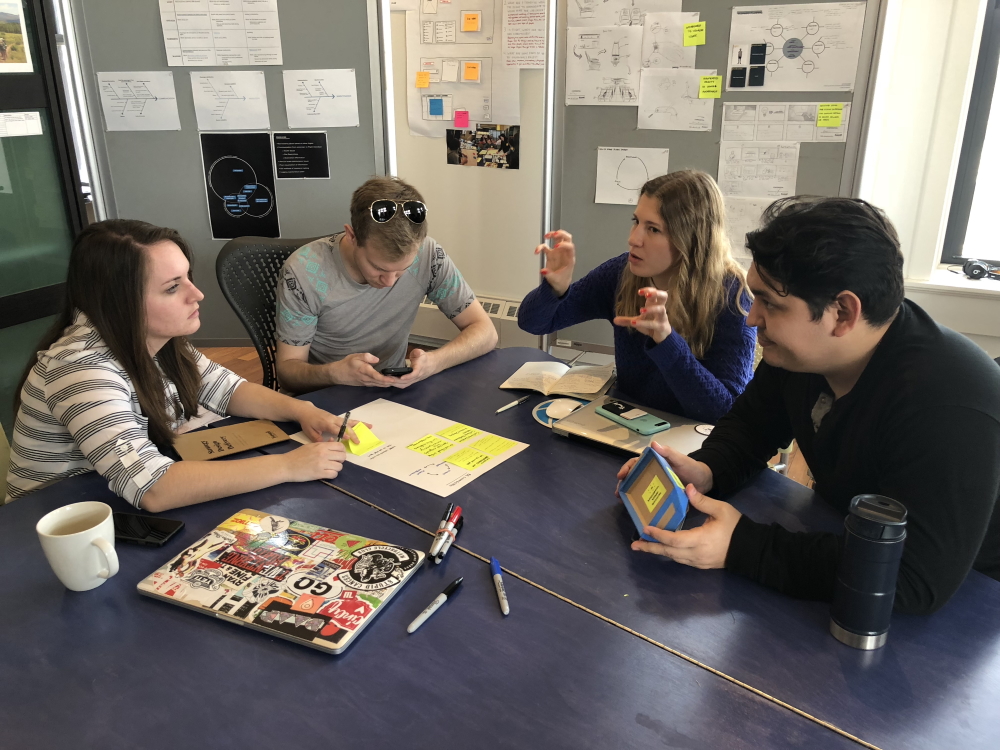
During his time at Live Well, Burjel worked with a team to solve the problems presented to them by Boeing, P&G, and Children’s Hospital.
In the case of the aerospace company, the challenge was to develop a smart cabin by 2030. “The idea was to design and figure out how to improve comfort for both passengers and flight attendants, as well as the rest of the crew—in other words, we had to design a cabin that was more efficient and intelligent. We were divided into three teams, and each had to come up with a different solution,” explained the ORT graduate.
To tackle the challenge, it was necessary to conduct preliminary research into the company’s history and how the cabins operate. So they decided to visit one of the company’s planes and held several meetings with flight attendants and passengers. “We work extensively with the public and in real-world scenarios. Each group came up with different solutions, which were presented to Boeing. Ultimately, the company decides which solution it wants to patent. After that, the project moves on to another level of research and development to bring that patent to life,” said the industrial designer.
An impressive portfolio
According to Burjel, when he applied to Live Well, he had to submit a portfolio showcasing the work he had done throughout his career. When it came time for the interview, the company expressed surprise at the variety of projects he had worked on: from food design to furniture, from recycling to headphones for race car drivers.
“It wasn’t just about furniture and variety within furniture; there was experimentation in a whole range of areas,” he said.
Two of the areas featured in his ORT capstone project are currently being implemented in Uruguay: furniture made from recycled plastic, called Ciclus, and play equipment for children with ASD. “My future goal is to specialize in projects that involve design, but whose purpose goes far beyond aesthetics or simple mechanical function. I want it to solve a social problem or a global issue, such as plastic waste. That’s what defines me: going deep and using design to solve a social problem or one with an environmental backdrop,” the graduate concluded.