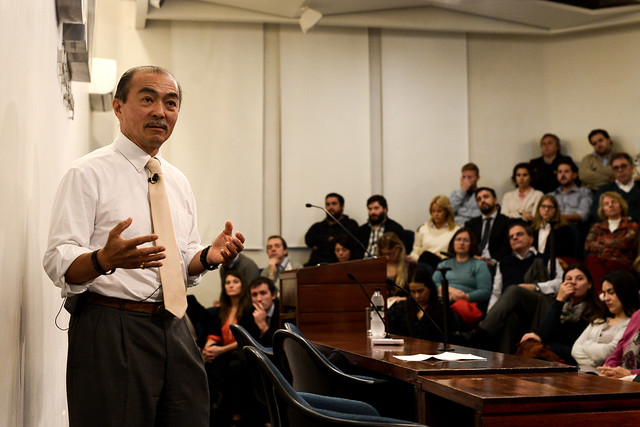
Michael Chu, a professor and researcher atHarvard Business School (HBS), said that the best way for major social interventions to improve people’s quality of life at the lowest possible cost is through private enterprise.
However, for this to happen and for added value to continue flowing to customers, these initiatives must lead the company toward the creation of an industry characterized by intense competition.
The expert also expressed support for government regulation of these services, arguing that an unregulated market “is a free-for-all.”
The lecture titled “Profitable Business Models with High Social Value: Feasibility and Impact” took place on Thursday, July 27, at Universidad ORT Uruguay was part of the Management and Business Lecture Series organized by the Graduate School of the Faculty of Administration and Social Sciences.
Chu, who holds an MBA from Harvard Business School and has extensive experience in the private sector, has focused his academic research on commercial ventures that operate in areas traditionally dominated by the public sector or civil society.
Water in Manila, Pharmacies, and Microfinance in Mexico
The expert began his presentation by giving three examples of this type of initiative:
-The first occurred in the city of Manila. Until 1999, only 60% of the population had access to piped water. Forty percent lived in poverty. Many of those who did have access to water could only use it for a few hours a day, and the water was of poor quality or not even safe to drink.
People living in the poorest neighborhoods obtained water from street vendors, who sold it at a price seven times higher than what those connected to the piped water system paid. Furthermore, although water was subsidized, it was the wealthiest who benefited from that subsidy.
But in 1999, Manila decided to privatize its water utility. The city was divided into two sectors, and two private companies were put in charge of water supply. At first, there were losses, but by 2006, water quality had reached world-class standards, providing 100% of the population with water 24 hours a day, with the company generating annual profits of 49 million.
-The second example Chu mentioned took place in Mexico, where the quality of the healthcare system was poor in the 1990s. People with limited means had to wait too long to see a doctor, and pharmacies were out of stock most of the time, making it impossible to obtain medications.
In response to this situation, in 1997 businessman Víctor González Torres launched a two-part project. The first part involved establishing a chain of pharmacies that sold medications at prices 30 to 75 percent lower than market rates. The second part involved opening a medical clinic next to each of the pharmacies. People could visit the clinics for $2, with a wait time of no more than 15 minutes.
Currently, 12 million Mexicans purchase their medications each month, and 3.5 million visit doctors at these clinics. There are more than 4,000 pharmacies of this type, located in every town with a population of over 5,000. And, following an initial investment of $2 million, their annual sales exceed $1 billion.
-The third example Chu mentioned was a business venture in which he had participated. The expert noted that the International Labour Organization has estimated that 70% of the world’s economically active population derives its income from the informal sector. But all of these microenterprises need access to financing—for example, to purchase the fruits and vegetables they will later sell at the market.
In 1990, a Mexican NGO began developing a microfinance program. It secured donations and became self-sustaining. By 1998, it had enough clients to apply for a license and operate as a financial institution. In 2006, it obtained a universal banking license.
Most of its customers were low-income, the average loan amount was $400, it grew by more than 50% annually, it had a 56% return on equity, and it was the most profitable financial institution in Latin America.
So they decided to take it public on the Mexican stock exchange, where the market valued it at $1.53 billion. It had been founded with an initial investment of $6 million.
The best treatment, at the lowest cost, right now
Chu noted that “these examples of major successes are important because they involve the delivery of goods and services that have a significant impact on the quality of life for most people.”
He noted that these are social interventions characterized by: providing the best possible assistance to people at a given moment, reaching those in need at the lowest possible cost, improving quality of life, and being implemented in the present. “This is the definition of success from the perspective of the people for whom the intervention will make a significant difference,” he said.
The professor added that these initiatives must reach a large number of people, be sustainable over time, become more efficient as their business model improves, and, furthermore, result in increasingly lower costs for the beneficiaries.
The expert continued his presentation by stating that “NGOs are generators of ideas that can change reality. Development agencies and philanthropic organizations provide the opportunity for these ideas to be tested in the field,” but that “the problem is that they are not structurally equipped to scale these initiatives up on a massive scale and ensure their sustainability over time.”
According to Chu, when these ideas emerge, the tendency has been to turn to the government, which is capable of achieving massive scale and sustainability. But to increase efficiency and effectiveness, “in the history of humanity, there has been only one entity that has been able to combine these four characteristics simultaneously and consistently, and that is private enterprise.”
The creation of a state-regulated industry
However, he added, this cannot be achieved through any single company, since all companies are destined to fail eventually. “What gives private enterprise that capacity? It is not the company itself, but the creation of an industry,” he said.
“The proof of this is the smartphone. We know that eventually there will be a device that is better, more efficient, and cheaper than the current one. And all of this happens because there is an industry competing to serve us.”
“The only way to ensure that the value added that is created does not remain trapped in the hands of investors and company management, but continues to flow to the customer, is through intense competition. That is the role of the industry,” he said.
The professor added that for an industry to emerge, companies must achieve above-average profitability, and the idea of “making money by solving social problems” is rejected regardless of the culture or country in question. This industry requires a paradigm shift in order to develop.
The expert also expressed support for government regulation of these services. “The role of the government is essential, because modern history shows that an unregulated market is a jungle. And in the jungle, it is the fiercest beast that prevails. The market needs someone to keep it in order,” he concluded.
Video:
https://youtu.be/ybeJZscN8FE?si=_4vawLj8XGtg_uZt
Image gallery: