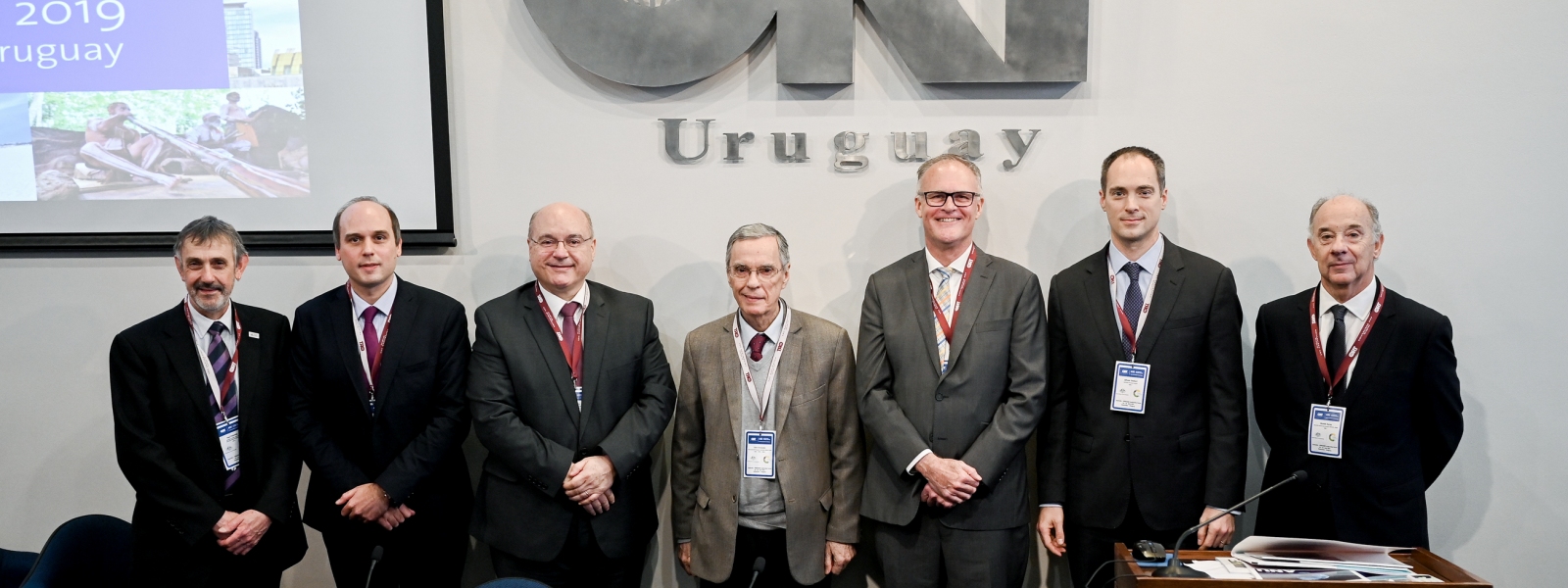
Representatives from the public and private sectors and academia in Australia and Mercosur came together to deliver presentations, engage in discussions, and develop an action plan on three topics: financing sustainable development, medical cannabis, and meat traceability. This took place at the“Australia–Mercosur Leadership Forum.”
The event, which took place from June 24 to 26, 2019, at the Pocitos Campus of Universidad ORT Uruguay, was organized by the Australian Studies Center (ASC) with funding from a grant awarded by the Council on Australia-Latin America Relations (COALAR), an agency of the Australian government’s Department of Foreign Affairs and Trade (DFAT). It also received support from the Australian Embassy to Argentina, Paraguay, and Uruguay; the Uruguayan Embassy in Australia; Hughes & Hughes; and Deakin University.
The forum, which took place at a time of significantly strengthened relations between Australia and Latin America, provided an opportunity for stakeholders from the public, private, and academic sectors in Australia and the region to exchange views on issues relevant to all participants. Furthermore, these issues align with the ASC’s various areas of study.
The three forums were held concurrently over three days. On the first day of each forum, presentations open to the public were held. On the second day, the members of each forum—primarily the presenters—met to discuss the presentations, identify obstacles to progress on the topics discussed, collaborate, and ultimately draft an action plan for Australia and Mercosur.
Opening sessions: strengthening the ties between Australia and Mercosur

At the opening session on the first day of the event, Dr. Gaston J. Labadie, dean of ORT’s School of Business and Social Sciences, kicked off the forum with a welcome address to all in attendance. Dr. Nicolás Gambetta, coordinator of ORT’s graduate programs in Accounting and Taxation and executive director of the ASC, introduced the Center for Australian Studies. The university’s academic vice president, Julio Fernández, was present during the ceremony.
Ambassador Ricardo Varela, director of the General Directorate of Cultural Affairs at the Ministry of Foreign Affairs, spoke about the ASC’s role as a cultural hub. Professor Paul Pickering, director of the Australian Studies Institute (ASI) at Australian National University, discussed the ASI’s mission to promote Australian culture. And Brett Hackett, Australia’s ambassador to Argentina, Paraguay, and Uruguay, gave a presentation on the Australian perspective on relations with Latin America.
During the opening session, a message from Victoria Francolino, Uruguay’s ambassador to Australia, was presented, in which she highlighted the importance of the forum and the ASC in further strengthening Australia’s relationship with Mercosur.
During the opening session on the second day, Gonzalo Pérez, Director of Latin America at Deakin University, spoke about Australia’s 28 years of uninterrupted economic growth.
For his part, Alfredo Taullard, Australia’s honorary consul in Montevideo and a partner at Hughes & Hughes, along with Federico Morixe and Lucía Patrón, president and vice president of the Uruguay-Australia Chamber of Commerce (CUA), spoke about relations between Australia and Uruguay. Meanwhile, Ignacio Celorrio, vice president of AusCham, gave a talk on relations between Australia and Argentina.
Companies that engage in corporate social responsibility activities are more profitable

Forum 1, “Financing Sustainable Development,” was moderated by ASC Executive Director Dr. Nicolás Gambetta.
The speakers included Colin Higgings, professor at Deakin University in Australia; Luis Di Pietro, director of the Sustainable Development Goals (SDGs) project at the Office of the President of Argentina; Nicolás Gambetta, executive director of the ASC; Mireia Villar, United Nations resident coordinator; Ana Laura García, director of strategic management and budget formulation at the Office of Planning and Budget; and Mariella de Aurrecoechea, partner at Deloitte and vice president of DERES.
The main topic of this forum was financing to achieve the goals of the 2030 Agenda, which was adopted by a resolution of all member countries of the United Nations General Assembly.
“The biggest concern regarding this agenda is its funding. Available funds are scarce, and the amount needed is substantial. The public sector alone cannot finance it; we need a very active private sector and a high level of coordination between the two,” Gambetta noted.
Mireia Villar outlined the various sources of financing for the 2030 Agenda and emphasized that the volume and direction of private investment flows must be anchored in a national development strategy.
Ana Laura García and Luis di Pietro, for their part, explained how national budgets are linked to the 2030 Agenda in Uruguay and Argentina, respectively, while Mariella de Aurrecoechea spoke about the value of sustainability for the private sector and how the Uruguayan private sector is addressing the challenges of the 2030 Agenda.
Finally, Colin Higgins of Deakin University spoke about the challenges and opportunities that the 2030 Agenda presents for businesses, and Gambetta discussed the potential of various industrial sectors to contribute to the 2030 Agenda.
Working group:

Regulation of Medical Cannabis: Between Challenges and Opportunities for Research and Business

Panel 2, “Medical Cannabis: The Main Challenges,” was moderated by Marcos Baudean, M.A., of Monitor Cannabis Uruguay, a researcher and associate professor of Research Methodology at ORT.
The speakers included Cristopher Grof, a professor at the Australian Centre for Cannabinoid Clinical and Research Excellence; Kevin Nafte and Andrea K. Krell of the Uruguayan Chamber of Medical Cannabis; Marcos Baudean and Leticia Cuñetti of the Uruguayan Society of Endocannabinoidology; and Diego Olivera, president of the Institute for the Regulation and Control of Cannabis (IRCCA).
The discussion at the Forum focused on four main areas: progress on regulation in Uruguay, scientific research on medical cannabis, business, and the role of physicians in strengthening the regulatory framework.
“The presentation by our guests from Australia gave us insight into how medical cannabis has been implemented in that country and how they have organized scientific research and the development of cannabis-based products for medical use. It was very enlightening and helped us understand the challenges involved in establishing a medical model and how to overcome them,” said Baudean.
For their part, the guests from Uruguay highlighted the various aspects of regulation. They discussed progress made, uses of the product, and ways to access it. The widespread availability of the product, the limited legal supply, challenges in training physicians, the existence of a black market for medical cannabis, and the use of the product without medical supervision were the main issues raised.
The business chamber’s perspective was very enlightening regarding the variety of business models and organizational structures in Uruguay, as well as the challenges entrepreneurs face in developing their businesses. “The discussion left us with the impression that there are many ways in which Uruguay and Australia can exchange experiences and knowledge to strengthen the development of medical cannabis regulations,” Baudean concluded.
Working group:

Value drivers in the meat industry

Forum 3, “Public Goods in the Meat Industry: Australia as a Benchmark,” was moderated by Dr. Francisco Rosas, a researcher and professor of Statistics and Econometrics at ORT.
The speakers were Wendy Umberger, a professor at the University of Adelaide; Ian Mortimer, an agricultural advisor with the Australian Department of Agriculture and Water Resources; Daniel Belerati, president of the Uruguayan Chamber of the Meat Processing Industry; and Federico Stanham, president of the Uruguayan National Meat Institute (INAC).
The speakers focused on the public goods characteristic of the meat industry in their respective countries, addressing the topic from the perspectives of the public, private, and academic sectors. These public goods include animal health, meat traceability, food safety, and meat marketing.
“These are goods that add value to the supply chain because, by providing consumers with assurance, they increase the value of the meat. They contribute to higher productivity and competitiveness, improve the business climate, and facilitate the domestic and international market access of these products, ”said Rosas. “They are called public goods because all stakeholders in the supply chain can ‘consume’ these goods.”
Australia serves as a benchmark for countries in the region, both because of the similarities in the structural aspects of the meat supply chain and because of the status its public goods have attained.
Working group:

The Center for Australian Studies
The Australian Studies Center (ASC) was inaugurated in 2016, with national and Australian officials in attendance, with the aim of strengthening ties between Australia and Latin America through academia, working collaboratively with researchers, professors, students, and businesses in various fields of study of interest to both regions.
Its main areas of study are: agriculture, biotechnology, sustainable development, natural resources, fintech, financial inclusion, business, and the humanities and social sciences. The ASC is the only center for Australian studies in Latin America, and although it is based in Uruguay, its reach is regional.