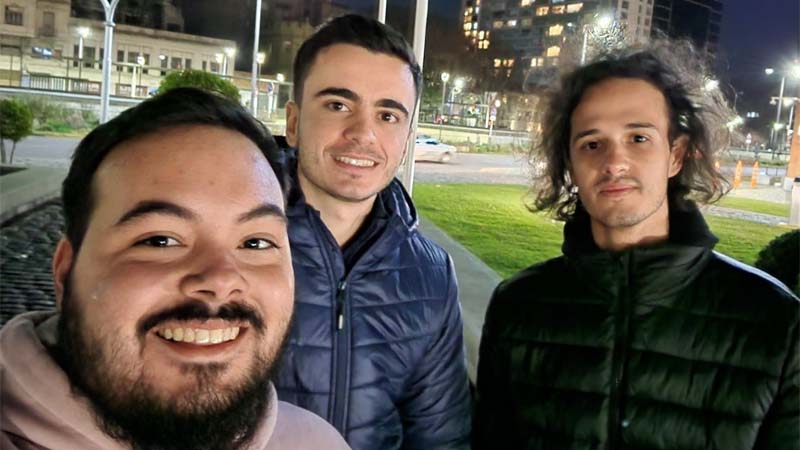
When does the collaboration with the Artificial Intelligence research group begin?
We had taken the course “Machine Learning for Intelligent Systems” in 2021 and were taking “Artificial Intelligence” in the first semester of 2022, both taught by Sergio Yovine. The three of us agreed that we enjoyed the topics covered in both courses, and we also had to complete a final project to earn our Bachelor’s degrees in Software Engineering by the second semester of that year. That is why we began reaching out to Sergio to see if it was possible to do a project with the Artificial Intelligence and Big Data department. Fortunately, that was possible, and we began engaging with the department’s research areas and tools, making contributions that allowed us to start working with the research group.
Why are you interested in that field?
All three of us have a strong interest in algorithms and their relationship to mathematics. Up until then, we had taken courses related to computer science, but we hadn’t taken any courses in the Artificial Intelligence department. It was taking Machine Learning and then Artificial Intelligence that sparked our interest.
They are currently working on their final project to earn their degrees in Systems Engineering. What is the project about?
Our paper is titled“Analysis, Evaluation, and Improvement of Active Regular Inference Algorithms for Neural Sequence Acceptors.” The department has tool called Neural Checker, which aims to provide frameworks and algorithms to enable the explainability of complex black-box systems, such as artificial neural networks. Our goal is to improve algorithms, optimize processes, and review the state of the art in the field.
What has it been like working in a research group for over a year now?
It's very interesting and helps us keep learning. We hold weekly meetings where we propose topics for discussion or talk about experiments we're conducting to achieve a specific goal.
What are the practical applications of the research you are conducting?
Artificial intelligence as an applied field in industry is still in its infancy. Its application using large language models is a very recent development.
The scientific focus of our research is to develop tools for safely analyzing and validating systems that contain components with learning capabilities.
They took part in an international competition. What was it about? What was that experience like? Where did they compete?
We participated in an online competition called Taysir, which focused on model inference using neural networks. We took second place in the competition, which led to the publication of our first scientific paper. It was a very rewarding experience that allowed us to learn a great deal and to test the performance of the Neural Checker tool and our contributions within the research framework.