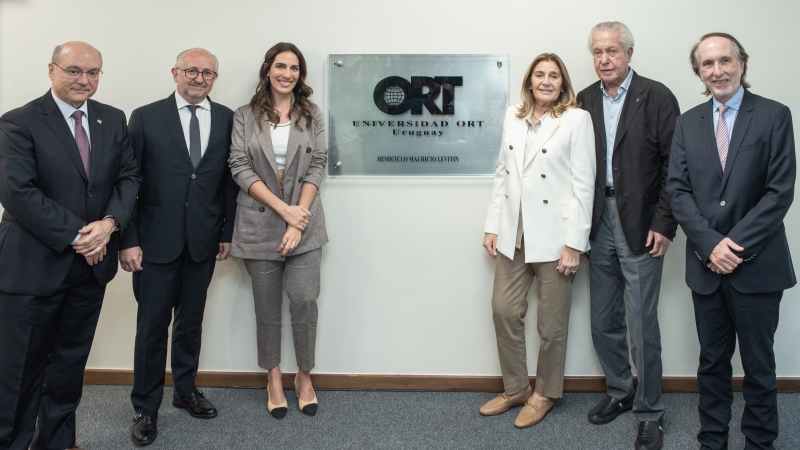
The School of Management and Social Sciences at Universidad ORT Uruguay the Mauricio Levitin Chair in Executive Education, whose primary objective is to create professional development opportunities for individuals working in fields undergoing rapid technological transformation and who, as a result, need to adapt to new ways of practicing their profession or advance to new positions.
The course will utilize state-of-the-art computer technology, enabling interactive participation from across the country.
This tribute aims to recognize the professional career and social and civic contributions of businessman Mauricio Levitin, who died at the age of 44 from a heart attack.
The event took place on Friday, October 28, in the Hemiciclo —which will now be known as the Mauricio Levitin Hall—at ORT’s Pocitos Campus.
The event was attended by Pablo da Silveira, Minister of Education and Culture; Ana Ribeiro, Undersecretary of Education and Culture; members of Mauricio Levitin’s family, including his wife and parents; and university officials.
The event concluded with a talk by international speaker Santiago Bilinkis, who addressed topics related to digital transformation.
https://www.youtube.com/watch?v=076TIbIIkRw
Promoting the common good
“As you may know, my husband, Mauricio Levitin, was very proud to be Uruguayan and was passionate about making a difference in the world and in society. He firmly believed that it was our shared responsibility to promote the common good, ”said Levitin’s wife. She added: “Mauricio was an exemplary student and a successful businessman who knew that lifelong learning was a means to enable students from diverse backgrounds to achieve success.”
“A close friend told me, ‘Today we’re not just honoring or remembering Mauricio; what we’re doing is keeping his wisdom alive. Every time someone asks why the chair bears his name and we share his story, people will be inspired, people will take risks, and Mauricio will live on through the wisdom he leaves with each of us,’” he concluded.
“What is happening today is a concrete example of a society that gets involved, that is capable of doing things right, of investing, and of committing to the country’s future—a future we all want for our children and grandchildren. So congratulations to ORT and the Levitin family,” said Minister Pablo Da Silveira.
Who was Mauricio Levitin?
“He was an outstanding businessman, consultant, philanthropist, entrepreneur, dreamer, and developer of transformative ideas”: this is how Dr. Gaston J. Labadie, dean of ORT’s School of Business and Social Sciences, described Mauricio Levitin. “His untimely passing unexpectedly and devastatingly deprived us of the contributions of a brilliant and committed individual, both in Uruguay and throughout Latin America.”
An MBA graduate from MIT, Levitin co-founded the real estate investment platform Península Investments with his partner and friend Joseph Preschel, which financed projects in Latin America and the United States.
Meanwhile, in Uruguay, he founded Altius Group, a company focused on developing innovative projects in the real estate sector.
During the pandemic, Levitin launched and led the “We Look Out for Each Other” campaign and helped ensure that COVID-19 vaccines reached every corner of the country.
The Chair
The Mauricio Levitin Chair in Executive Education is an academic forum dedicated to advancing innovative initiatives in education designed to address the challenges posed by digital transformation, by developing the skills and knowledge needed to reskill and upskill professionals.
These activities are supported by investments that enable multimodal and hybrid education.
“These classrooms, their technology, and the training we are already providing to teachers—both in terms of technology and pedagogy—enable in-person and remote students to participate simultaneously in an integrated virtual environment (…) Teachers, in-person students, and remote students share in the classroom dynamics in real time,” added Labadie.
“Our view is that these technological innovations are part of the ongoing transformations that were accelerated by the pandemic,” said the dean.
“As with any challenge related to digitization, we don’t yet have a clear picture of where this will lead or what the ultimate outcome will be. But we do know that this is a path of innovation that should enable greater access to segments of the population that currently cannot access high-quality education, whether due to work commitments or geographic location,” he concluded.
The event concluded with a presentation by Santiago Bilinkis, who highlighted Levitin’s career, his entrepreneurial spirit, and his work with educational organizations. “Very intelligent people are one of my weaknesses,” he said. “I’m sure that if we had met, we would have been great friends.”
Image gallery:
