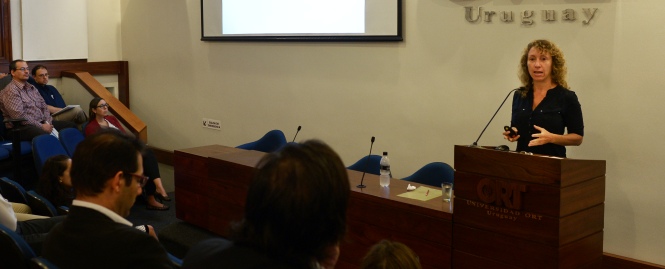
What are the most important factors involved in innovation? What is the role of leadership? What does the future hold for innovation? These were some of the questions answered by Veronique Arnoldi, M.Sc., at the conference titled “Leading Innovation.”
The event, which took place on March 10, 2016, was part of the Management and Business Lecture Series organized by the Graduate School of the Faculty of Administration and Social Sciences.
Some basic concepts
“Innovation” is a word that only became fashionable in the 1990s. It refers to the process of turning an “idea into a solution that creates value.” That is what Arnoldi explained, and to illustrate the concept, he gave the example of the solar panel. However, he noted that the innovation that created the most value was not the invention itself, but rather the realization that it could be adapted to create a cheaper, portable model for use in places where there was no electricity supply.
The speaker also explained that innovation can take place in various areas. It can involve the business model, the product or service offering, the customer experience, or processes, organizational structure, and resource allocation.
Arnoldi also noted that successful companies “tend to innovate in more than one category at a time.” In fact, those that innovate in five or more categories “have a market capitalization that is double the average.”
Keys to Innovation
“Innovation doesn’t come for free,” warned Arnoldi, who served as executive director of technology and innovation at various companies in Europe. “You can’t innovate without a budget, on weekends, or after hours,” she added. According to the expert, only 4% of new products yield a positive return on investment for the company. The remaining 96% contribute to worsening the company’s results.
He therefore emphasized the importance of the innovator’s mantra: “Fail often, fast, and cheaply.” “The good news is that there is no experimentation without failure, and there is no innovation without experimentation. So, statistically speaking, ‘more failure’ ultimately means ‘more innovation.’”
For the speaker, the method is essential, as it limits the impact of failures on the company: “Having a method means you’re ten times more likely to succeed than if you don’t.”
He also said that it is essential to have a strategy to ensure that innovation efforts are consistent and that resources are directed toward the same goals and priorities.
In his view, innovative companies must foster a culture in which employees are not “afraid to take risks, make mistakes, and experiment.” For that reason, he stated that the role of leadership is “to define and maintain a coherent innovation system.”
The Future
While there are many predictions about what will happen, Arnoldi emphasized that everyone agrees that innovation will be based on four factors.
First of all, because of the “freemium” model: a business model that offers the basic service for free but charges for advanced or special services.
The “Internet of Things,” which refers to the digital interconnection of everyday objects, enabling the collection of information.
The engineer also noted that innovation will be driven by the sharing economy—meeting a need without going through traditional channels.
And, finally, it won't neglect the planet's sustainability.
Photo gallery: