
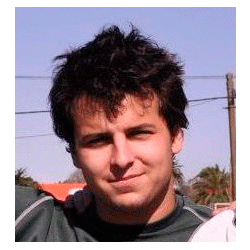
Felipe Coirolo is finishing his thesis to earn a degree in Systems Engineering from Universidad ORT Uruguay; if all goes according to plan, he will receive his degree in April 2014.
His first job was at a software development company; in 2012, he represented his university at the ACM International Programming Contest in Buenos Aires; and in January 2014, he will begin an internship as a developer at Facebook in California.
The first Uruguayan on Facebook
Felipe may be the first Uruguayan to work at Facebook.
He first came into contact with the company in 2012, through the ACM International Programming Contest, in which he participated alongside his team.
At that event, several technology companies sponsored the activity, including Facebook, which shared information with all participants about its job opportunities and internship programs for students in their final year of college.
In September 2013, the Graduate Student Association of the School of Engineering got in touch with Facebook after learning that one of its developers, the Argentine Alejandro Marcu, would be coming to Uruguay to give a lecture.
Following this initial contact, senior students in the Information Systems program at Universidad ORT Uruguay invited to submit their applications for an internship at the company; in addition, several in-person interviews were conducted with students.
This invitation prompted Felipe to reconnect with the person he had first met through his participation in the Programming Contest.
The key is to find a good solution quickly
As Alejandro Marcu mentioned during his visit to the university, Facebook has a fairly rigorous hiring process. Interviews are conducted in English, last about an hour, and at some point during the interview, candidates are given at least two exercises to solve on the spot.
On this topic, we asked Felipe about the selection process he had to go through and how prepared he felt.
"The selection process consisted of two interviews conducted via Skype, each with a Facebook engineer. "
Both interviews are part of the hiring process; after the second interview, you may receive a job offer.
In my case, both interviews followed the same format, except that the second one was a little more difficult than the first. They were 45-minute interviews in which they asked me some personal questions, such as why I wanted to work at Facebook, but no specific technical questions.
The main part of the interview involved solving two problems in the style of competitive programming. You did this on a web platform where the engineer conducting the interview could see what you were typing in real time. It was just a plain text editor, but you had to write actual code, not pseudocode.
You had about 15 minutes to think about and solve the problem.
They evaluated things like whether you came up with the most efficient solution, wrote concise and understandable code, coded quickly, handled edge cases, didn't get stuck, and so on. Then they asked you a couple of questions about the time and space complexity of your algorithm.
The truth is, it's not exactly the ideal situation for thinking; you're pretty nervous because people are watching what you do, and you're short on time. The key is to come up with a good solution quickly—if you spend too much time thinking, your nerves will get the better of you and your time to code will run out.
Luckily, I was able to solve all four problems, and they made me an offer.
As for my preparation, I was fortunate to have a foundation in competitive programming that I gained from the contests I participated in.
On Facebook, they send you links to help you prepare with sample questions and tips.
"When I saw them, I realized that while the level they were looking for wasn't out of my reach, it required me to be well-versed in certain areas and to learn several algorithms I didn't know. So in the days leading up to both interviews, I spent my time studying, trying to build at least a solid foundation in as many topics as possible."
An excellent opportunity
Felipe had his first job in 2013; he worked for six months at a software development company and is now focused on finishing the thesis that will allow him to earn his degree, but this is an opportunity he won’t let slip by.
The proposal is to join the company through a three-month internship at the California office, a location Felipe chose because it is Facebook’s headquarters—the largest of its offices—and also a key hub for major technology companies.
The job opportunity is very rewarding; you'll start working on projects that go live on Facebook quickly, so your work will be seen right away.
Felipe was surprised by the excellent offer:“It’s all-inclusive: tickets, transportation, meals (there are restaurants on campus), lodging, laundry, a gym, and excursions.”
They offer you perks like covering your excess baggage fees, buying you a bicycle, and to top it all off, the monthly salary is also very good.
"They really care about making you feel comfortable—for example, they let you choose which computer and smartphone you want and which projects you'd like to work on."
During those three months, the company will evaluate Felipe’s performance, and since internships are a process for recruiting and evaluating talent, he may receive a permanent job offer at the end of the three months.
Interview published in October 2013.