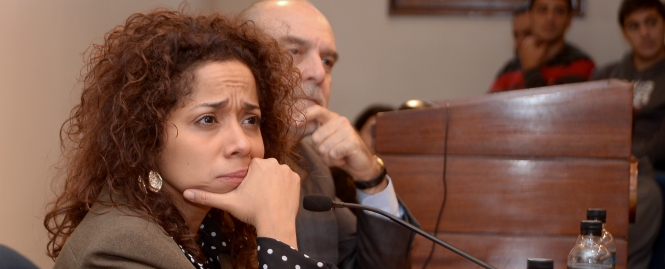
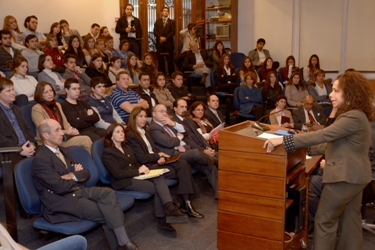
On May 6, 2013, the Faculty of Administration and Social Sciences hosted a lecture titled “Uruguay and the United States: A Busy Agenda of Mutual Cooperation,” presented by Dr. Julissa Reynoso, U.S. Ambassador to Uruguay.
“Cooperation between Uruguay and the United States is very close,” Dr. Reynoso began. “We have many areas of focus, ranging from education to defense cooperation, but one aspect that particularly caught my attention when I arrived here—and which I’d like to focus on today—is the importance of trade.”
Reynoso focused his talk on three points: first, the importance of the United States as a country and the perception—which he believes to be mistaken—that it is still in the midst of a crisis; second, the global perception of his country regarding trade issues; and third, sharing some data on trade relations between the two countries and U.S. investment in Uruguay.
“Why is the United States important?” Reynoso began by asking, referring to the first topic of the conference. “I’m not just saying this because I’m the ambassador,” she joked. “We’re important because of our size, our innovation, our openness to the world, our technology, flexibility, and diversity—in every sense of the word. All of these factors are essential when evaluating a trading partner.”
 Reynoso noted that the U.S. economy is one of the most transparent in the world, that its consumers spend the most per capita, and that it is the leading importer and exporter of services. He noted that the United States is overcoming the crisis, with unemployment falling from 10% to 7.6%, credit flowing again, housing prices rising once more, and the country producing more natural gas than ever before.
One very important export, he noted, is education. “President Obama launched the ‘100,000 Strong’ program in the Americas to draw attention to the vital importance of quality education for regional prosperity.” This program promotes greater student exchange opportunities for young people, future leaders, and innovators; fosters social and business ties; strengthens bilateral relations; and prepares young people to become the workforce of the 21st-century industry. He added that Barack Obama believes that “an increase in student exchanges will lead to greater understanding among the peoples of the Americas.”
Reynoso added that the dollar is the global benchmark currency and continues to be used as a store of value in times of uncertainty. “Our economy remains the largest in the world; it is nearly twice the size of China’s, two and a half times that of Japan’s, and more than four times that of Germany’s.”
Regarding the second point—the U.S. global vision on trade matters—the Ambassador stated: “Facilitating international trade remains a priority for Washington.” She noted the conclusion of free trade agreements with various countries and an increase in trade relations with the European Union, which would strengthen what is the world’s largest trade relationship. They are also putting “a lot of energy” into negotiations on theTrans-Pacific Partnership (TPP) agreement among countries in the Americas and Southeast Asia. “We want to conclude the agreement this year,” she said, adding that “Uruguay is increasingly committed to Asia. And we view with great interest Uruguay’s request to become an observer of the Pacific Alliance (between Mexico, Peru, Colombia, and Chile).”
Finally, regarding trade and investment between the United States and Uruguay, he noted: “The United States is among the most significant investors in Uruguay. More than 100 U.S. companies directly employ over 12,000 people in quality jobs with good wages. Many of these companies provide employment for young people.”
Reynoso said that last year the United States was the leading buyer of traditional Uruguayan products, such as meat, timber, and honey, but also of less traditional ones, such as blueberries and medical implants. He added that Uruguay could be a good strategic partner for his country because “it’s a great place to do business. American companies say so, and I’ve seen it myself. They’re drawn by its stable investment climate, its people, and its professionals.”
“Obviously, there’s room for improvement (…) I think it’s just a matter of time before we can take Uruguay to the next level. The potential is enormous, and one thing that always surprises me is that few people realize the potential Uruguay has,” he said, adding: “I think Uruguayans are down-to-earth, very humble—perhaps too much so. I have no hesitation in saying that the human and professional capabilities of Uruguayans are outstanding. This helps me promote economic ties between peoples, the exchange.”
Finally, the conference concluded with a series of questions from students and faculty to the Ambassador on topics such as international agreements, diplomatic relations, education, and defense.