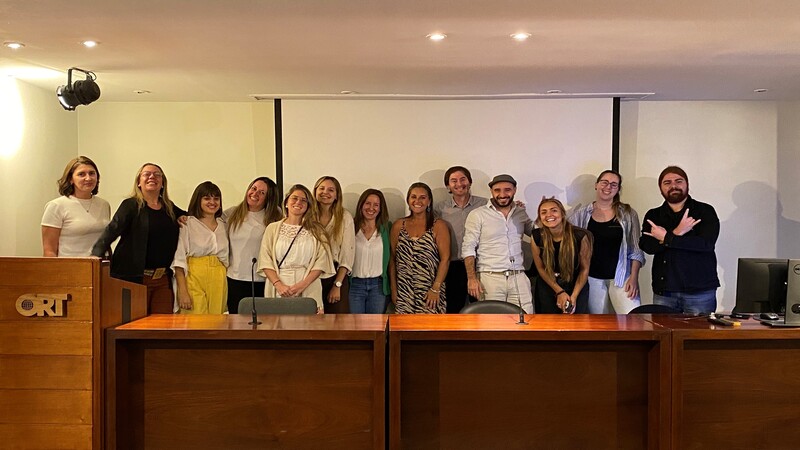
As it does every year, a new and prominent gathering bringing together academia and industry took place at the School of Graduate Studies and professional development of the School of Communication and Design. On this occasion, the event consisted of two parts: the Final Report and the Innovation Plan.
The students demonstrated their analytical skills and strategic thinking as they developed communication, marketing, and innovation proposals for real companies, while facing rigorous evaluation by experts and real-world clients.
Both events took place on March 28 and 29 at the Auditorium of the School of Communication and Design at Universidad ORT Uruguay. There, students from both graduate programs gave their final project presentations and defended their work. Below are some testimonials and highlights from the event.
Final Report: Communication and Marketing Plan
The Final Project is the work submitted by students in the Master’s in Communication and Marketing Management. The project, a fundamental component of the program that allows students to apply their acquired knowledge to a real-world situation, consists of a strategic analysis and a communication and marketing proposal for a company.
This project offers students a unique opportunity to gain firsthand insight into how a real company operates, assess its strengths and weaknesses, and develop a solid, realistic proposal that can be implemented in the near future. By working with a real company, students face challenges typical of the professional world, which allows them to gain practical professional experience and develop essential career skills.
In this regard, the students interviewed shared extremely positive views about the master’s program, noting how it broadened their horizons and enabled them to apply the knowledge they gained with confidence and assurance in their companies.
They also emphasized the importance of working with a real company, as this allowed them to have a realistic basis for their work, manage their own figures, and propose solutions that they could implement and that would convince them, all backed by data at every step.
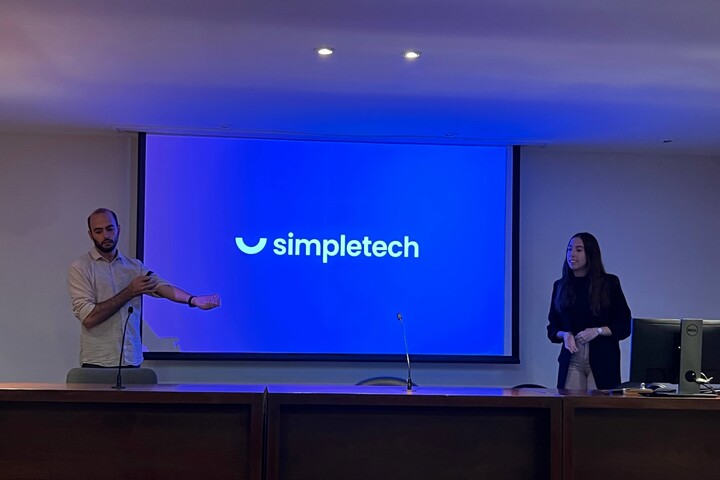
On this occasion, the companies with which the students collaborated were Simpletech (with which Daniel Olhagaray and Lucía Sánchez worked), Mapfre (Leonel Delfino and Florencia Usher), 1000 razones (Eduardo De Castro and Sabrina Muslera), and Urucap (Verónica Balderrain).
When asked about this experience, students Daniel Olhagaray and Lucía Sánchez, who worked with Simpletech (with Federico Lamaison and Marie-France Bourgeois serving as mentors), highlighted the importance of being part of a project with a real company and the positive impact it has had on their professional careers. In this regard, Olhagaray noted:
When it comes to the experience of working with a company, I don’t think it would be the same if you didn’t have a real-world context and someone to bounce ideas off of who could tell you, “That makes sense in the real world, and that doesn’t.” The experience becomes much richer when you have the support and foundation to know that you’re doing something meaningful, backed by the assurance that you’re making decisions based on real things—on data, not assumptions. It’s not just academic work; it becomes practically real work, because tomorrow many of the ideas we propose may end up being applied in our jobs, and that makes the experience much more enriching.
Lucia Sánchez, for her part, emphasized that the master’s program played a significant role in supporting her professional growth, which “was crucial to my success.” “It helped me transition from a non-management role to a management position in marketing and communications—something I believe would have been very difficult to achieve without the master’s program,” she noted.
Florencia Usher and Leonel Delfino, who worked alongside Mapfre and were supervised by Carlos Souto and Adriana Fernández as proofreaders, highlighted the learning experience gained from this project and the new knowledge they acquired.
In this regard, Usher noted that it was an“intense but very positive”experience in which they received comprehensive training and developed different perspectives on how communication and marketing work. Delfino, meanwhile, emphasized that in his particular case—having worked in communications for some time—it “was very helpful for reinforcing the knowledge I already had and delving deeper into new areas of knowledge.”
Together, Eduardo De Castro and Sabrina Muslera emphasizedthe demanding nature of this challenge, as well as the rich rewards that await those who persevere.
The case we were assigned involved a company that came to us to develop a communication plan. It was very challenging because it required us to learn about a market neither of us was familiar with; we had to do a lot of research and read extensively, and that was very enriching in terms of both knowledge and practical experience because we had to work hard to get to this point.
Eduardo De Castro
Castro and Muslera worked on the "1,000 Reasons"project, withMarcela Mailhos and Pablo Rodrigo serving as proofreaders.
As for the master’s program itself, it’s very challenging and comprehensive. It requires hours of work and a lot of brainpower. The communication and marketing plan itself requires you to apply everything you’ve learned to a real-world case study, where you’ll always find more problems than solutions, but creativity helps you come up with strategies to address those problems.
Sabrina Muslera
The most recent case was that of Verónica Balderrain, who worked with the company Urucap and had Agustina Navarro and Federico Banchieri as her instructors. Reflecting on the experience, Balderrain also noted that it was a real challenge, but that “the faculty was always very open and supportive of the students; there were no ‘silly questions’—they were all interesting, and that was what mattered.” She added:
It was very hard work that required a lot of dedication and sacrifice. Working for a real company was the biggest challenge, because you’re dependent on other people who don’t share your schedule or work pace; I think it really helps you develop a lot of patience and flexibility.
Innovation Plan
The Innovation Plan is an extremely valuable and multifaceted project. Essentially, it is an academic tool designed to integrate the knowledge students acquire during their first year of the Master’s in Creativity, Innovation, and Communication. However, it also serves an even broader purpose: to provide useful and practical consulting services to companies facing real-world challenges in their day-to-day operations.
Through this project, students have the opportunity to put their analytical and diagnostic skills into practice, using the context and case study presented to them as a starting point. From there, they must make informed decisions throughout the entire innovation process, from ideation to conceptualization, the proposed solution, and the suggested implementation.
This project is a comprehensive tool that enables students to develop skills essential to the business world, such as critical thinking, problem-solving, and creativity. At the same time, it offers companies the opportunity to receive guidance and innovative solutions that can help them address the problems and challenges they face on a daily basis.
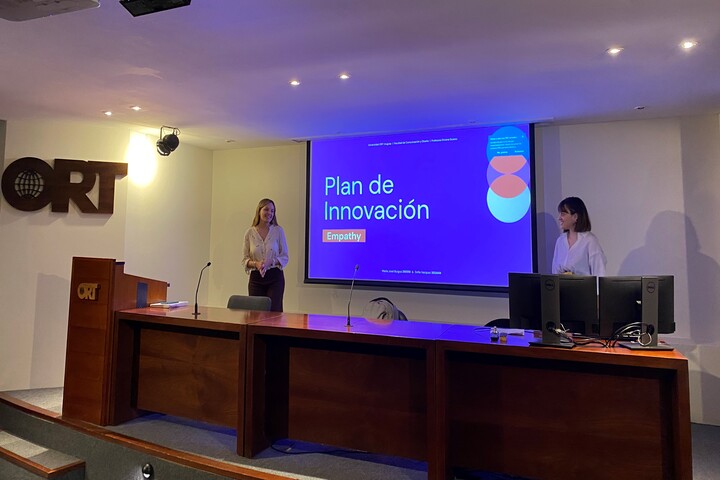
This year, the companies with which the students collaborated were Empathy, with which students María José Burgoa and Sofía Vázquez worked; Quanam, with Florencia Bertón, Natalia Epíscopo, and Gonzalo Cuello; RDA Ingeniería, with Florencia García and Andrea Pérez; and the Gonzalo Rodríguez Foundation, with students Rafael Antúnez and Stefany Delgado.
María José Burgoa and Sofía Vázquez, who worked alongside the Empathy team and were edited by Ximena Scasso and Carolina Barrientos, noted that “viewing the company from a different perspective, starting to think analytically when the focus is more on how to improve the company as a whole—beyond our professional role—contributing knowledge from what we learned in the master’s program, and applying concepts that aren’t discussed on a daily basis” were some of the highlights of this experience.
Gonzalo López Baliñas, who serves as Executive Creative Director at Alva Creative House and as a consultant at Empathy, highlighted the value of this activity and what it entails, noting that “(..) the benefit for us is a perspective that is sometimes hard to maintain when you’re in the thick of things—the perspective that a methodology can provide, seeing improvement processes and business processes, and understanding how the different parts can be analyzed, measured, and improved.”
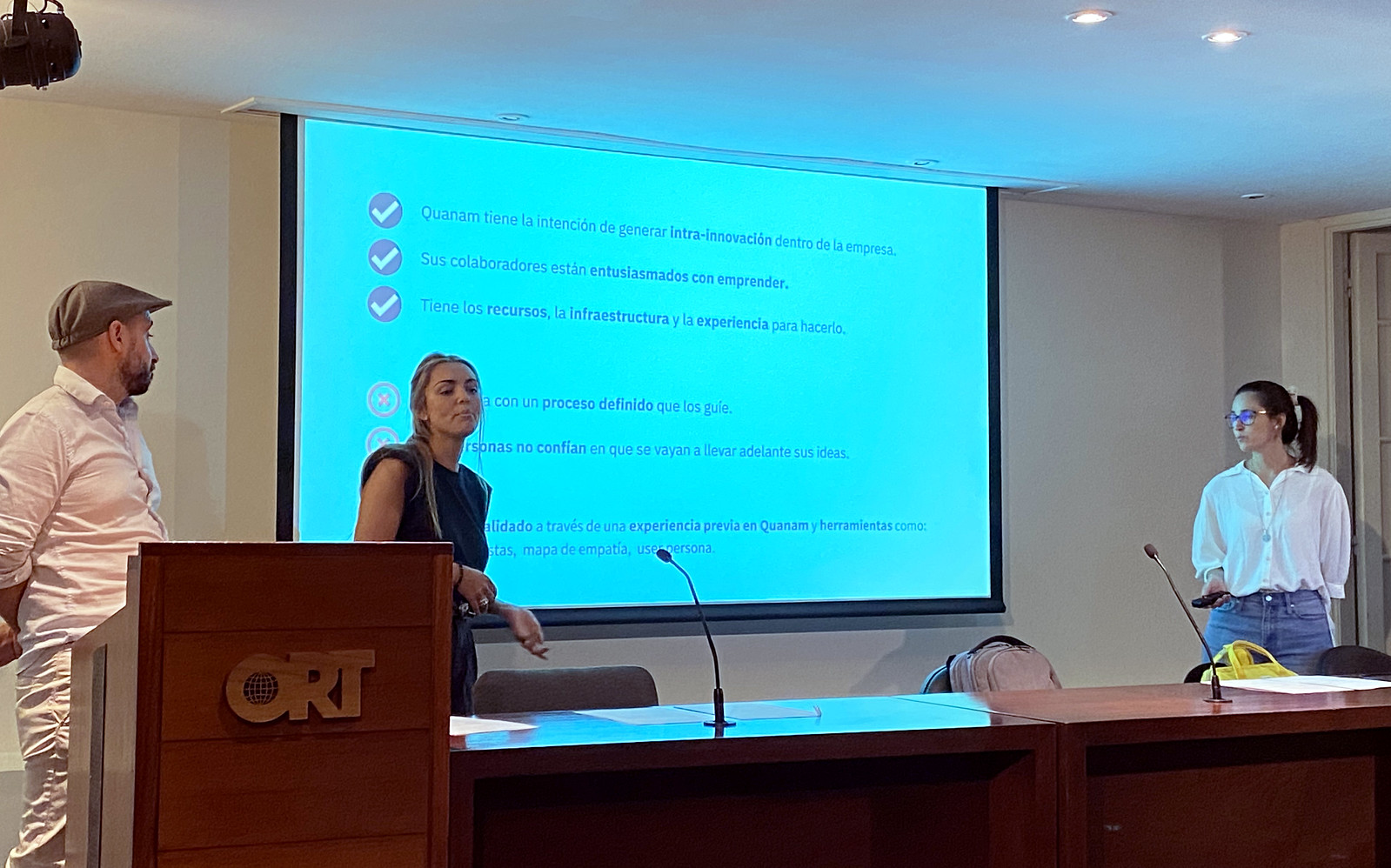
When asked about this, Quanam’s director, Edgardo Noya, stated that his company must periodically reinvent itself and that it does so with the help of its consultants, but that this “is not a strictly defined process; therefore, when the desired outcome is not achieved, we seek to extend it and broaden the base of people capable of creating new things,” in this case, he continues, “we’ve experienced this firsthand; we made progress, and the results align closely with what we observed, and in a way, they extend and broaden innovation.”
Florencia Bertón, a student and Human Resources representative at Quanam, recalled that the company had identified the need to “create a micro-enterprise with its own employees, so that they can develop viable business ventures,” so the team set out to develop“process innovations so that these projects could be carried out through all their stages and validated, enabling them to receive investment, financing, and support from the company by the final day.”
For his part, Gonzalo Cuello, the other member of the duo—which included Ximena Scasso and Carolina Barrientos as proofreaders—said:
We bring our academic background and theoretical knowledge to the table, but in practice, things often don’t work out the same way. That back-and-forth with the company allowed us to finalize and arrive at this final product in process innovation, which I believe will be well received by the organization. Ultimately, the two aspects came together: the academic and the practical, combined with all of Quanam’s experience.
Students Florencia García and Andrea Pérez, who worked with the firm RDA Ingeniería and were supervised by Ximena Scasso and Álvaro Pena, highlighted the value of the new skills they acquired:
The most important tools for me were having the courage to be different, not being afraid to fail, to try things out, and to test them; having specific, concrete tools to use, put to the test, and evaluate over short periods of time—because that’s what’s sometimes hard to bring yourself to do when you’re thinking about a startup or an idea (...).
Andrea Pérez
Martín Reina, Managing Partner at RDA Ingeniería, highlighted the value of an experience like this, in which “people who are unfamiliar with the organization—with a different perspective and mindset”—worked side by side with his team. “Whether you like it or not, when you’re immersed in the organization all day, you have the opportunity for people from outside the industry to analyze the company and give us their opinion (...) for us, it’s very enriching, ”he said.
Finally, Rafael Antúnez and Stefany Delgado, under the supervision of Ximena Scasso and Álvaro Pena as advisors, worked with the Gonzalo Rodríguez Foundation. The students also emphasized the value of the new skills they had acquired, as well as the importance of being able to work with a company on a real-world case and, in particular, the relationship that developed as a result. In this regard, Antúnez noted:
Our connection with the organization began during a presentation with the company, where we discussed various ideas. They then told us more about the foundation’s potential, its key stakeholders, and its network of connections with the market and decision-makers. Afterward, we stayed in touch and exchanged emails, during which they sent us highly relevant information.
As we can see, opportunities like these offer unique chances to fully develop students’ professional and interpersonal skills and to gain new knowledge and experiences in real-world settings. Furthermore, these experiences can help students expand their professional networks and connect with people from different fields and with diverse perspectives.