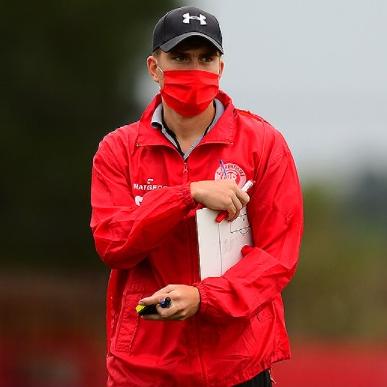
Rentistas achieved one of the greatest feats in its history by drawing with the mighty São Paulo, a team with 20 million fans, one of the wealthiest in Brazil, and the club with the most international titles. Martín Varini, its head coach, holds a Bachelor’s degree in Management and Administration. How did his studies at ORT influence this sporting achievement? What does management have to do with being a soccer coach? What does academic training contribute to athletes?
How did you come to hold your current position as a coach at Rentistas?
I played in the youth ranks at Defensor until I made it to the first division. I stopped playing when I was 22. I had gone to Italy but couldn’t finalize the contract I’d had a preliminary agreement for. When I came back, I was eager to broaden my horizons. I’d already been studying and wanted to break into the business world. I didn’t know that I’d eventually return to soccer as a coach.
When I was 25, I completed the coaching course, and Defensor signed me on again, this time to work with the youth teams. I coached the U-14, U-15, and U-21 teams, and then I got the opportunity to join Rentistas.
When did you earn your bachelor's degree?
I started at ORT in 2011. I was a freshman at Defensor and on the U-20 team. I attended night classes because I had training in the mornings and afternoons. I had to take a break in my second year because I went to play in Italy. When I came back, I focused on my studies full time. Then I started the coaching course and began working. For a while, I went to ORT in the morning, worked part-time in the afternoon, and took the course at night.
Did you ever work in management and administration?
Yes, when I was a sophomore, I worked at a law firm as an accounting assistant. Then I moved on to Trafilea, a digital marketing and e-commerce company, as head of finance. I stayed there for two years, until Defensor contacted me. That’s when I left Trafilea to focus 100% on soccer.
How do you prepare for a game against a team as strong as São Paulo?
I used the tools I had learned in college. We conducted a SWOT analysis (Strengths, Weaknesses, Opportunities, and Threats) based on our competitor’s characteristics. Based on their weaknesses, we identified the opportunities available to us. And based on their strengths, we identified the threats.
They’re opponents we have to be very careful with, because their strengths are significant and their weaknesses are few. But there’s always a weakness somewhere, so we try to come up with a fairly assertive plan that will help us compete with them. We knew that on equal terms—or in any matchup dictated by budget constraints—we’d be at a disadvantage.
What were St. Paul's weaknesses?
We saw that they struggled with set pieces. We were able to score a goal that way. We also realized that, with their three-man defensive line, we could exploit the flanks.
What was their main strength, and how did they counter it?
Their main strength is the individual quality of their players. If we couldn’t create a numerical advantage in defense—having one more of our players in each area of the field—they would make things very difficult for us, because they’re decisive in one-on-one situations. So, strategically, we mapped out some runs to create that numerical advantage.
What does management have to do with being a soccer coach?
A great deal. Especially given my background and natural inclination toward leadership. A manager is a leader. As the head coach of a first team, I have a lot of people under my supervision. Not just the 25 or 26 players on the field, but also the coaching staff, the medical department, and the equipment staff. We’re talking about 15 or 20 more people who, to some extent, depend on me or report to me. Therefore, having leadership skills—the ability to manage and delegate—is very important.
A soccer coach, especially at the top-flight level, is both a leader and a team manager. In that regard, there are many similarities between management and the coach.
Many organizations want their soccer players to develop intellectually as well as athletically. What can an academic education offer a soccer player?
An education is essential. It’s very important. A few years ago, people used to say that players should study so that, if they didn’t succeed in soccer, they would have a skill to fall back on.
But the paradigm has shifted. Today, soccer players need to study in order to develop the intellectual habits that will enable them to thrive as players, because the game increasingly requires them to make decisions within very limited time and space.
So, the intellectual challenge of a college or graduate degree program ultimately works in his favor.
And on a personal level, training that focuses on values—so that they become responsible, mature individuals who know how to make the right choices when faced with situations that could affect their performance on the field.
But above all, making decisions on the field: a player who has the ability to process information and distinguish between one course of action and another. A college education—regardless of the major—helps develop the intellectual capacity that is increasingly in demand in soccer.
Some of the skills you gain from a Bachelor's degree in Management and Administration include coaching, teamwork, and leadership. How do you advise your players?
I try to encourage them to be happy, because in any activity, when you enjoy what you do every day, you tend to do it to the best of your ability.
I really enjoy fostering a pleasant work environment, just like in a company. That organizational culture stems from motivation, satisfaction, and providing benefits. In our case, it means making training sessions as enjoyable as possible, with plenty of ball work—which is what players always want—so that they can perform at their best.
Rather than just giving advice, I prefer a two-way conversation—sharing experiences we’ve had as part of the coaching staff—but not speaking from a position of authority, but rather on an equal footing. I’m a big believer in empathy and active listening. And from there, I’d like to offer some recommendations, especially regarding how to be a professional, a good person, and a teammate—to put the group before the individual.
One value that ORT instills in its students is lifelong learning. How have you incorporated this into your development as a coach?
I’ve been committed to it from the very beginning. When I decided to leave everything related to business behind to pursue soccer, it was a calling—a passion.
I wanted to make it to the top league, and to do that, I knew I had to work hard to develop my skills. So I devoted as much time as possible to studying, reading, traveling, learning, and listening. I still have a long way to go in terms of growth and improvement, which is why I’m always looking for ways to develop my skills.