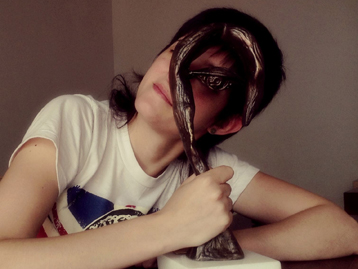
 Francesca Crossa is a technician in Sound Design, a 2012 graduate of Universidad ORT Uruguay . She currently works in the Sound Department at Sodre, where the team handles all sound-related needs for both Sodre’s own productions and those of other organizations—primarily foreign ones—that are presented at the Doctora Adela Reta Auditorium. “Our tasks range from setting up, internship, “rehearsal or live performance operator, system calibration, sound engineering, recording, and more,” he explained. “The truth is that every experience is unique.”
Crossa, who also taught at the Sound Workshop at Universidad ORT Uruguay, was responsible for the sound design of the play *Lo que los otros piensan* in 2013. This work earned her a Florencio Award. The ceremony, at which she was also nominated for Best Newcomer, took place on December 9 at the Sala Zitarrosa.
Francesca Crossa explained how she chose the music and what challenges she faced in creating the atmosphere of the play through sound.
What is the play about?
*What Others Think* is inspired by road movies. It’s about a family’s journey following the death of the father; along the way, the mother and her two children avoid saying what they really think… and don’t.
How did you come to join the team?
I met the play’s director, Domingo Milesi, while working on a short film by alumni of Universidad ORT Uruguay, *Hostias*, directed by Viviana Berrogorry. I was doing live sound and Domingo was acting; we hit it off right from the start. In late 2012, Patricia Canén, who was in charge of photography and graphic design for the play, contacted me and invited me to attend a preliminary meeting with Domingo to see if I wanted to join the project.
I was immediately drawn to the idea. Venturing into road theater was a novelty, and the direct inspiration for the piece was Dogville ( the film by Lars von Trier), which led to minimalist set design and a complex soundscape. The potential of the sound was there, the material was excellent, so the only option for me was to accept.
What what did your job involve?
I was in charge of the sound design, which involved selecting, recording, editing, and mixing to create the various soundscapes and effects that make up the show’s soundscape. I also designed the system used during the performance, which was a challenge since we used multiple sound sources rather than the typical stereo setup people are used to.
As for the music, there’s only one original track, by Fernando Ulivi—it’s great. The rest came from a long process of selecting existing songs. The show’s soundtrack can be heard on the radio and on the cassette tape the family keeps in the car; this allows for an interaction with the characters that I think is wonderful. Some tracks were suggested by the director, others by the actresses, and others by me. None of them were written by me; they were all selected from a long list of suggestions.
The aim was always to ensure that the music complemented the play as effectively as possible, but without evoking in the audience a sense of familiarity that might be distracting; for this reason, songs in Spanish were avoided (with one exception), although this choice also stems from the concept of “road culture” and the Beat Generation.
Each song evokes something and has its own story with the characters... I admit that's true for me, too: I couldn't help but include Darno singing Dylan.
So, how would you rate your first experience in theater?
The sound design emerged directly from the interaction during rehearsals: if something didn’t work there, it was discarded; if an action led to confusion rather than clarity—no matter how unbelievable it might sound—it was removed; if something was missing to make it sound realistic, even if it felt overdone, it was added.
The conventions of staging that I was used to weren’t broken; they were adapted. It’s a constant back-and-forth between the actresses: the sound speaks, they respond, and vice versa. And it happens all the time, throughout the entire play, every night.
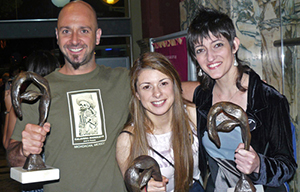 In the category Sound design You shared the nomination with Andrés Bedó, for The Decentralized Ones, by Edú Pitufo Lombardo, by The Silly Lady, and with Silvia Meyer, by Top Girls. Did you get to see those plays?
I saw *La Dama Boba*, whose musical composition I found exceptional. I had heard some of Silvia Meyer’s work, which was great, and the feedback I received about the play was overwhelmingly positive. I didn’t see*Las Descentradas*, but it was a play that won several awards—including Best Show—and I was also familiar with other works by Andrés, all of which were excellent.
I shared the shortlist with people I greatly appreciate and respect professionally—all established in their fields, all well-known in the industry. Suddenly, finding myself with two nominations, and among those names, was incredible. I was already more than happy with that result.
What did winning mean?
It was a surprise—a rare one.
You get used to being behind the glass, behind the console—never in the spotlight. You never expect recognition or applause beyond what the artist themselves and the project as a whole receive. Mind you, that’s great: I feel like part of that applause and I like that spot on the side of the stage. But suddenly, receiving recognition directly is a tremendous boost to the soul and to what one does, as well as an incentive to keep growing. It also creates something very beautiful within the family, which is what moves me the most.