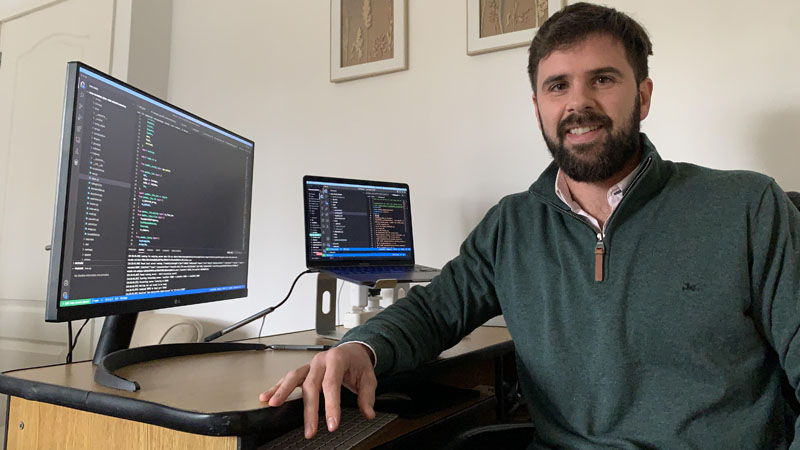
Federico currently works as a Senior Data Scientist at ConsumerAffairs. As he explains, it is a “U.S.-based company that helps consumers make smart purchasing decisions for unique, one-time events in people’s lives, such as buying a home, a car, solar panels, medical devices for the elderly, mortgages, and various other categories.”
“Specifically, in the field of data science, we have developed models using natural language processing (NLP), where we collect and analyze reviews of products and services across various categories to provide consumers with reliable and useful information. We also develop intelligent recommendation systems, propensity models, and time-series forecasting models,” he adds about his work.
In addition, Federico teaches machine learning courses for both undergraduate and graduate programs at the School of Engineering. He loves this work because of the interaction with students and because teaching requires him to stay up to date.
What motivates a chemical engineer to pursue a master’s degree in big data?
As a chemical engineer, my career has taken me down many different and fascinating paths. I worked in pharmaceutical quality control, where precision and accuracy were crucial; I coordinated operations at a logistics center, where efficiency and optimization were key; and I led a production team, where managing people and processes was essential to success.
Each of these roles provided me with valuable skills and insights. I learned how to analyze and solve complex problems, manage and optimize processes, and lead teams toward common goals.
However, as I progressed in my career, I began to realize that we are living in an era where data is the new oil and information technology is rapidly transforming every aspect of our lives and work. Although chemical engineering had provided me with analytical skills and critical thinking, I felt I needed to equip myself with a new set of tools to tackle the emerging challenges of this data-driven world.
"We are moving toward an increasingly digital and connected world, a world where data—if understood and used correctly—can transform industries and societies," says Federico.
Far from being a gradual change, we are moving at breakneck speed. That realization is what led me to decide to pursue a master’s degree in big data with a specialization in artificial intelligence.
It might seem like an abrupt transition, but for me it was a natural shift. While chemical engineering and artificial intelligence may appear to be polar opposites at first glance, both disciplines share a common core: the modeling and understanding of complex systems. Instead of equilibrium equations and reaction kinetics, I now found myself immersed in algorithms, data analysis, and AI-driven predictions.
Therefore, my decision to completely change my approach was driven by a desire to be at the forefront of this data revolution. I wanted not only to understand, but also to model and predict behavior based on large volumes of data.
I was fascinated by the promise that artificial intelligence would radically change the way we live and work. The realization that tomorrow’s challenges will lie in the millions of bytes of data we generate every day. The desire to uncover the hidden patterns in this data and use them to make the world a better place is what drives me in my current career.
Why did you decide to change the direction of your career?
I think I could sum up the answer in a few words: the jobs of the future. Artificial intelligence and big data are reshaping our future, and I wanted to be an active participant rather than a passive observer.
If there’s one thing I’ve learned from my experience as an engineer, it’s the importance of curiosity, rigorous analysis, and analytical skills. It was this combination that allowed me to recognize the dawn of the “fourth industrial revolution”—an era in which digitalization and artificial intelligence are transforming everything, from how we work to how we live.
One of the ideas that really stuck with me years ago, when I was pushing my limits to make a career change, was the concept of the future of work.
How do we prepare for a world whose shape we don't know?
I’d like to paraphrase Santiago Bilinkis (an Argentine author, entrepreneur, and technologist) here, who presented a thought-provoking scenario in one of his lectures. Imagine you’ve qualified for the Olympics, but you’re not told which discipline you’ll be competing in. Only five minutes before the event, a random draw determines which sport it will be. How would you prepare? How would you train? The best approach would be to develop transferable skills, such as flexibility, strength, endurance, and concentration. This is the dilemma we face today: the only thing we know about the future of work is that we don’t know what it will look like, and we have to prepare ourselves. We have a strange privilege: we are the generation that will experience the greatest change in the history of humanity in the world of work.
This idea provided the missing piece I needed to convince myself that this master’s program would give me a solid foundation in the skills I needed to achieve my future career goals.
Another point I consider key is that artificial intelligence and data science are fields that cut across and run through all industries and fields of study; I see them as something like the universal language of the future.
"From healthcare and education to logistics and commerce, every sector benefits—and will benefit even more—from the ability to process large volumes of data and derive valuable insights from them," he explains.
I realized that, to be truly prepared for the future, I would need to understand the principles and techniques behind a machine learning model or a generative AI application.
What did the master's program offer you professionally?
The Master's in Big Data and the specialization in artificial intelligence provided me with a wealth of professional benefits, which I can break down into two key areas: networking and technical knowledge.
In terms of networking, it gave me the opportunity to connect with a diverse and talented network of professionals and academics.
This includes both my classmates—many of whom are now colleagues and collaborators—as well as professors and guest lecturers. These connections have been invaluable to my career, providing me with opportunities to collaborate on projects, receive guidance and support, and stay up to date on the latest trends and innovations.
In terms of technical knowledge, the master’s program provided me with a solid and comprehensive foundation in fundamental techniques and tools. I learned about a variety of data analysis methods, ranging from traditional statistical techniques to advanced machine learning and deep learning algorithms. I also had the opportunity to work with a variety of software tools and platforms, which prepared me for a wide range of roles in the field of data science.