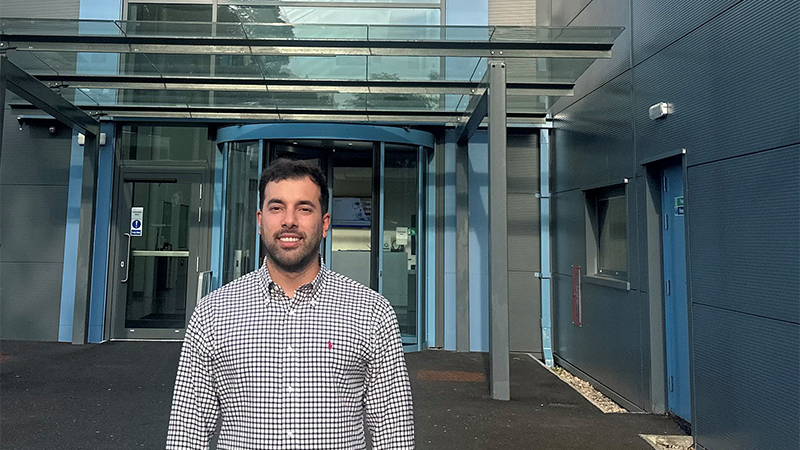
From Glasgow, where he currently lives, he shares how electronics paved the way for a challenge in precision medicine: the design of customized implants to treat cardiovascular conditions.
A calling that began during college
Mascheroni discovered his passion for biomedical engineering during his final college project, where he worked alongside CCC Medical Devices. "That project not only introduced me to the world of biomedical engineering, but also sparked a deep calling within me: to apply engineering to improve people's quality of life. That’s when I realized that engineering is present in every aspect of our environment,” he says.
The clinical impact of engineering
"What surprised me most when I started working in the medical field was the direct and tangible impact our work can have on people's lives. Coming from an engineering background, where projects can often feel more technical or abstract, and moving into an environment where every decision, every product improvement, or every optimized process can contribute to people's well-being or even save lives, was truly eye-opening."
"In addition, I specialize in cardiovascular medicine and minimally invasive procedures, where this connection between technology and healthcare becomes even more apparent."
"It's a rapidly evolving field, with constant innovations, that demands the highest level of precision and responsibility." He was also struck by the rigor of the sector: "The quality standards, regulations, and focus on patient safety are extremely high, which presents unique challenges but also gives a strong sense of purpose to our day-to-day work."
Custom Implant Design
The development of custom implantable devices is a complex and highly specialized process, especially since many patients are in critical condition, according to Sebastián. "Terumo is a Japanese company with a strong culture of precision, efficiency, and continuous improvement, which is directly reflected in every stage of the work."
"It all begins with a detailed analysis of the patient's CT scan and the establishment of clinical parameters in collaboration with a medical team. From there, the technical drawings for the device are created, a 3D model of the anatomy is generated, and a prototype is manufactured in less than two weeks."
To achieve this quickly and accurately, the team uses specialized software for medical imaging, 3D CAD design, and 3D printing of anatomical models, which allows them to anticipate technical challenges. Methodologically, they follow a standardized workflow inspired by lean manufacturing, optimizing each stage without compromising quality or patient safety.
In addition, close collaboration between clinicians, engineers, quality specialists, and the Regulatory Affairs team is essential. "Although Terumo has manufacturing facilities around the world, custom-made devices are produced at its UK facility, enabling real-time monitoring and rapid response."
"It's a fast-paced but rewarding process: we know that every device can represent a chance at life."
A combination of merit and networking
"I joined Terumo through a direct application, which involved a rigorous selection process with four rounds of interviews and aptitude tests. However, networking was a key factor that made a huge difference," says Sebastián.
"Terumo has a very close relationship with the University of Strathclyde (Glasgow, Scotland), where I completed my master's degree, and the advisor who supervised my thesis recommended me for the position. That recommendation was invaluable. As in many industries, networking is essential, and even more so when you’re a foreigner who arrived without knowing anyone. Knowing how to build relationships and lean on those who know you professionally can make a huge difference,” he says.
Electronics as a foundation
Although he doesn't design circuits anymore, his background in electronics was crucial.
"Subjects like control systems and simulation gave me the tools to tackle complex problems and adapt to new technologies."
"The competitive advantage of my background in electronics became more apparent when I started working in the medical field, as it allowed meto take an analytical and methodical approach to tackling complex problems, even when the final product did not involve circuits or active electronic components."
He also notes that "the rigor and technical discipline I acquired during my studies made it easier for me to quickly adapt to new technologies and methodologies, and to understand complex technical aspects—such as computer-aided design, medical image analysis, and advanced manufacturing—which are essential to the development of the implantable devices I work on today."

New challenges
"One of the most challenging aspects of my job is managing the extremely tight deadlines we work with. Many of our devices are intended for critically ill patients, so every day counts. Coordinating the design, validation, manufacturing, and international shipping within such short timeframes—with no room for error and in compliance with strict regulatory standards— requires precise planning, constant communication, and a great deal of attention to detail."
There are also times when he has to be present in the operating room to provide technical support during the device implantation. "It's an intense experience, because everything has to work perfectly, but it's also very rewarding, since it allows me to see in real time how the work we do in engineering translates directly into a clinical solution."
However, what is most rewarding for Sebastián is seeing the human impact of his work. The company often organizes events where they have the opportunity to meet patients who have received one of the devices they design.
"This year, for example, I had the chance to meet a patient from southern England who came up to me to thank me in person. He told me that he now knew he’d be able to keep playing PlayStation with his grandchildren. Moments like that make all the effort worthwhile."
Soft skills for clinical settings
Working on technical teams in a clinical setting requires much more than just technical knowledge.
"Soft skills are essential for effective collaboration and ensuring that the focus always remains on the patient's well-being."
First and foremost, Sebastián emphasizes "clear and empathetic communication." "It is essential to be able to explain technical concepts in language that doctors, nurses, and non-technical staff can understand, especially in high-pressure situations such as a surgical procedure."
Teamwork is also essential. "In a clinical setting, every decision can have critical consequences, so collaborating with professionals from different disciplines—such as surgeons, radiologists, engineers, and quality assurance staff—requires an open, constructive, and solution-oriented attitude."
Another essential skill is adaptability. "Every patient is different, and unexpected situations often arise that require us to adjust our plans quickly. Knowing how to stay flexible—without losing focus or composure—makes a huge difference."
Finally, he considers responsibility and ethical commitment to be essential. "Working with devices that are implanted in people demands a very high level of precision and rigor, and we must always keep in mind that what we do can directly affect someone's life."
A message for future engineers
"I would encourage you to take the plunge. Studying abroad not only opens professional doors, but also transforms the way you see the world and how you see yourself."
From a practical standpoint, Sebastián believes it is important to build a strong technical foundation during one’s studies, but also to work on soft skills, such as communication, teamwork, and resilience. “In an international setting, these skills are just as important as knowing how to design a circuit or program an embedded system.”
"I would also suggest that you take advantage of every opportunity to get involved in real-world projects, do internships, participate in competitions, or collaborate with industry partners. Not only does this enhance your resume, but it also helps you discover which area you’d like to specialize in."
"Perhaps most importantly: be prepared to step outside your comfort zone. Moving to another country, studying or working in a different language, adapting to other cultures—all of these things are challenging, but they also make you stronger."
"For me, it was a life-changing experience, not only professionally but also on a personal level."
Finally, "don't underestimate the value of networking." "Many opportunities arise thanks to the people you meet along the way, and even more so when you arrive from another country without any prior contacts. Being curious, proactive, and maintaining a humble and open attitude makes all the difference."
What I would have done differently
"When I was a student, I wish I had taken better advantage of opportunities to get involved in interdisciplinary and collaborative projects. We often focus too much on theory or specific subjects, but working in teams with students from other majors, or participating in real-world practical projects, provides a much broader perspective and prepares you for the challenges of the professional world."
"I also think I could have benefited more from networking activities and direct contact with the industry, such as trade shows, talks, and internships."
"Finally, I believe it would have been helpful to spend more time developing soft skills—such as communication, project management, and teamwork—which are essential for excelling in professional settings, especially in fields as complex as medical engineering."
"If I could go back, I would definitely try to take a more comprehensive and proactive approach, combining technical knowledge with practical experience and personal development."