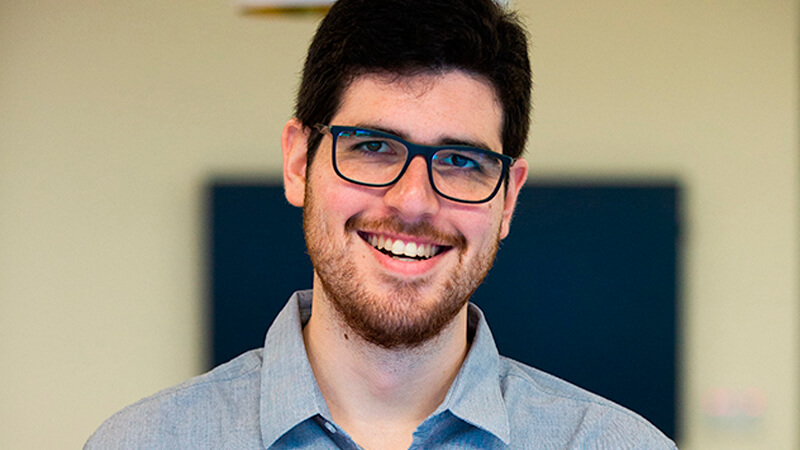
Opportunity Insights is a nonprofit organization affiliated with Harvard University (United States), whose ultimate goal is to collaborate on the development of public policies that positively impact people’s quality of life. Schertz, a graduate of the Bachelor’s Degree in Economics from Universidad ORT Uruguay.
How did your interest in research begin, and what are your plans for that field? What led you to apply for a pre-doctoral program? The graduate shares his story in the following interview.
How did the opportunity to apply for a pre-doctoral program at Harvard University come about?
I'm very interested in the world of research, and I felt that a pre-doctoral fellowship was a good way to move toward that goal. I applied to various research groups and was fortunate enough to receive an offer from Opportunity Insights at Harvard.
How much did your experience as a research assistant at ORT factor into your decision to apply to Harvard?
The truth is, it had a lot to do with it. The tools I use—whether in programming, statistics, or economics—are essentially the same ones I used at ORT. The work I did with Professor Néstor Gandelman—head of the Economics Department at ORT—convinced me that this was what I wanted to do, and his support was instrumental in enabling me to be here today.
What does your day-to-day role at Opportunity Insights entail, and what areas are you currently researching?
Opportunity Insights is a fairly large research center, and we're all working on various projects. I found it very interesting to analyze the different levels of social mobility among various groups.
We are currently working on a project that tracks economic activity in the United States —including consumption, employment, and student performance—on a daily basis and by region. We also use this information to analyze the effects of the coronavirus and various policies that have been implemented. For example, higher-income individuals reduced and adjusted their consumption, which meant that the greatest economic impact of the pandemic—in the United States—fell on low-income individuals who worked near them.
"The work I did with Professor Néstor Gandelman—head of the Economics Department at ORT—convinced me that this was what I wanted to do, and his support was essential in enabling me to be at Opportunity Insights today."
How do you remember deciding to pursue a Bachelor's degree in Economics at ORT?
I remember that at the time I spoke with various departments, both at ORT and at other universities, and this program was the one I liked best.
To be honest, I didn't really know what I was getting myself into, but I think things are going pretty well, and I'm really happy with my decision.
What was your experience like at ORT?
I really enjoyed my degree program. For one thing, I feel like I learned a lot and was able to take advantage of the various opportunities the university offered, such as attending seminars or conducting research with professors. It was these experiences that led me to choose the path I did.
I also enjoyed other experiences, such as a semester abroad at the University of Manchester (United Kingdom).
What knowledge gained during your degree program do you apply in your day-to-day work?
I’m currently conducting research in economics, and it’s essential to have a solid grasp of the field’s fundamental concepts—from basic principles like supply and demand to more advanced knowledge of mathematics and statistics. I learned all of this during my undergraduate studies.
My bachelor’s degree in economics also gave me the opportunity to work with professors like Gandelman, Flavia Roldán, and Francisco Rosas, through whom I discovered the world of research. The work we do at Opportunity Insights is quite similar. Obviously, there’s a difference in scale (at Opportunity Insights, there are fifteen research assistants, and, for example, there’s a team focused on translating research into specific policies), but the techniques we use are essentially the same.
What kind of legacy would you like to leave through your work?
I'm just getting started, and my goal is to learn how to conduct research at the highest possible level. I enjoy my work, and I like the idea of one day leading my own projects.