Among the activities planned by the national government during its visit to China, a highlight is its visit to leading academic institutions that train specialists in international relations and diplomats.
In the academic sphere, ORT has maintained a partnership for over a decade with Beijing Foreign Studies University, a key institution in the training of Chinese diplomats.
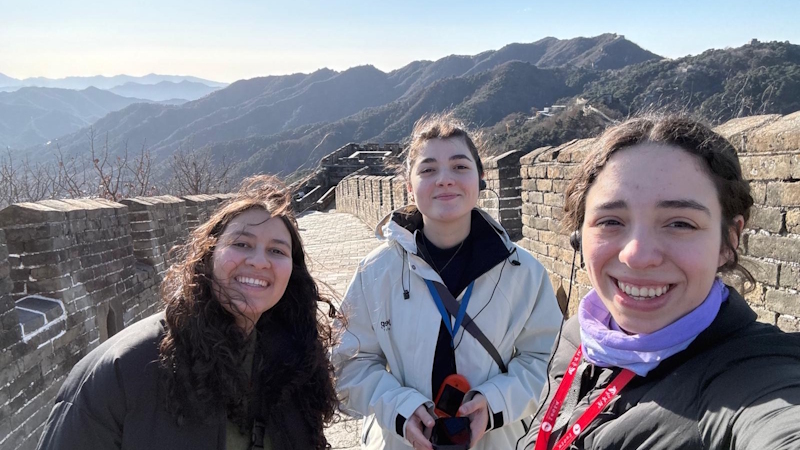
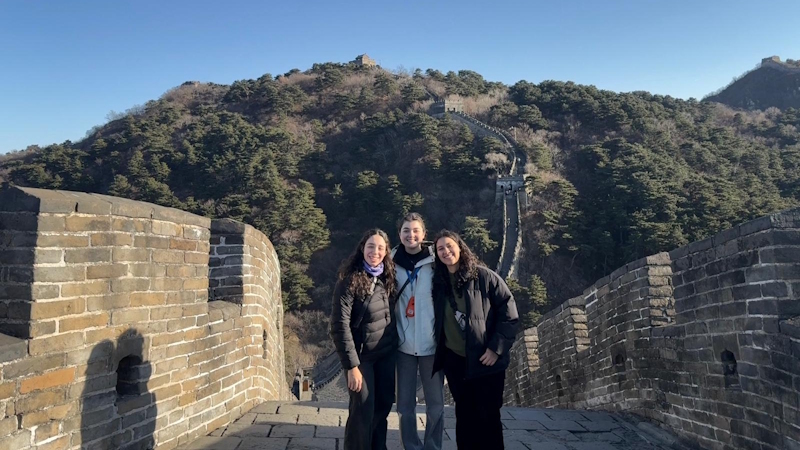
Serrana Giovannini, Lucía Carabelli, and Manuela Tasende, students in the Bachelor’s Program in International Studies, shared their experiences studying in China and what they took away from an experience that bridges their university education with the major issues of the contemporary international scene.
Studying China from the Inside
For Serrana Giovannini, it was “an enriching experience” both academically and personally. As she explains, it allowed her to acquire the tools to better understand China’s role as a key player in global politics and economics, through direct observation of everyday practices, political culture, and the relationship between the state, society, and the country’s international influence.
Living and studying there allowed me to step outside the Western perspective and understand how China sees itself in the international system.
Serrana Giovannini
Lucia Carabelli spoke about the challenge of adapting to a completely different environment. For her, living in China meant dealing with different rules, social dynamics, and political views, as well as going through a process that ranged from initial discomfort to daily adaptation.
We cannot understand what is happening in China, or in the world, from our own perspective; we do not view events through the same lens.
Lucia Carabelli
Manuela Tasende agrees. The exchange experience allowed her to gain firsthand insight into the political, social, and cultural factors that explain China’s status as a global power: “Living in China allowed me to stop viewing the country as a distant player and to understand the factors that have shaped it into the global power it is today.”
A Chinese Perspective on the Global Stage
Tasende notes that the experience strengthened her ability to analyze situations from different perspectives and highlighted the importance of adapting to diverse cultural environments—a key skill for her studies in International Studies and for her future professional career.
Carabelli highlighted the diversity of the academic environment and the daily interaction with students of many different nationalities. He also noted that China constantly revisits its history to shape its foreign policy and international presence.
In China, there is a constant review of the past to decide what to repeat and how to remain consistent with its history; understanding this completely changes the way we analyze its foreign policy.
Lucia Carabelli
For his part, Giovannini highlighted the emphasis placed on the Chinese perspective on international relations and international trade—an approach that allowed for an analysis of political and commercial ties that, from a Western perspective, do not typically take center stage.
The experience had a direct impact on the way he analyzes international issues. As he explained, the exchange strengthened his ability to engage in critical and contextualized analysis, taking into account the cultural, historical, and political factors specific to each country. Furthermore, this experience deepened his interest in Asia and in the comparative analysis of foreign policies.
Gain an international perspective through your education
Given that China is playing an increasingly significant role in the political, economic, and trade agendas of Uruguay and the region, exchange programs have become a central component of education in International Studies.
These opportunities allow us to go beyond books and simplified speeches, providing a much deeper and more realistic understanding.
Serrana Giovannini
From his perspective, these kinds of experiences help shape professionals with a global outlook, capable of understanding different interests, building bridges, and engaging in dialogue with other stakeholders based on firsthand experience rather than just theory.
Tasende agrees. In his view, these experiences allow students to apply what they’ve learned in the classroom to real-world, complex situations—ranging from everyday conversation to the analysis of a political debate in a country with a different political system.
Leaving the classroom and experiencing it firsthand is essential to our education as International Studies students.
Manuela Tasende
In this regard, academic exchanges have established themselves as a key tool for training professionals with a global perspective, capable of understanding different interests, building bridges, and engaging in dialogue with other stakeholders based on firsthand knowledge and international experience.