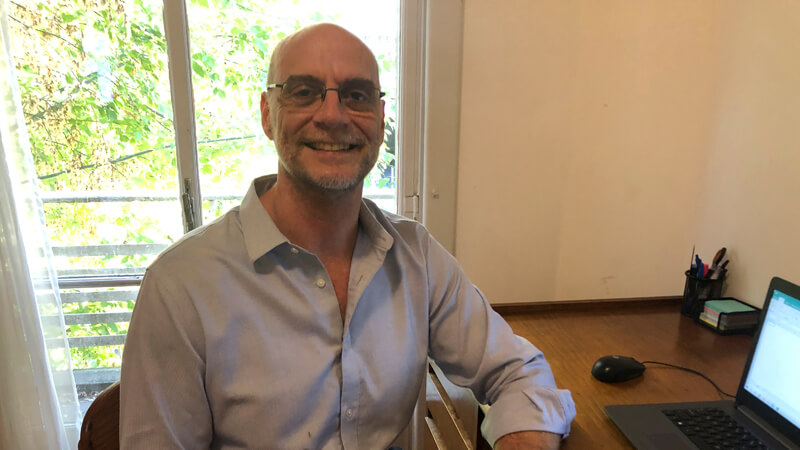
How can we improve the quality of life for women in rural Uruguay? That was the question that led to the founding of Manos del Uruguay, a nonprofit organization that has become a flagship brand for the country and represents it around the world.
Rodolfo Gioscia, who has served as the general manager of Manos del Uruguay for more than 20 years, earned a Bachelor’s degree in Management and Administration, and later earned a Master of Business Administration (MBA) from Universidad ORT Uruguay. In addition, he is currently a professor of Family Business Management at the same university.
In his role as general manager, Gioscia interacts daily with a wide range of stakeholders and oversees the journey of Manos del Uruguay’s products, which travel from the country’s deepest interior to some of the world’s most famous locations, such as Fifth Avenue in New York (United States).
In this interview, the ORT graduate discusses his experience at one of Uruguay’s most prominent organizations, his time as a student at the university, and his role as a professor in the School of Business and Social Sciences.
"The track record that Manos del Uruguay has built and continues to build opens doors that we must take advantage of, while always remaining true to the same values that the organization has always held, continues to hold, and will continue to hold."
What is it like to be part of an organization like Manos del Uruguay?
I have been leading Manos del Uruguay for 23 years, and I am very proud of that.
First and foremost, Manos del Uruguay has been promoting all the values of sustainable development— which are particularly recognized today —for more than half a century.
The owners of Manos del Uruguay are its artisans. It is a nonprofit organization, and one of its greatest challenges is to bring the artisans’ work to the world’s most demanding markets despite limited resources and difficulties.
Today, we are all truly proud that Manos del Uruguay is recognized by the world’s leading fashion brands, and that the work of a craftsperson in Cerro Largo can make its way to Fifth Avenue in New York. This is truly impressive.
What challenges and opportunities does leading one of the country's most prominent organizations entail?
One of the biggest challenges is working with a very diverse group of people andstakeholders, such as artisans from the interior of the country, the sales and design team in Montevideo, and international clients. In other words, it’s about bringing all these different groups together to create value and ensuring that value stays here in Uruguay. That is a very significant challenge.
I believe that the track record Manos del Uruguay has established—and continues to build—presents opportunities that we must seize, while remaining true to the values the organization has always held, continues to hold, and will continue to hold.
"Life presents us with situations that aren't covered in books, and while books provide theoretical frameworks that help us understand issues, the decision-making process is complex and requires thinking outside the box."
How do you recall your experience at ORT as a student in the Bachelor’s program in Management and Administration, and later in the MBA program?
Deciding to pursue a Bachelor's degree in Management and Administration and an MBA at Universidad ORT Uruguay two very important steps in my professional development.
ORT promotes entrepreneurship and has a strong focus on business, management, leadership, and innovation—elements that set the university apart and generate numerous synergies that are highly valued in the marketplace. In addition, there is a constant effort to stay up to date, not only in terms of academic programs but also in terms of teaching approaches and faculty members, who provide tools that help students build their professional careers.
While a career path isn't built solely on a college education, a college education does provide very valuable tools.
As a professor and chair of the Family Business Management program at ORT, what do you hope to convey to your students?
What I want to convey to the students, beyond the technical tools and theoretical frameworks we cover in the courses—which are, in fact, the ones most widely applied in the real world—is that they should not view family businesses as a monolithic group, because they are not all the same.
I believe it is very important for them to learn to identify the unique characteristics of each situation and to understand that the support one can provide as a family business owner, a consultant, or a director of a family business is tailored to each specific case.
Another point I always emphasize—and perhaps my background in management helps me here—is that life presents us with situations that aren’t covered in textbooks. While textbooks provide theoretical frameworks that help us understand issues, the decision-making process is complex and requires thinking outside the box.
"ORT fosters entrepreneurship and has a strong focus on business, management, leadership, and innovation—elements that make the university unique and generate many synergies that are highly valued in the market."
What situations do you think have helped you grow professionally?
Without a doubt, throughout my life, the personal and professional situations that have had the greatest impact on me and allowed me to grow have been times of crisis or difficult situations. I have experienced many such situations, and I believe that resilience is a key factor, as is staying true to one’s values.
Furthermore, I believe that guidance during difficult times is essential. It’s important to seek help and support, but ultimately, you are the one who must make the decision and take responsibility for it. Throughout life, as you face many such events, you continue to grow and develop.