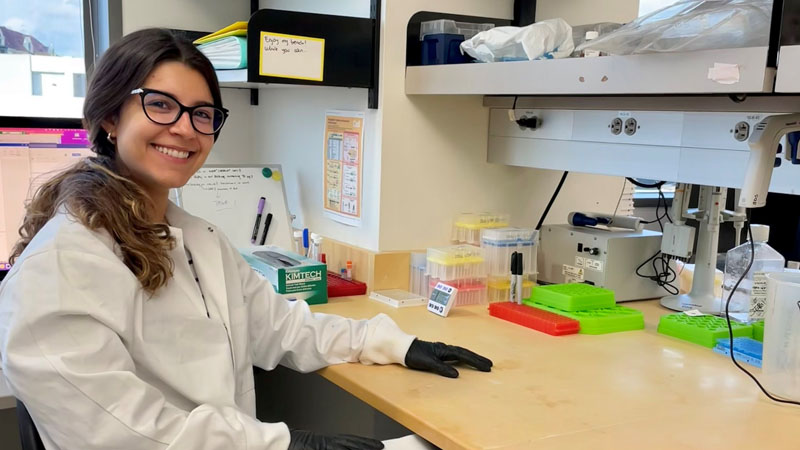
What was the process like for working abroad and then applying for a Ph.D.?
Ever since I started my degree in Biotechnology Engineering, moving abroad to continue gaining new knowledge has been one of my goals. Not because Uruguay wasn’t a good option, but because the experience and personal growth that come from living and working abroad are unmatched. Furthermore, in a field like this, having the opportunity to develop professionally in cutting-edge countries is invaluable.
I had only two requirements: to leave on my own and to be free to choose whether or not to return to Uruguay. My efforts to emigrate began a year before I left. I looked for opportunities all over the world and applied to schools and scholarships that I knew were out of my reach. But there’s no such thing as a failed attempt—you have to try. The truth is, it wasn’t easy at all. I was selected for a master’s scholarship in Spain, and at the same time, a very interesting opportunity came up in Chicago, which then fell through a month before I was set to leave.
All those obstacles only motivated me to keep looking for opportunities. That’s when I turned to my thesis advisor and professor of molecular biology at the university, Dr. José Badano, who always supported me in my search.
He was the one who encouraged me and suggested that a “Plan B” could be to contact Baylor College of Medicine (BCM), where he had earned his PhD, and request an exception to apply for the PhD program, since applications were already closed at that time. That’s exactly what I did—I left the lab and immediately wrote that email, explaining my situation, and received a response that literally changed my life.
Andrew Groves, the director of the Development, Disease Models and Therapeutics Ph.D. program, told me that it wasn't possible to make an exception in this case, but that I could send my résumé to all the labs at the university to see if anyone was interested, and that perhaps I could start working there a year early to gain experience and then apply for the Ph.D. program.
So, I got right to work. I did five or six Zoom interviews with BCM labs until I came across the man who is now my boss, Bruno di Stefano. We hit it off right away. He had complete faith in me and acted as my “sponsor” for the visa so I could go work at his lab.
I went from working with zebrafish to working with human embryonic cells (which I’m now passionate about). One day I asked Bruno why he had trusted me and why he had chosen me, even though he knew I didn’t have the skills to work in this field. His answer was: “Because of your attitude and your drive. The skills can be taught.”
That's how I came to work at the world's largest medical center: the Texas Medical Center. I worked there from May 2021 to July 2022, and then I started my Ph.D. program.
Applications for the PhD program opened in September 2021. I was already convinced that I wanted to stay in Bruno’s lab, so I did everything I could to make that happen. I started writing the application letters two months in advance, since they’re quite long. One described my scientific background, and the other specifically explained why I wanted to pursue a PhD. Something that sounds so easy took me two months of back-and-forth. But after sending the letters, I was selected to move on to the interview stage. I had the interviews on a Friday, and the following Monday the program director called me to say they had chosen me and wanted me to be part of their program. I was overjoyed. After almost two years of effort, I had made it.
Ultimately, it all required a solid foundation of knowledge, a great deal of conviction, personal effort, and a little bit of luck. Although the truth is that “luck” is nothing more than an opportunity meeting someone who is ready to seize it.
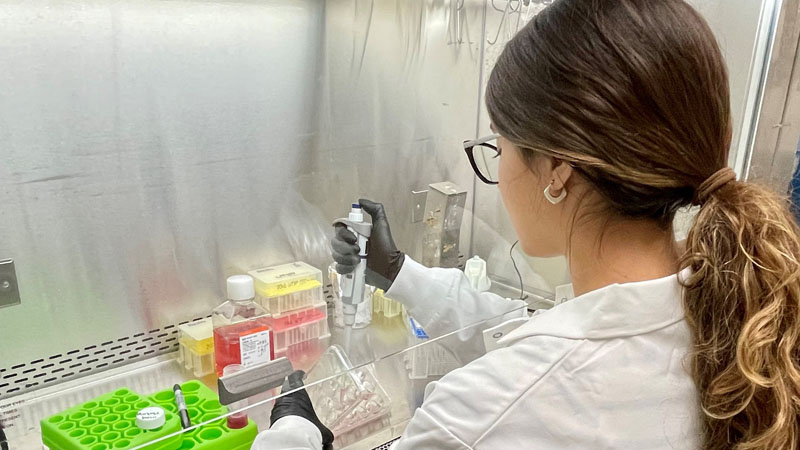
What are you working on?
As I mentioned earlier, I am currently working in Bruno di Stefano’s laboratory at Baylor College of Medicine. The laboratory’s main focus is developmental biology. Specifically, it focuses on studying the molecular mechanisms that control cell fate decisions.
This means we study what causes a stem cell (cells capable of differentiating into any type of cell in our body and widely studied in regenerative medicine) to decide to become a muscle cell, an epithelial cell, or any other type. This also applies, for example, to diseases such as cancer. What causes a completely healthy cell with a defined identity to decide to change its identity and become a cancer cell?
My project focuses on understanding what regulates and how the earliest cellular decisions are regulated during human development. In short, how a single cell or two can develop into a human being, what this process entails, what is happening within these cells, and how they know what to do during the next division in order to ultimately form a human being.
To make things even more interesting, we share about 70% of our genes with mice and nearly 98% with chimpanzees, and the early stages of development (from a genetic standpoint) are very similar. However, how can it be that we are so different? This is where the part of our DNA that isn’t genes—and was once classified as “junk DNA” (known as transposable elements)—comes into play. So, it is in this “junk or non-coding DNA” that the differences between the various species lie.
In short, my research focuses on how this non-coding DNA regulates gene expression during development, and how these elements influence and distinguish human development from that of other species, such as mice.
Did you feel that your degree prepared you to work in a top-tier laboratory?
Universidad ORT Uruguay spectacular. I would even go so far as to say that, in many cases, I was better prepared than students from the United States and Asia. If I had to highlight one thing about the Biotechnology Engineering program, it would be the hands-on training it provides. Having worked in individualized lab settings across all scientific fields (molecular biology, cell biology, chemistry, plant biology, microbiology, etc.) is an unparalleled advantage.
Another notable aspect is the faculty. There are excellent professors and scientists.Infact, it was through the faculty that I met José Badano and ended up working in his lab at the Pasteur Institute in Montevideo. To tell the truth, that connection was my springboard to the United States.
What do you find most rewarding about studying biotechnology?
I absolutely love biotechnology—in every way, both as a concept and as a career. Personally, I find it incredible to have the opportunity to use science and develop knowledge that can ultimately be applied or turned into a service that helps or makes a difference in someone else’s life.
It's a dynamic profession. It's not the kind of job where you know what's going to happen or what you'll be facing every day. Based on my work and experience, you never know what your next discovery will be, and that's what I love about it.
It’s a challenging field because the world is moving so fast, and I think that’s also worth noting. But above all, biotechnology is versatile, and I’d go so far as to say that the career opportunities are almost endless. The program prepares you to work as a researcher in a lab, become an entrepreneur, or pursue any career in the biotech industry.