What was the topic of the research?
“The topic of interactions is overlooked in practical training. We discuss many other things, but when I’m actually interacting with the children, what do I do? What actions can I take to help a child learn a subject or a concept more effectively, or to interact more effectively with others?” asked Claudia Lagos, a graduate of the Doctor of Education program at Universidad ORT Uruguay.
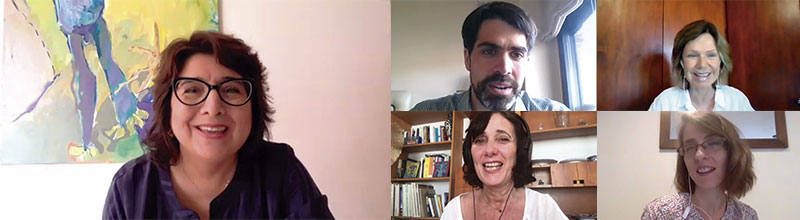
On Tuesday, February 23, 2021, she defended her doctoral dissertation, titled Academic Text, Social Text, and Types of Questions in Early Childhood and Elementary Education Classes for Trainee Teachers.
This study examined the interactions between student teachers and children aged 4 to 7 in Chilean preschool and elementary schools.
More specifically, it sought to identify the instructional situations that give rise to an academic text (the body of content included in the curriculum as elements to be taught), a social text (the knowledge necessary to participate in interactions), as well as the use of questions to manage both types of texts.
What are academic and social texts? Through what interactions do future teachers integrate these texts into their classrooms? Why and how do they use questioning as a teaching strategy? What differences exist between pre-service early childhood educators and pre-service elementary school teachers?
“The aim is to contribute to a better understanding of the use of discursive strategies, in order to improve opportunities for learning how to teach, which can be offered in the future by institutions responsible for teacher training,” said Lagos.
He added: “In the classroom setting, various types of questions arise, and it is interesting to ask whether the ones that are actually asked lead to learning or knowledge acquisition on the part of the children—or whether they simply reflect more routine aspects of classroom interactions.”
With this in mind, in her doctoral dissertation, she examined the number of words used by trainee teachers and by the children. She also looked at the total number of distinct words, vocabulary diversity, the number of turns—in other words, the number of times the teachers spoke during interactions—and the number of questions asked.
The study employed a mixed-methods approach and, for the analysis, utilized video recordings of 44 classes: 24 from early childhood education and 20 from elementary education, which were then transcribed using the CHAT software and analyzed using the CLAN software.
What were the findings?
Regarding the findings of the thesis, Lagos found that the number of shifts worked by preschool-aged children is proportionally higher than that of elementary school-aged children. This could be due to the underlying structures at both levels.
In preschool classrooms, interaction dynamics tend to be “more flexible,” and therefore, turns to participate “can be managed in a much more horizontal manner.” In elementary school, both aspects are more regulated by adults and “operate in a much more structured way.”
She also concluded that the lexical diversity used by children is greater in elementary school; their vocabulary is much more diverse. In the words of the Ph.D. in Education graduate, while younger children speak more, what they do is repeat words rather than “expand or diversify their vocabulary.” “This is consistent with the vocabulary development expected at that age,” she added.
With regard to female teachers, Lagos found that those working in elementary education use a significantly greater total number of words, as well as a wider variety of word types. As he explained, this indicates that elementary school teachers’ turns are longer and exhibit greater syntactic complexity.
It could also highlight how “both groups of teachers have adapted their teaching to the language development level of their respective groups of children.”
There is a connection between opportunities for self-expression and what is perceived—from the adults’ perspective—as the ability to participate.
Generally speaking, more questions are asked in elementary school than in preschool. However, the informative academic question—that is, one in which teachers are the primary source of information and lead to a closed-ended answer—is by far the most commonly used at both educational levels, compared to other types of questions that might open the door to different kinds of interaction.
The question in which the teacher is the primary source of knowledge and has the opportunity to elicit an open-ended response, however, is not used consistently at both levels: “It is not very common, although one would expect it to be used more frequently in a dialogic style of interaction.”
Regarding social questions, Lagos noted that one might think they “encourage opportunities for children to learn to interact or participate in exchanges.” In reality, however, these questions tend to focus on social compliance. In his words, they are geared toward interactions such as “be quiet, sit down, raise your hand.”
According to his defense, these teaching sessions are primarily focused on conveying curricular content —since academic texts predominate at both educational levels—and are combined with interventions designed to regulate behavior.
“In both educational cycles, the style of interaction is much more directive, with little room for participation and dialogue,” he stated.
What thoughts come to mind?
Lagos’s concern is how the findings of his dissertation and everything he has learned can be incorporated into teachers’ initial and continuing education. “I’m interested in research and interaction within the classroom—what does and doesn’t happen in terms of dialogic exchanges,” he said, adding that his study “clearly highlights things that don’t happen.”
In that regard, he emphasized the importance of children’s early years for their education and future development.
At the same time, he emphasized that it is essential to improve the transition from early childhood education to elementary school. “That is a major challenge and a significant paradox,” he noted.
In her view, the reason lies in the fact that people often fail to understand how children develop: “When we work in early childhood and elementary education, we’re talking about the same child. There are nuances, but in terms of development, we’re talking about a child who exhibits certain patterns of thinking.”
“The paradox arises when I break things down and change the setting, the classes, the content, and the way I interact with him,” he added. That is why it is so important to prioritize continuity and coordination across educational levels.
“It’s a wonderful challenge that we need to tackle soon,” he concluded.
https://youtu.be/dC3eUGUUoO0
The panel of judges for the defense in Lagos consisted of Dr. Alejandra Stein, a researcher at the National Scientific and Technical Research Council (CONICET) and professor at the University of Buenos Aires; Dr. Jesús Manso, professor in the Department of Pedagogy at the Faculty of Teacher Training and Education of the Autonomous University of Madrid and visiting professor at the Institute of Education at Universidad ORT Uruguay; and Dr. Denise Vaillant, academic director of the Doctorate in Education.
Dr. Celia Rosemberg, director of the Interdisciplinary Center for Research in Psychology, Mathematics, and Experimental Sciences (Ciipme) and a member of the Academic Committee for the Doctor of Education program at Universidad ORT Uruguay, served as Lagos’s thesis advisor.