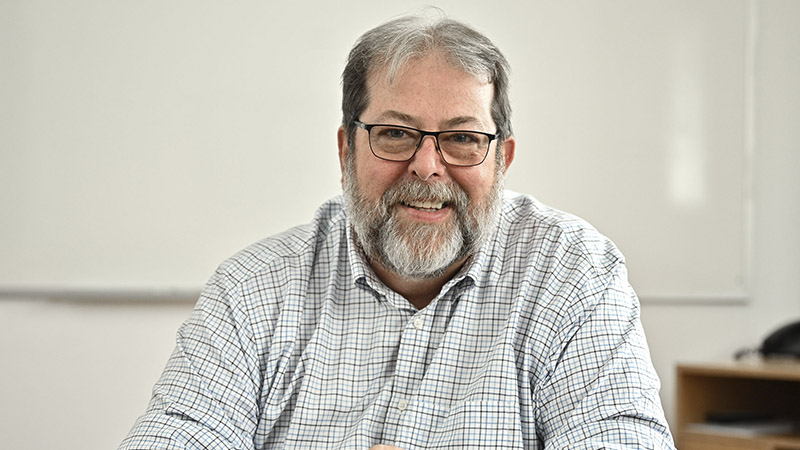
Upon completing his term in April 2024, the academic coordinator of the Specialization Diploma in Teaching English as a Foreign Language and the Advanced Certificate in Teaching English at Universidad ORT Uruguay on the distinction of being the first Latin American president of IATEFL. In turn, Díaz Maggioli recounted the achievements, challenges, and initiatives aimed at overcoming the specific issues in the teaching and learning of English.
What did it mean to be the first Latin American president of IATEFL?
It was a very significant honor, as it recognizes 40 years of dedication to teaching and learning English. The most important thing is that this recognition comes from my peers—colleagues from 94 countries who are members of the association and who cast their votes.
Being the first Latin American to lead this organization in its 60-year history is also a recognition that the work we do in the Global South is significant. It contributes to the development of a profession that, for many years, was Eurocentric.
Furthermore, having served on the Board of Directors of the Teachers of English to Speakers of Other Languages (TESOL) association—based in the United States—between 2006 and 2010, has allowed me to contribute to professional activities in other parts of the world. It also reinforces the idea that the voices of Latin American researchers are heard far and wide across the globe.
Beyond personal recognition, the position involved charting a course—a possible path forward—for these nonprofit organizations, whose goal is to contribute to the profession by connecting, supporting, and professionally developing English teachers around the world.
It is worth noting that the work of the association, of which I have served as president until now, is entirely voluntary and unpaid. It is part of our duty to serve the profession, a responsibility that all teachers should embrace.
What unique contribution was a Latin American president able to make to the association?
The main contribution is to serve as a professional platform from which the voices of Latin American colleagues can be amplified. IATEFL is a highly inclusive association that prioritizes environmental sustainability in all its activities and places great emphasis on ensuring the representation of groups that are typically underrepresented.
My specific contribution during my term as president was to develop a component of the association’s strategic plan focused on diversity, inclusion, and the internationalization of its activities.
This included promoting annual in-person and virtual events, contributing to the editorial direction of the journals and books we publish regularly, and representing the association before various international organizations. Finally, it involved supporting 16 interest groups, which are responsible for specific aspects of the profession (for example, assessment, professional development, inclusion, teaching of specific-purpose English, or teacher training), and which also carry out activities around the world.
What were the association’s most notable achievements during your term?
Without a doubt, and based on what happened during the COVID-19 pandemic, the greatest achievement was working in true collaboration with the Board of Directors to revise the business plan, which enabled us to address the significant decline in membership (which is only now beginning to recover). At the same time, we established a growth strategy for the association that is far more inclusive, fair, and relevant.
And what were the main challenges they faced?
Our greatest achievement also turned out to be our greatest challenge. We tackled it on two levels. Like any association, we have a team of staff members who handle day-to-day operations. Therefore, one level of intervention was administrative.
In this regard, we are working to reduce costs without affecting our staff. We are also working to establish remote work as an alternative to in-person work and to support employees in various ways to minimize the impact of the crisis.
At the same time, we took action at the organizational level to ensure that none of the benefits our members received were interrupted. We shifted an international conference with 3,000 participants to an online format, digitized all our publications—which were made available on our website—and worked to provide support and means of communication to colleagues around the world.
In particular, we took action when the war between Russia and Ukraine broke out. Although we are not a political organization, our mission is to support all our members equally. With that in mind, we offered specific programs, free of charge, to those members affected by the conflict.
Have you been able to work on addressing the specific challenges faced by Latin American teachers?
There is a misunderstanding regarding the specific challenges faced by Latin American teachers. Our colleagues face the same challenges as their counterparts on other continents. For this reason, IATEFL acts as a bridge between the professional challenges our members face and potential solutions.
For example, we have a tiered membership system that allows any teacher worldwide to become a member of IATEFL through our network of local associations.
In addition, as a registered charity in the United Kingdom, we provide annual funding to support projects in different parts of the world. For example, last year we supported our affiliate organization, ELTA Africa, in training academic mentors as a way to reduce the gender gap in that region. There are many other examples like this one.
Finally, what areas will require further work in the future when it comes to English language learning and teaching?
We are currently exploring that area. As the outgoing president, my mission starting in April will be to conduct a global study that includes all of our members.
The goal is to identify the areas of the profession that pose the greatest challenges to teaching, the administration of bilingual institutions, and teacher training at the international level. The information we collect between April and May 2024 will be used to refocus the association’s strategic plan and promote its development.
Nevertheless, there are issues that cause concern: the working conditions of English teachers, the impact of generative artificial intelligence on the profession, the digital divide that still exists, and, not least, the global shortage of teachers.
Are you interested in teaching English?
Learn about the Specialization Diploma in English Language Teaching