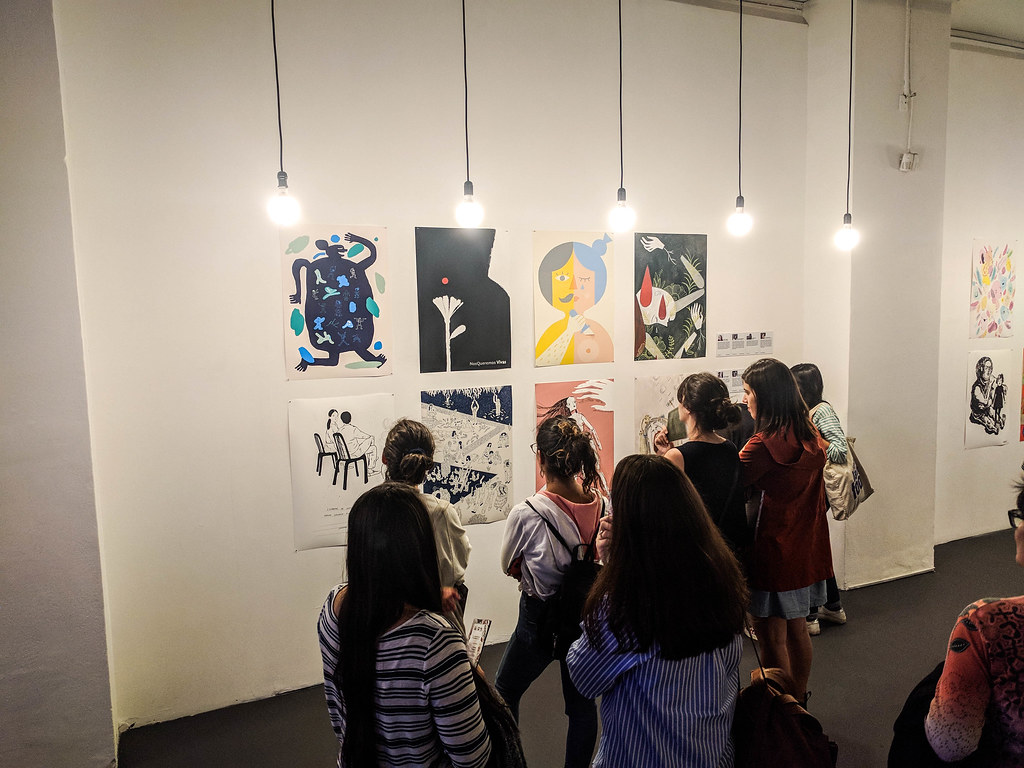
Carolina Curbelo—a graphic designer, teacher at ORT, and author of the blog Mirá Mamá—was in Mexico when she ran into her colleague and friend Dani Scharf. Together they went to the Spanish Cultural Center to visit the exhibition *Vivan las mujeres*.
“The exhibition took up a large part of the building; the walls were bursting with color, featuring more than 50 posters created by female illustrators, artists, and designers from all over Latin America. I immediately recognized some of the stars of the global illustration scene… and then I spent my time marveling at other works and jotting down names to look them up online later,” Curbelo writes on her blog. “We met up with Dani again, and the question popped into our heads: ‘Did you see any Uruguayan artists?’ No… we didn’t, so we went back to comb through the exhibition, now like two bloodhounds searching for a clue that smelled of home, but no.”
That was the impetus for Carolina Curbelo to reach out to Abril Castillo and Clarisa Moura—members of Vértigo Galería and curators of the exhibition—to see if it would be possible to include Uruguayan illustrators in the exhibition.
“The response came quickly and was overwhelmingly positive: ‘Of course! You’re welcome!’”
50 + 10
Almost spontaneously, Curbelo became the link that brought Uruguayan female illustrators into the “Long Live Women” campaign, which is an initiative by Amnesty International to put an end to the most extreme form of violence against women: gender-based killings.
The project was submitted to the Visual Arts Division of the Ministry’s National Directorate of Culture, and the curator began to bring together the 10 Uruguayan artists who would be included in the exhibition, which originally featured 50 posters.
“We looked for female illustrators whose work relates to the theme or who, based on their track record, would be able to rise to the challenge of tackling this theme,” Curbelo explained. “I wanted to open up the project so that more artists could participate.”
“All of them were invited to create a piece that would use gender-based violence as a starting point, emphasizing that the most important aspect of the project was for each participant to approach the topic from a personal perspective—whether testimonial, poetic, or conceptual—with the goal that both the images and the texts serve as bridges connecting experiences that reach all of society,” she continued. “Some of the resulting works are based on personal experiences, well-known stories, and specific cases. I believe we can identify a perspective rooted in empathy, in the experience of being a woman and understanding firsthand what it feels like to be part of this society that sometimes does not want us or does not take us into account. One positive aspect to highlight is that, while there are many stories of violence experienced firsthand, one can also see a great deal of hope, the strength to carry on, and a conviction that this reality can change.”
The works are by Lucía Franco, Lucía Estévez, Cathy Burghi, María Noel Silvera, Florencia Durán, Lucía Picerno, Daniela Beracochea, Michelle Marlechauffe, Sabrina Pérez, and Claudia Prezioso.
Women are making strides in the creative industries, Curbelo noted: “The entire illustration sector is becoming more professional, and so are women.” “Uruguay is no different from other countries in that regard; the important thing is to keep pushing so that job opportunities come our way, because what’s sought is a certain quality or style, regardless of whether the person doing the work is a man or a woman. I believe that compared to other professions, this is a field where there shouldn’t be too many barriers preventing women from becoming active participants in this industry and working on equal footing.”
The exhibition "Vivan las mujeres" is on view at the National Directorate of Culture of the Ministry of Education and Culture (1116 San José Street, at the corner of Paraguay) through Friday, April 13, from 10 a.m. to 7 p.m.
Posters
Malrechauffe, who earned abachelor's degree in graphic design from ORT, depicted a ballerina breaking free from her music box in her poster.
He did his initial research and sketches on paper, but the final result was entirely digital. As for the colors, he used a dark, cool shade—blue—to depict the character’s surroundings, and a warmer, lighter shade for the liberation scene.
"Although the theme of the exhibition is somewhat distressing, given the title *Vivan las Mujeres*, I immediately imagined that the poster should depict something that celebrates women's lives and their strength—something positive and hopeful. I liked the image of the music box because it can symbolize many things. On one hand, it’s loaded with stereotypes that women are subjected to from childhood, such as delicacy, fragility, being flirtatious, or engaging in ‘feminine activities’ like ballet. And on the other, there’s the idea of slavery and dependence that the ballerina faces as she’s forced to spin in circles, tied to that box from which she cannot escape. "This ballerina represents all of us, who in one way or another grew up following ideals and models that predetermined our lives and took away our freedom. This poster is a call to action—to break free from the bonds, dare to leap, and stand up for ourselves," she said.
Franco, a graphic designer and illustrator who graduated from ORT, created a composition featuring girls and women alongside various organic elements, using colored pencils on white paper. She chose the colors blue, red, and magenta and digitally incorporated pink silhouettes.
She depicted a group of women who dream of and hope for a better world—women connected to their origins and their essence—where symbolic elements such as birds appear, "which are both fragile and powerful because they are the only ones that can fly and be free." Red drops appear—blood “as a flow of life and death”—and, as a central element, a sleeping wolf, that beast that attacks and can kill its prey.
"For me, participating in this exhibition is a truly enriching experience. Sharing our art with so many fellow Latin American artists is our small contribution to raising awareness in society, because a paradigm shift is needed now so that we can build a better society—not based on hatred, but on love and equality. Both men and women are victims of the system," she said.
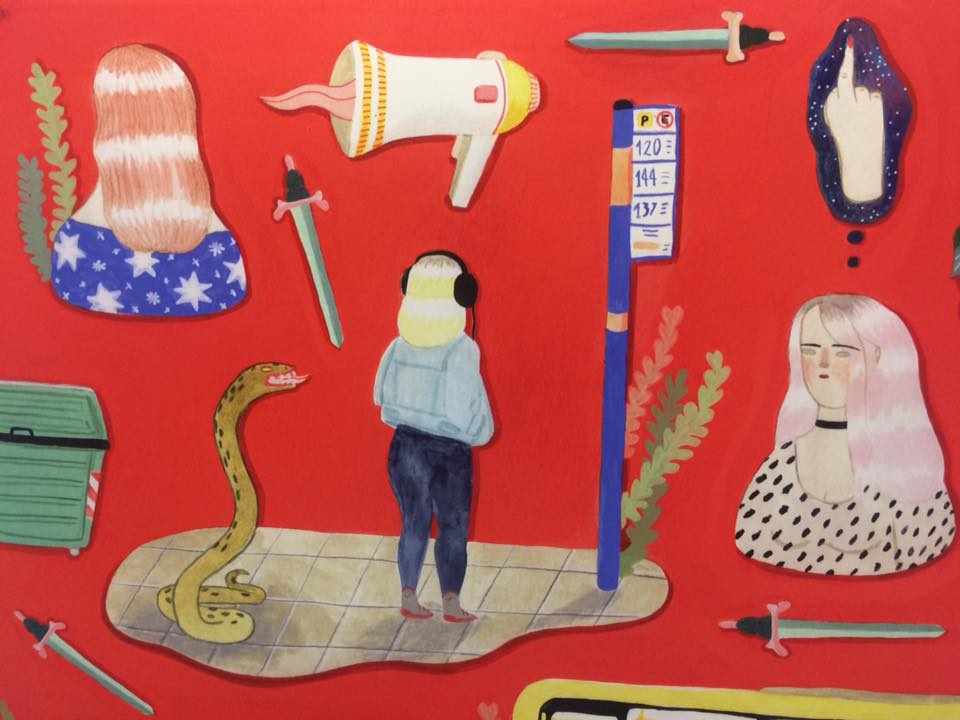
Picerno, who also studied design at ORT, illustrated a woman crying. "In her tears, you can see phrases and words that men sometimes shout on the street. To stay true to reality and as a form of catharsis, I used phrases that have been shouted at me and asked friends and acquaintances what had been shouted at them. Those tears run down her face and body and, in turn, become nourishment for the plants and flowers growing around her," she said.
"It's my way of reaching out to all the women who have experienced violence. We can't change the past, but we can build on what remains and bring about change," she added.