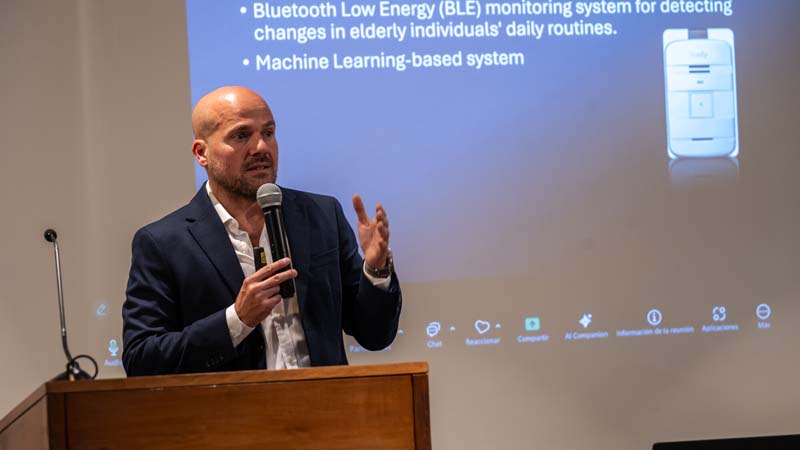
This annual event, organized by the IEEE Education Society for Region 9 (Latin America) in collaboration with the Science and Education Research Organization (COPEC), took place from March 22 to 26 in both online and in-person formats.
The Evolution of Artificial Intelligence
Mangarelli recalled that one of his first experiences with an AI system was in 2011, when a Silicon Valley startup was using sensors to monitor the health of older adults. Since then, he explained, the field has evolved thanks to three main factors: increased computing power, the widespread availability of data, and advancements such as deep learning and Transformer architecture.
“What has happened in recent years is a significant increase in computing power for cloud-based data processing, advancements in hardware (GPUs), the widespread availability of data that enables the training of systems across various fields and contexts, and the emergence of architectures such as Transformers.”
Six months of major changes
The dean noted that the pace of technological change has been particularly rapid. In January 2025, the reasoning model developed by the Chinese company DeepSeek proposed an architectural evolution that transformed the way language models are designed and improved their efficiency.
“The progress we’ve seen over the past six months has been phenomenal. The pace of change has been remarkable, and that means all of us—engineers and educators alike—have a responsibility to stay up to date so we know how to incorporate and respond to technological advancements.”
“To understand what to do, how to proceed, and what strategies to adopt, we need to have a deep understanding of how these systems work and operate.”
What made generative AI so disruptive?
The turning point came when models began to master language, creating a direct association with intelligence. According to Mangarelli, this capability enabled AI to become a tool for processing knowledge, fostering creativity, and is now beginning to serve as a tool for reasoning.
“The key question is not whether these are creative systems or not, but how these systems affect our creativity—how they foster, encourage, or support it.”
Models that reason
Today's models don't just respond—they also reason. This is made possible by two techniques: " chain of thought," which teaches models to solve problems step by step, and reinforcement learning.
“What’s amazing is how these systems are able to learn by being shown thousands of examples of how to reason.”
“By combining examples of thought chains with modifications to the reward function, we arebeginning to develop systems capable of reasoning.”
Efficiency and sustainability
Mangarelli called for reflection on the environmental impact of AI use. He explained that both training and inference are highly energy-intensive processes.
“A response from a model like GPT-4 consumes 20 times more energy than a Google search. We need to think about how to improve efficiency and how to be environmentally responsible.”
Context menus and tools
The dean emphasized the importance of understanding which model and which tools are being used in each case and which one is best suited to a particular situation. He explained how tools such as Notebook LM make it possible to work with large volumes of data and reduce the risk of incorrect answers.
“Saying ‘I used ChatGPT’ today doesn’t mean anything at all, because I might have actually used 4o, 4o-mini, or o1. They’re completely different models with different capabilities.”
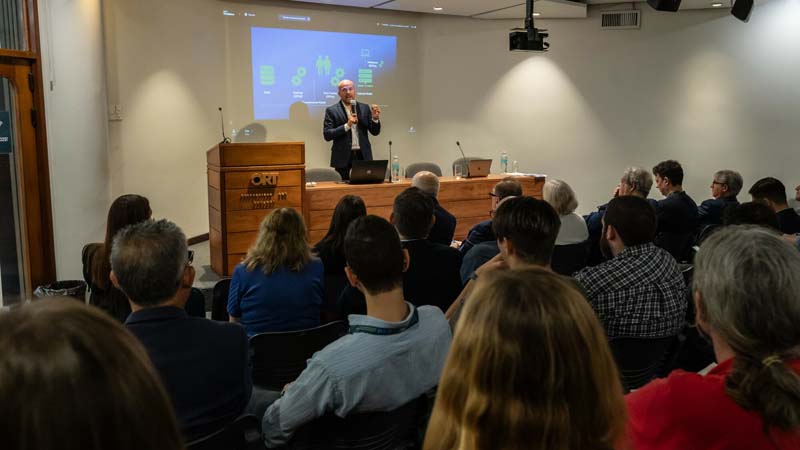
Education: The Role of Teachers
In response to the challenges posed by generative AI, Universidad ORT Uruguay a continuing education program for faculty members across the university, promoting the early adoption and responsible use of these technologies.
“It starts with the teachers. In order to educate students, we mustfirst have a deep understanding of these technologies, their capabilities, limitations, and risks.”
Mangarelli identified three key pillars for engineering education that is aligned with today's context:
- Provide training on the fundamental concepts of artificial intelligence and generative artificial intelligence, including other key disciplines.
- Provide practical tools that enable employees to perform professionally in the new environment.
- Actively integrate generative AI into the educational process as a regular part of classroom instruction and learning.
“Our responsibility is to train engineers who are capable of understanding and applying these tools with depth and discernment.”
Encouraging and developing skills for engineers
In addition to technical knowledge, Mangarelli emphasized the importance of developing new skills:
- Curiosity as a driver of learning.
- Critical thinking, to evaluate the results, sources, and responses of AI systems.
- Prompt engineering, as a key skill for communicating accurately with models.
- Problem-solving skills, the ultimate goal of all engineering education.
“These tools can be wonderful gateways to curiosity, or they can be tiny holes that limit access to knowledge. It all depends on how we use them.”
Evaluation and Ethical Use
Mangarelli argued that the use of AI in learning also requires a rethinking of assessment methods. From essays and projects to oral or written exams, the goal is to encourage the proper use of AI, not to ban it.
“The challenge is to design tasks whose complexity inherently requires the use of generative AI and that can only be solved by using it correctly.”
Technological intuition
In his closing remarks, the dean put forward a key concept: incorporating AI into our professional intuition, just as we use Google Maps without even thinking about it.
“If someone needs to get from one part of the city to another, they don’t even think twice: they just open Google Maps or Waze. It’s an automatic reaction. With AI, we’re still a long way from incorporating its capabilities—what it’s capable of solving—into that intuitive reaction.”
“We haven’t fully internalized how to quickly connect different scenarios and technologies to solve problems. This skill is a direct result of our education.”
https://youtu.be/Ie-nfCazboY
You might be interestedin: "Engineering leaders reflect on education in the age of artificial intelligence"