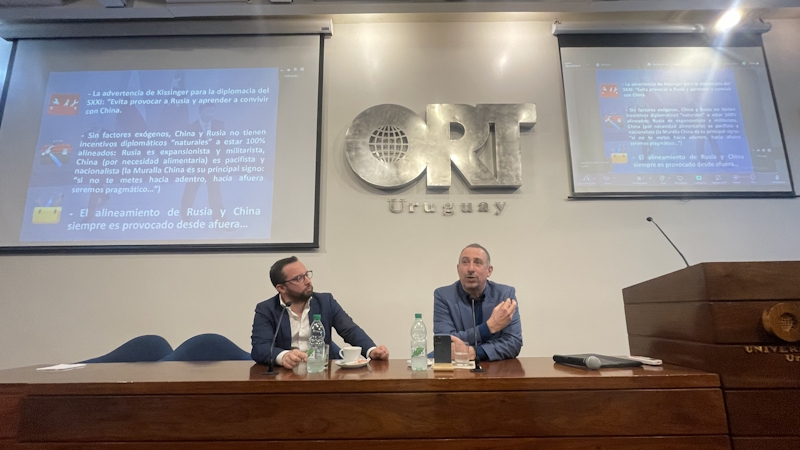
In this context, Universidad ORT Uruguay the conference “Geopolitics of an Uncertain World,” led by Dr. Nicolás Albertoni, former Deputy Foreign Minister of the Republic (2022–2025) and current professor of International Relations and Integration in the School of Administration and Social Sciences.
A turning point marked by global crises
During his presentation, Albertoni offered a long-term perspective on the current international situation.
Over the past 35 years, the global system has undergone a series of critical junctures that have redefined the rules, balances, and forms of interaction among states.
Among the most significant milestones, he mentioned the fall of the Berlin Wall, which marked the end of the bipolar world order; the attacks of September 11, 2001, which irreversibly transformed the logic of international security; the global financial crisis of 2008; the Ebola epidemic in 2014; the Mediterranean migration crisis in 2015; and the COVID-19 pandemic, among other events that marked profound turning points.
I recall what Enrique Iglesias said. Perhaps others have said it as well, but I heard it from him: “We are no longer living in an era of change, but rather a change of era.” Given the current accumulation of geopolitical events, this observation is by no means insignificant.
While history has always been marked by crises, what sets the present apart is the cumulative and simultaneous nature of these crises, which complicates the ability to respond on a global scale.
More agreements, more interdependence
Another key focus of the conference was the transformation of international trade. In the 1990s, there were approximately 40 trade agreements; today, according to data reported to the WTO, there are more than 560 regional trade agreements in force .
This growing network reflects an increasingly interdependent world, in which global value chains play a significant role.
In this regard, Albertoni noted that we are no longer talking solely about " made in China," but increasingly about " made in the world," referring to production processes spread across multiple countries.
Migration, the Environment, and Democracy: Concurrent Challenges
The conference also addressed cross-cutting issues that affect all regions.
The global migration crisis, with increasing flows, is no exception in Latin America and poses significant economic, social, and political challenges.
Added to this are environmental challenges, pressure on food systems, and the strains facing democracies, all against a backdrop of polarization, misinformation, and rapid technological change.
A world without clear coordination
Looking ahead, Albertoni emphasized that one of the main problems with the current situation is the lack of clear geopolitical and geoeconomic coordination.
In a world marked by new technologies, food crises, and growing demands for adaptation, the lack of global consensus only deepens the uncertainty.
The conference encouraged participants to reflect on the importance of education in international studies and geopolitics for understanding a complex, changing, and increasingly interconnected world.
https://www.youtube.com/watch?v=z3PnUZsQTNY