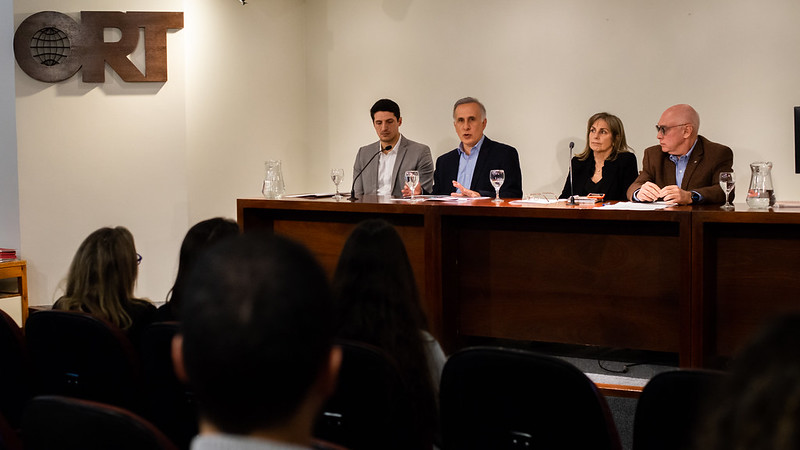
The Bachelor’s Degree in Global Communication is a groundbreaking program, according to the dean of the faculty, Eduardo Hipogrosso: “It is the first program in Uruguay that consists of three years of study in Uruguay, in Spanish, and one year abroad, conducted entirely in English.”
This program involves being in a place where there won’t just be local students, because students from other parts of the world will also be attending those classes. “So there’s already cultural interaction among the students right in the classroom.” Furthermore, he added, the courses taken abroad provide students with “interaction with the media, businesses, and organizations.” That is why, Hipogrosso concluded, “students are trained to work in different cultures and to know how to convey messages effectively.”
We are living in an era in which globalization has permeated every field, and communication in particular.
Eduardo Hipogrosso
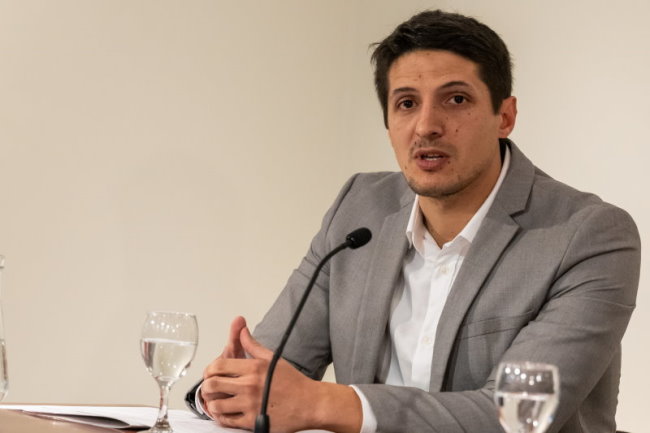 Marcelo Cardozo holds a bachelor's degree in Corporate Communications from Universidad ORT Uruguay serves as a Senior Communications Specialist at UPM. He has been based in Paso de los Toros for the past two years, where he is in charge of internal and external communications.
“The truth is that communication has taken me to a place I never imagined: creating communication through a work of art, through a shipping container,” he said. “Given all the aspects of this project, I now see myself as a global communicator.”
In carrying out this work, they take into account numerous communication plans issued by UPM headquarters, and to implement them, it is necessary to “combine a global perspective with local knowledge, because these plans must be adapted, interpreted, and executed at the local level.”
In the day-to-day work routine, Cardozo explains, there is a cultural fusion between those working from Finland and those based in Paso de los Toros. “There are some cultural differences, such as the fact that they are very organized or place a great deal of importance on their word. You gradually incorporate those things, and they eventually become part of your daily routine.”
When you meet the needs of regions in other countries, such as China or Finland, you realize the impact your work has on other parts of the world. You come to understand the scope of your role and your responsibility.
Marcelo Cardozo, Esq.
This new initiative is being introduced at this time because, as Dr. Héctor Bajac—the academic coordinator of the bachelor’s degree program—explained, “we are facing a new global reality that demands new skills, and as an academic institution, we must respond.” New habits and customs in a far more globalized world, along with new intercultural relationships, are shaping a new landscape.
Why Uruguay? “Priorities around the world are shifting. Today, companies are setting up shop in countries that offer greater legal and economic security, stability, clear rules, and good prospects, rather than in countries that offer nothing but cheap labor.”
In this context, the Academy must train professionals to lead communication efforts in other countries and also to project Uruguay’s message to the world. There is a new focus: not only mastering the technological skills and tools of corporate communication, but also understanding different cultures. “And understanding cultures is not something that can be done solely from Uruguay: you have to live it, you have to experience it,” Bajac summarized.
https://www.youtube.com/watch?v=h5iKqAcx6yc
Meanwhile, the academic coordinator of the Communication program, Virginia Silva, MSc., explained thatthe curriculumis structured around three distinct core areas:
- basic training in content—the foundation every communicator needs;
- specific knowledge of strategic communication in organizations;
- courses abroad, at universities that offer the same programs as ORT.
The goal of this program isto “train strategic communicators who are capable of operating professionally in today’s rapidly changing and highly dynamicworld; who possess a specific, open-minded, and innovative vision; and who are willing to adapt with flexibility and openness to the diverse sociocultural contexts of a wide range of cultural environments; professionals capable of analyzing and managing strategic communication plans tailored to the needs of organizations in today’s world.”