Your boss, who helped you land your current job three years ago, is about to be fired. In your opinion, the reasons for her dismissal are unfair. What’s more, you know she’s the sole breadwinner for her family. Two weeks before her employment with the company ends, she asks you to give her some company files that will be useful in her job search. Do you give them to her? Do you say no? Do you give her only the reports and files she created?
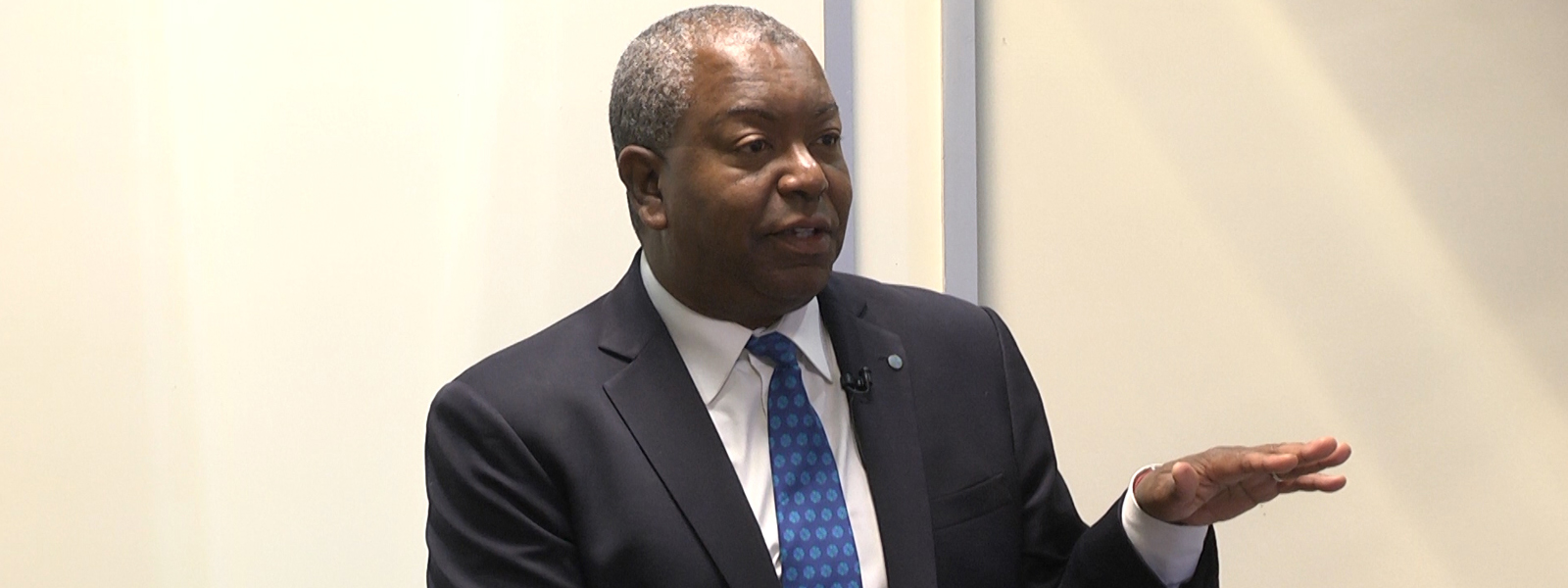
This is one of the scenarios regarding ethical dilemmas in organizations presented by Michael G. McMillan, Director of Ethics and Professional Standards at the CFA Institute, a global association of investment professionals, during the conference “How to do the right thing even if no one is watching.”
The event, organized by the Graduate School of Business of the Faculty of Administration and Social Sciences, took place on Tuesday, June 25, 2019, at the Pocitos Campus of Universidad ORT Uruguay.
McMillan holds a Ph.D. (George Washington University), an MBA (Stanford University Graduate School of Business), and a BA in Sociology and Economics (University of Pennsylvania). He joined the CFA Institute after more than a decade as a professor of Accounting and Finance at the Johns Hopkins University Carey School of Business and the George Washington University School of Business.
When Doing the Wrong Thing Is Legal
You’re on a business trip. In the culture of the country you’re visiting, refusing gifts is considered an offense. You have a business meeting where you’re representing the company you work for, and you’re offered an extremely expensive gift. Do you accept it and keep it? Do you refuse it? Do you accept it but donate it? Do you accept it but inform your superiors of what happened?
The expert opened the discussion, and event participants debated how they would handle situations of this kind. The spirit of the conference was summed up in a quote from environmentalist Aldo Leopold that McMillan cited:
"Ethical behavior means doing the right thing when no one else is watching, even when doing the wrong thing is legal."
“The law represents the minimum standard we must follow. We cannot simply follow the law; we must hold ourselves toa much higher standard, ”McMillan stated, and asked the audience, “Why must we act ethically?” To answer, he quoted former U.S. President Abraham Lincoln: “When I do good, I feel good. When I do wrong, I feel bad. That is my religion.”
Finance and The Wolf of Wall Street
McMillan pointed out that fiction portrays both good and bad doctors, as well as good and bad lawyers. The overall portrayal of those in the finance industry, he noted, is negative. He cited the movie *The Wolf of Wall Street* as an example.
He explained that, since the finance industry operates on a commission basis, people wonder whether the motivation behind a sale is in the seller’s best interest or the buyer’s. In contrast, when we seek medical advice, we automatically assume that the interest is in improving our health.
Ethics as a difficult decision
For McMillan, ethics involves education, honesty, integrity, character, and the responsible management of resources.
People often assume that if someone makes an unethical decision, they must be a bad person. McMillan refuted this, arguing that there are often reasons behind such decisions, such as obedience to authority, a desire to mimic the behavior of those around us, or simply overconfidence.
Another important factor influencing unethical decision-making is the fact that it is a gradual process. McMillan discussed the boiled frog syndrome. If you place a frog in boiling water, the frog will jump out. If you place that same frog in lukewarm water and then the water begins to boil slowly, it will not perceive the danger and will die.
Some reasons given to justify unethical behavior include “everyone else is doing it, so it must be okay,” “that’s how they do it at Company X,” “if we don’t do it, someone else will,” and “it’s always been done this way.”
To resolve an ethical problem, McMillan suggested a plan that includes acknowledging that the problem exists, determining who it concerns, gathering relevant information, exploring other options, making a decision, and, finally, reflecting on what was learned.
Finally, the expert noted that“no one will find out”is a phrase that should alert us and motivate us to look for a new job.
Image gallery:
