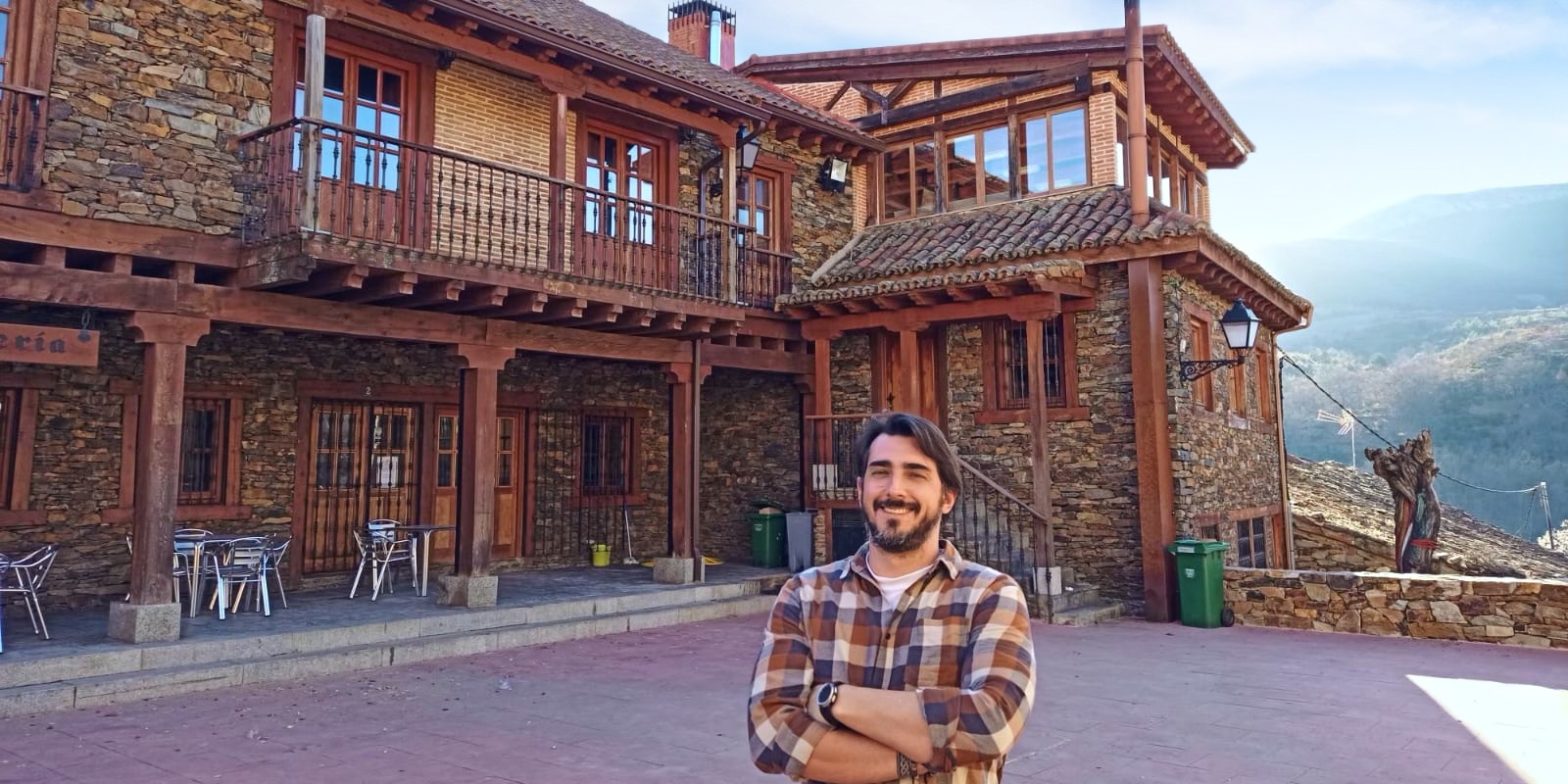
Interview with Martín Fleischer, a graduate of the Marketing Analyst Universidad ORT Uruguay at Universidad ORT Uruguay. Fleischer spoke about the startup he founded with two partners: El Refugio, a coworking and coliving space that aims to provide a safe, peaceful place in a unique setting for both work and living.
What is El Refugio?
El Refugio is an old inn that we renovated to turn into a rural coworking and coliving space. It is located in a small village with fewer than 100 residents, at an elevation of nearly 1,200 meters in the Sierra Norte region of Madrid (about 80 kilometers from the city center).
El Refugio aims to help digital nomads and freelancers reconnect with nature and with themselves, recharging their batteries to boost their productivity and focus more on their projects.
How did the idea come about?
It all started when I began rethinking what I’m passionate about. I’d spent practically my entire life in the corporate world. About a year and a half ago, I started questioning my professional future and decided to take some time for myself. I applied to an international business development program for digital nomads in Asia and was lucky enough to be selected, so I spent some time living in Thailand, Malaysia, and Indonesia.
While I was there, I lived in coliving spaces and worked from coworking spaces, where I met a lot of professionals who travel constantly and work remotely from places I never would have imagined. I learned about their interests, concerns, and needs, to the point that I became one of them. That’s when the light bulb went off, and I started researching similar places closer to home in Madrid. I couldn’t find any, so I decided there was a potential niche to develop.
Tell us about the process, from when the idea first came up to its completion.
It was, and still is, a tough process. The life of an entrepreneur—whether working on a small or large project—involves a great deal of expectations, moments of satisfaction, but also a lot of stress. It is in those moments that you have to be very clear about what motivates you to see that project through.
It’s very important that when we decide to start a business, it’s something we’re truly passionate about, so that during the toughest times we can remember why we’re doing it and it gives us a new burst of energy.
I started by taking a close look at what I like and what I think I could be good at. First, I brainstormed some ideas that seemed appealing. After much back-and-forth, I realized that this was the idea that always brought a smile to my face.
I spent a lot of time gathering information, interviewing digital nomads, and visiting different places.
Out of curiosity, I started reading about depopulation in Spain. I realized what a major national problem rural depopulation is—a problem we also face in Uruguay.
For a moment, I strayed from my original plan and started rambling about possible ideas for solving this other problem, but in the end, I combined the two.
What could be better than bringing young people to a town like that? Today, young people can work remotely from anywhere with an internet connection. In the town, they experience a different environment where they can feel welcomed by a community. Plus, they spend money in the town, which forces local businesses to produce goods or make them available. This creates a market demand that doesn’t currently exist in the town and gradually revives the local economy.
So I shifted my focus, which is pretty standard when you're starting a business. You have to be flexible to adapt to the new reality ahead.
I tried to make as much progress on the project as possible while I was living in Asia, but I really needed to be in Madrid to get to know the new environment better, so I returned to Spain in June 2019.
I started going up to La Puebla de la Sierra practically every weekend to study the area—its pros, cons, possibilities, challenges, and so on.
Finally, we submitted our business plan and operational plan to the Government of the Community of Madrid, which reviewed them and issued us a project feasibility certificate. We then submitted them to the La Puebla de la Sierra City Council to obtain the necessary permits. This entire process lasted until January 2020, when we were handed the keys to the property.
Now comes the hardest part: fostering and maintaining that sense of community around El Refugio. We hope to strike the right balance between work, nature, sustainability, and the town’s growth.
What tools did the Marketing Analyst program provide you with to start your own business?
My work as a marketing analyst has given me strong analytical skills to identify different needs, a broad and strategic perspective that allows me to see the big picture, and the ability to figure out how to fit one piece together with another to provide a creative solution to those needs.
What parts of the course did you find most interesting?
You value different things when you're in school than when you're actually out on the field playing the game, and that has made me appreciate practically every aspect of the sport. The way the program is structured is very practical for everyday life.
For example, I’ve always loved marketing and sales, and I’ve always been pretty good at them, so they were my favorite subjects in college. But then, when I started my own business, I began to appreciate other areas, such as market research and economic and strategic analysis.
For a while, you were part of the marketing faculty at ORT. What was that experience like?
It was incredible. The constant challenge you face with students—who force you to stay up to date and always be open to change—is truly impressive. Today, everything changes so quickly that we have to be flexible even when it comes to sharing knowledge. Access to information is very easy. And the groups are so diverse that managing expectations becomes even more complex. As a member of the faculty, I learned more than I taught.
What has your career path been like?
I’ve always considered my first job—cleaning swimming pools when I was 15—to be the start of my career, since that was the first time I experienced the sense of responsibility that comes from completing a task for someone else.
After that, I sold dog and cat food until, at age 18, I dove headfirst into the corporate world. I started as a messenger at the pharmaceutical company Roche, where I did everything over the 14 years I was there. From delivering mail and handling bank transactions to sales and administration, managing access to medications, working as a marketing assistant, and finally, in my last few years there, serving as product manager for Uruguay, Bolivia, and Paraguay for the hematology and dermatology divisions.
I then spent a short time at a marketing agency, which was a great opportunity to see things from the other side of the counter, working closely with designers and programmers, until I moved to Madrid.
My first experience in Spain was at a monastery, where I worked for two months and took the opportunity to immerse myself in Spanish culture. Finally, four months after arriving, I returned to the healthcare sector at the insurance company Sanitas, where I work in the dental unit in addition to running my own business, El Refugio.