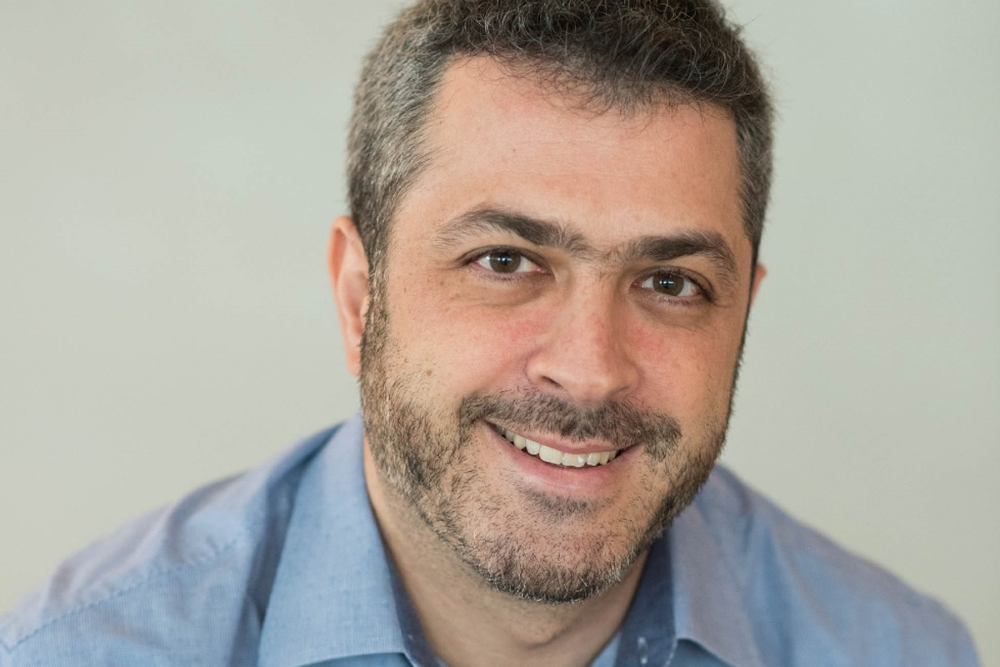
Simone, a graduate of the Systems Engineering program at Universidad ORT Uruguay, recently began working for one of the largest companies in Brazil and Latin America: Petrobras. Since October of this year, he has been serving as executive director of Digital Transformation and Innovation, a new division within the company.
Before arriving there, Simone worked for several years at the beverage company AB InBev, the retail chain Lojas Renner, Banco Itaú, and the Boticário Group, a beauty company has than 4,000 retail locations worldwide. His extensive career has taken him to countries such as Venezuela, the United States, Belgium, and Brazil, where he has lived for over ten years.
At each of these companies and in each of these countries, he says his role has been to bridge the gap between the technology departments and the rest of the company, with the goal of breaking down barriers.
Innovation as part of the company's DNA
He currently oversees more than 3,000 people at Petrobras, including the Information Technology, Digital Transformation, Information Security, and Process Reengineering departments, as well as the Petrobras Research and Development Center (Cenpes). “The new division involves not only creating technology focused on the digital realm, but also technology and innovation in our core business: from drilling to refining and platforms. We are also now establishing a corporate lab to complement the startup ecosystem,” says Simone.
For this ecosystem, he explains, a site was set aside within Cenpes based on the “lab of labs” concept. Today, Cenpes has than 300,000square meters, housing nearly 147 laboratories and over 8,000 pieces of equipment. “It’s a space with capacity for about 300 people. It’s not just a single innovation center, but rather several innovation centers within the same site. It’s a coworking space with infrastructure to support various methodologies such as design thinking and hackathons, among others,” the engineer notes.
The innovation center he heads develops technology for both Petrobras' refinery and offshore platform operations, as well as for the corporate environments of the company's various departments, such as finance, human resources, and information technology.
“Innovation has always been in Petrobras’ DNA. We make extensive use of technology. The oil wells are 2,500 meters deep in ultra-deep waters, so we rely heavily on robotics, artificial intelligence, and augmented reality, and we’ve acquired supercomputers to run seismic simulations capable of processing large volumes of data,” says the director.
Challenging the status quo
He believes the biggest challenge is accelerating the path to digital transformation in a company the size of Petrobras. “It’s not just a technological transformation, but also a cultural one within the organization—from the way we work to the implementation of methodologies or new models like design thinking,” says the ORT graduate.
Simone’s goal is to use these methodologies to break down barriers with the business sector and foster a collaborative environment. “Technology departments need to stop being viewed as cost centers and instead be recognized as value-generating, empathetic, and proactive units,” she says.
Regarding his degree program at ORT, he said it gave him “a broad overview of everything.” “It prepares you for a business or executive environment, which helps you advance more quickly within an organization,” explains the CEO of the Brazilian oil company.
He also recalled one of the first classes he took as a systems engineering student in college, which, he says, speaks to the way teaching is done at ORT. “One of the first classes was on SmallTalk, a programming language that nobody knew at the time, but which was part of the new tools emerging on the market. I think ORT has always been driving that kind of innovation, that challenge to the status quo, and that led me to do the same in my professional career,” he says.
Uruguayans: World Leaders
According to Simone, the international market is far ahead of Uruguay in terms of innovation. “I think Uruguay is at least five years behind other countries like Brazil,” she says.
He also explains that many Uruguayans who completed their university studies in the country and went abroad are now recognized as top talent in the international market. “Several CEOs and COOs of companies in Brazil, Europe, and the United States are Uruguayan,” he says.
According to him, the market in Uruguay could foster major technological innovations, but these are often not realized due to macroeconomic policies that limit opportunities for entrepreneurship. “Uruguay has everything it needs to be the Silicon Valley of Latin America, with excellent professionals, but they often have to leave the country due to a lack of opportunities or because their potential exceeds what the market has to offer,” he says.
He also concludes by noting that the country produces professionals with qualities that are hard to find elsewhere in the world: a hunger for challenges, excellent technical and educational skills, as well as the right attitude and resilience.