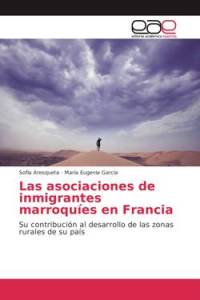
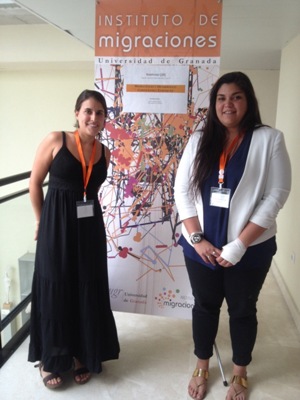
 María Eugenia García and Sofía Aresqueta, graduates of the Bachelor’s program in International Studies at Universidad ORT Uruguay, published the book in October 2016 Moroccan immigrant associations in France, which was based on his undergraduate thesis.
Addressing a highly topical issue, the authors sought to highlight the many positive consequences that can be associated with immigration. In the country of residence—in this case, France—one of the positive impacts is the demographic importance of having a young population in countries where the population pyramid has aged.
“Cultural exchange, exposure to a different reality, and, consequently, ‘an understanding of others that can lead to better integration or a more positive perception of immigrants by French society,’” García noted.
The case study focused on the Federation of Figuig-Morocco Associations in France (FAF-MF), which brings together six immigrant associations from the Moroccan city of Figuig.
“Immigrants who come together in associations maintain very strong ties. One of the reasons they do this is to stay in touch with their home country and contribute in whatever way they can,” said Aresqueta. Therefore, when immigrants achieve a significant level of organization, it has an impact on their home country.
It is common for immigrants to feel guilty about leaving, often leaving their families behind. Upon arriving in their new home and finding a better quality of life (in terms of basic infrastructure services, for example), they hope that their hometowns can also have the same access to what they are enjoying in their country of residence.
The thesis advisor, Professor Javier Bonilla Saus—program coordinator and professor of political science—noted that he found the originality of the thesis topic chosen by the students highly rewarding, as well as their “eagerness to tackle a subject quite different from those typically addressed at the end of the program.”
“In turn, since the students agreed to work beyond the empirical and theoretical horizons that are always close at hand, in the course of writing this thesis they ‘established meaningful academic, personal, and cultural ties that can only be achieved in a world where globalization is at work,’ said Bonilla.”

García had the opportunity to visit the Figuig region, located in southeastern Morocco, on the edge of the Sahara. He was there in October 2014 to attend a seminar. The seminar focused on the participation of immigrants from that region who had moved to Europe in local development initiatives from their places of residence. He stayed there for a week and lived with the family of FAF-MF President Abderrahmane Benkerroum. “It was a total immersion in local life since there are almost no tourists. A very enriching experience,” reflected García.
The research was conducted entirely using external sources, both in terms of documentary and bibliographic material and interviews.
One of his main interviewees was Joan Lacomba, who holds a Ph.D. in Sociology from the University of Valencia.
Lacomba suggested that they participate in the 8th International Migration Congress in Granada. Their research was accepted for presentation at the Migration and Development Symposium, which they attended in September 2015. It was following that presentation that Editorial Académica Española contacted them about publishing the book.
Publishing Information
“Moroccan Immigrant Associations in France” is available through Amazon, eBay, More Books,Editorial Académica Española, and the libraries of Universidad ORT Uruguay the Catholic University of Uruguay.