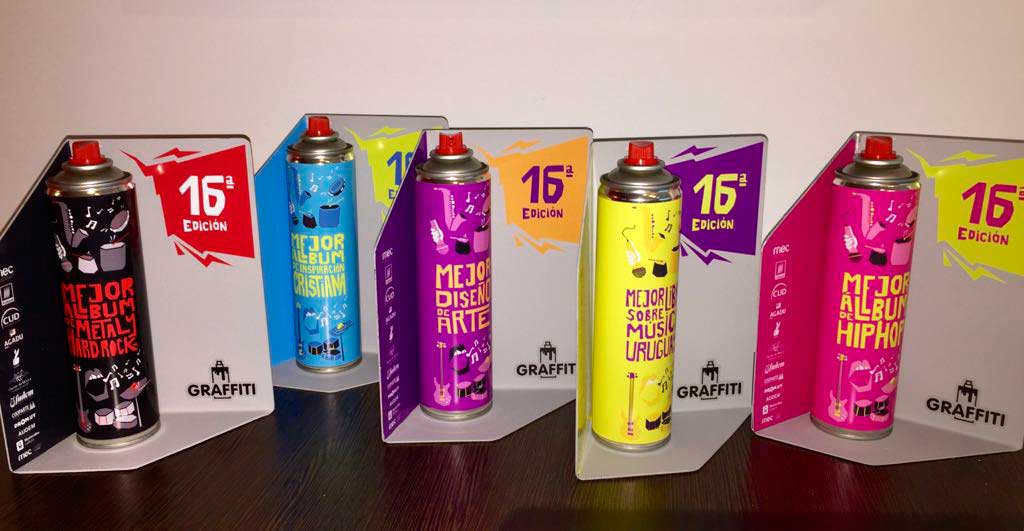
On the evening of July 19, at the Sala Zitarrosa, the Graffiti Awards —now in their 16th year—presented awards in 16 categories. The remaining awards will be presented at the ceremony on July 31 at the Sodre Auditorium.
One of the awards already announced was Best Art Design for *Fuera de la realidad* by Otro Tavella & Los Embajadores del Buen Gusto, created by Gustavo “Maca” Wojciechowski and published by Yaugurú. Maca is a member of the Graphic Design faculty and serves as an associate professor of Editorial and Advertising Design.
It was also announced that the award for Best Electronic Music Remix went to " Weather Control" by Daniel Anselmi, an independently released track.
Both Maca and Anselmi have received the faculty’s Award for Teaching Excellence on separate occasions.
The diversity of electronic music
Daniel Anselmi explained that the track “Weather Control” “is a remix of an original piece I composed a couple of years ago, based on my experience using field recordings (specifically of a storm) as a compositional tool, incorporating them into a typical electronic music production environment.”
There’s an excerpt from a speech discussing the possibilities of climate control, which I found unsettling as a topic because of the ambiguity surrounding what that kind of technology would entail. I’ve always felt that electronic music also possesses that duality—one that many have viewed as a threat (for example, to music performed on acoustic instruments) and others as a means of expression.
Regarding the category, Anselmi noted that there was “an interesting diversity,” ranging from key figures in the scene, such as Fernando Picón, to emerging artists, “which speaks to a sense of continuity and a legacy that has endured, with the torch being passed from the veterans to the younger generation.”
Events like these awards, he said, “provide exposure and recognition for the work in a field that is relatively new but has seen tremendous growth in recent years.” Furthermore, “it calls for new opportunities for solid training, strengthening the foundations, refining methods, and establishing the standards of professionalism that were unthinkable a decade ago.”
Awards as a tool for promotion
Journalist Kristel Latecki, a member of the awards jury for several years—and author of the book *Nos íbamos a comer el mundo. 20 años de rock en Uruguay (1990-2009)*—acknowledged that these awards aim to “be another cog in the wheel” of the music industry. “It’s a tool for promotion, for press coverage, for raising public awareness of music, and for highlighting domestic production.”
The representation of genres depends on the year’s output. Furthermore, it is the artists themselves who enter their work in one category or another; the jury may then suggest changes as they listen to the entries. “It’s an issue we’re always debating: how to categorize albums by genre,” Latecki remarked. “Since we agree that these are general and sometimes somewhat arbitrary labels, organizing them can sometimes be very chaotic. Then it often happens that artists complain or laugh about being in a category they didn’t expect.”
Awards play an important role in the industry: they are necessary to keep the wheels turning that keep the machine running. It’s an event that gets artists in the press (whether as winners or complaining about not being nominated—there’s something for everyone), gives them an excuse to perform, and allows them to include it in their press releases to demonstrate their national and international recognition. The same criticisms that have always been leveled are also those directed at something as established as the Grammys. These are systems that must continue to evolve to keep pace with something as fluid and diverse as music. I believe that the way these awards operate (they are televised, have sponsors, and rely somewhat on the participation of popular artists), as well as the jury’s tendency to prioritize popularity over creativity, works to the detriment of diversity and support for lesser-known artists.
Latecki points out that domestic production is growing year by year, making it increasingly difficult to keep up with everything.
Specifically regarding emerging artists, she says she is “quite critical of how they are represented.” “Over the years, many have decided not to participate in the awards, either because they don’t feel their voices are being heard on an equal footing or because they feel the awards are geared toward the mainstream side of Uruguayan music and don’t represent them,” she explained. “This year, it seems to me that this absence has reached a worrying peak; I fear that in the long run, the awards will fail to represent everything that is happening across the broad spectrum of music and will not support a renewal, which is more than necessary. This applies not only to musical genres but also to women and artists from the provinces, both of whom are consistently underrepresented.”
In any case, he acknowledges that, in that regard, the Awards have had “their moments of success”: Riki Musso won five awards, and Alucinaciones en Familia won three. “Little by little, artists who aren’t necessarily popular but whose artistic work stands out are gaining recognition.”