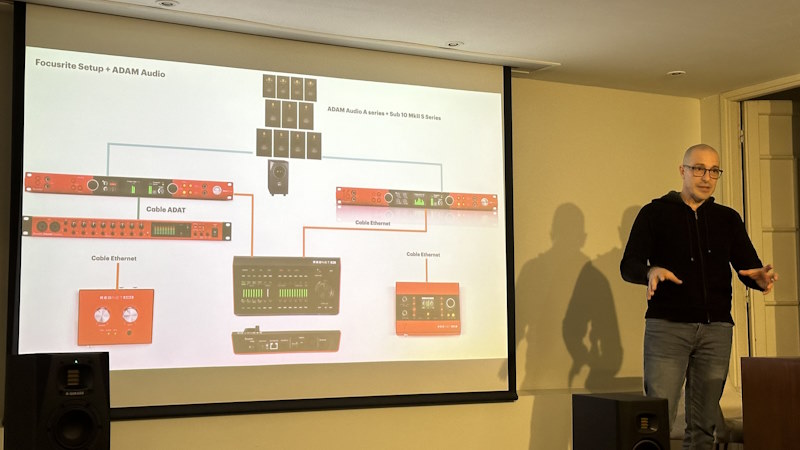
On Tuesday, June 18, the event “Dolby Atmos Music Production” took place at the School of Communication before a packed auditorium. It was co-organized by Palacio de la Música, Focusrite, Novation, and Adam Audio. The keynote speaker was Argentine musician, producer, arranger, and audio engineer Gustavo Sacchetti, who has been part of the Focusrite team for Latin America for the past six years as a product specialist and marketing coordinator.
His studio has been validated in Dolby Atmos 7.1.4 format by Dolby, and he has been certified as a Dolby Atmos mixing engineer.
An ideal Dolby setup, he explained, would involve a 7.1.4 system—that is, “seven speakers around the room, a center speaker, and four speakers on the ceiling.”
And what happens when we use headphones?
The key is to understand how to create these mixes in a binaural environment, which is how we hear.
At the event, Sacchetti detailed every stage of the production process for Dolby Atmos Music, providing a comprehensive overview of its implementation and benefits in music production. He also delved into typical Atmos system configurations, explained how object-based audio works, and reviewed examples of artists and albums that use Atmos Music, as well as the advantages and challenges of producing and listening to music in the Atmos format.
About Gustavo Sacchetti
Since his early days, he has been a member of various local bands in his hometown of Rosario. At age 18, he co-founded the rock band Vilma Palma e Vampiros. Later, he worked in electronic music under the name Aural Distortion. In 2006, he served as co-producer alongside Lulo Pérez on Alejandro Sanz’s albums *No es lo mismo*and *El tren de los momentos*.
His experience also includes collaborations with artists such as Cory Rooney, Chris n Teeb, Alejandro Sanz, Thalia, Marco Minnemann, John Patitucci, Dave Weckl, Greg Howe, Joe Blaney, and Vivir Quintana.
In recent years, he founded MammothcaveMixroom with the goal of helping new artists improve their work and reach a professional level.