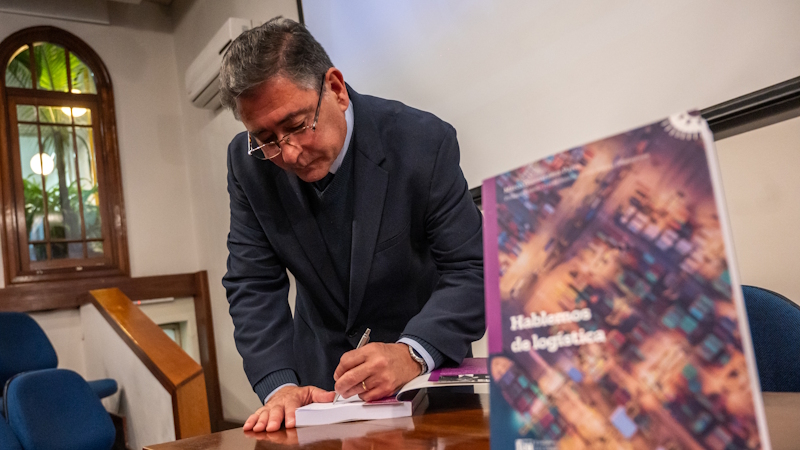
Dr. Marco Guimaraens —an associate professor of Operations and Logistics at the school—presented *Let’s Talk About Logistics*, a book that comes “at a timely and important moment,” as it allows for “the systematization of all this knowledge, which is abundant but scattered,” according to Mtr. Érika Lanzeta, academic coordinator of the Logistics and Supply Chain Management Analyst program.
Originally conceived as a technical manual, the book goes beyond a mere compilation of definitions: it offers a strategic, operational, technological, legal, and ethical perspective. “It is a very valuable academic contribution,” noted Lanzetta, who emphasized that the text encourages the analysis of logistics from multiple perspectives and fosters discussion on the subject.
It is a technical manual, but also an invitation to consider logistics from strategic, ethical, and technological perspectives.
Erika Lanzetta, M.A.
A flexible, people-centered, and sustainable approach
During the presentation, held on June 24, 2025, at the Pocitos Auditorium, Dr. Guimaraens explained that the idea to write the book arose from a need he identified in his classes: the lack of up-to-date materials in Spanish that took an inclusive approach.
“I wrote the book for my students, who were constantly searching for materials from various sources—most of them in English,” the author said.
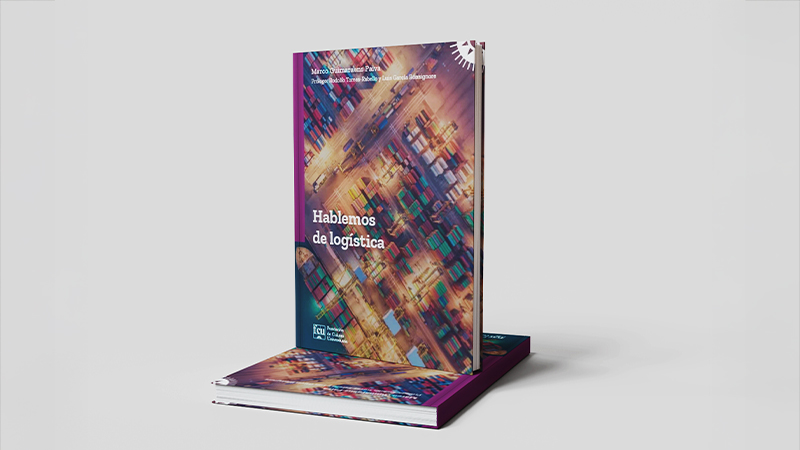
The book was originally conceived as a manual, but the author decided to rewrite it after the pandemic, incorporating technological changes, supply chain challenges, and a new concept: liquid logistics. “Digital transformation and the culture of immediacy meant that supply chains had to be disrupted. So I had to rewrite the book, which was already finished, updating it to reflect new technologies,” he explained.
I tried to take a human approach, to humanize management. Our management style is cold and complex, so I wanted to approach it from an ethical perspective—in terms of the labor market—and with an eye toward sustainability.
Dr. Marco Guimaraens
Guimaraens defined logistics as “the backbone of global trade, ” echoing a quote from Caroline Freund, a director at the World Bank, and added: “In my classes, I say it’s the backbone of a business. We all notice when logistics are lacking. And I’d add: our work is invisible.”
Bringing a Human Touch to Logistics
One of the central themes running through the text is the need to give a more human dimension to a discipline that is usually perceived as technical.
In this regard, Lanzetta emphasized:“Let’s Talk About Logistics is much more than a technical manual, because what Marco does is bring the topic to the table to analyze it from a competitive and strategic perspective—and, why not, from an ethical perspective as well.”
The book also extends beyond the academic sphere. Guimaraens sees this book as a way to contribute to national development: “If Uruguay wants to become a logistics hub—which is what concerns me—I’m at least going to do my part. I want Uruguay to take off. For that to happen, the only thing I can do is pass on the knowledge, however much or little, that I’ve accumulated over nearly 40 years.”
