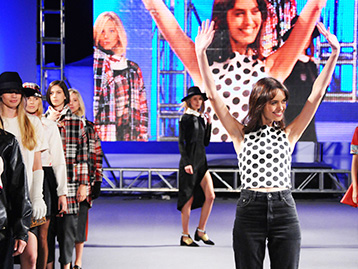
 “I always think that my introduction to design was a bit of a coincidence, but I know that I’ve always had an affinity for fashion,” said Cecilia González. “A few days ago, my sister reminded me that when I was little, I didn’t like to wear certain clothes together because ‘they weren’t friends’: that was my way of saying that, to me, they didn’t go together.”
In 2013, while in her third year of the Bachelor’s degree in Fashion Design at Universidad ORT Uruguay, she made time to enter the Lúmina competition. “I’d always wanted to enter because I’d experienced the Lúmina fashion shows from the other side—I’m also a model. I always saw Lúmina as an opportunity that seemed unparalleled to me, and I really felt it was a must for any design student to apply.”
Her collection is called Curio and was one of the five finalists in the eighth edition of Lúmina, where it received a special mention from the jury.
“I first encountered the objects that would later inspire me when I lived in Taiwan. In fact, I think my fascination with Eastern culture began at an early age: for example, I wore a kimono when I was 15,” she told In situ. “The collection, then, stems from some boxes called Curio boxes, which I saw at a museum in Taipei. As soon as I saw them, I knew that one day I would want to use this concept as a starting point, but since they didn’t allow photos in the museum, I jotted down everything I read about them in a little notebook, and that same information was what I used to start thinking about Curio.”
González says that “a box for storing small personal items with special meaning” struck her as “a very contemporary concept”: “It’s something we all do these days; I myself keep a box of mementos from this trip that I love to look back on every now and then.”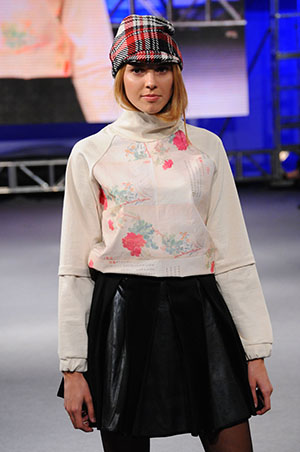
“Then I became interested in these Curio boxes because of their construction. They’re designed so that each object fits precisely where it’s supposed to go. To achieve this, they’re built with different levels and compartments, and end up being visually divided like a grid. In particular, this is what I incorporated most into the collection: the use of perpendicular lines to create new spaces. The tailoring of the garments strongly emphasizes this quality, and it’s also evident in the choice of tartan. The prints are another fundamental aspect. On the one hand, in their most literal application, they feature the Chinese paintings that emperors kept in these boxes, and these are what bring the most color to the collection, and perhaps the most youthful aspect of some garments. On the other hand, because most of the garments are printed over 100% of their surface, they achieve a stiff and shiny look, creating materials that set this collection apart.”
The designer explained that this initial concept aligned perfectly with Lúmina’s premise: to create a winter collection. “This is important because it defines the overall look of the collection, where layering different garments is key, as is the use of accessories such as gloves, scarves, beanies, and hats. From the very beginning, my priority was to create a collection that was truly winter-appropriate, one that focused on coats and pants, sweatshirts, and accessories that were, above all, functional.”
González acknowledges that designing and creating this collection was a personal challenge. “Having brought exactly what I envisioned to life gives me a tremendous sense of satisfaction, beyond any award. I entered the competition for the experience; then, after becoming a finalist, I was able to create the entire collection, which was practically like a real-world work experience. It’s an opportunity where you’re involved in every stage—not just creating a collection, but also presenting it.”
The young designer said that participating in Lúmina marked a turning point in her career. She now has one more year left to complete her bachelor’s degree in fashion design. “Among many other things, Lúmina gave me the joy of knowing that I’m doing what I love, and, luckily, it made me want to keep doing more.”