When Paula Spinatelli was pursuing her bachelor’s degree in Industrial Design and it was time for the Capstone Project course—in which each student must address a real-world need for a real company—she was very clear about one thing:“I wanted to work for children with disabilities; I wanted my project to improve their quality of life.”
She took on the case of Thiago, the son of some family friends. She set out to understand what daily life was like for a child with a disability, working closely with Thiago’s support network: first, they focused on his daily activities, such as bathing, eating, and other routine tasks at home. “Thiago, just like Jazmín—the 13-year-old girl with a severe disability who inspired the foundation—has siblings: all his siblings could go play in the little park, but Thiago couldn’t. Just like Jazmín.”
View this post on Instagram
That’s how Paula began thinking about games that all children could play. And that’s how she came to the Jazmín Foundation.
-
First contact with the Jazmín Foundation
When I started looking into how to create inclusive spaces, accessible games, and so on, I came across the Fundación Jazmín project. Nadia and Fabián—the foundation’s presidents and Jazmín’s parents—wanted nothing more than for their daughter to be able to enjoy her childhood.
They developed Plaza Portugal, in the heart of La Blanqueada, which is Uruguay’s first accessible and inclusive plaza.
I got in touch with them and had a Zoom meeting with Nadia: I told them what I was studying, what I’d like to do, and how they could help me. We had a great conversation, and I started working with the Foundation.
-
Design in the Integrative Project
There were four games, just like a square.
Then I submitted my final thesis project, they continued their work at the Foundation, and at one point, Nadia called me to ask if I’d be interested in joining the Foundation to do a little bit of everything—some communications, some design—and see what I felt comfortable with; I told her yes, of course.
-
The Foundation's Proposal
At that time, the Foundation had no employees—it was just Nadia and Fabián, Jazmín’s parents. Fabián owns an architecture firm, where the architects and other employees volunteered their time. But there was no one working exclusively for the Foundation, which is the role I now fulfill.
When I joined, there were many projects on the agenda, and one of them was at the Botanical Garden. In 2019, the Foundation held a contest for ideas for playground equipment, and they wanted to use the winning design for the project that the Montevideo City Government had commissioned for the Botanical Garden. They asked me to oversee the construction and rethink the playground equipment a bit—to give it a fresh twist.
-
Inclusive hammocks in Uruguay
An inclusive swing isn't just an accessible swing where you can wheel a wheelchair right up to it. On an inclusive swing, any child—with or without a disability— can swing. A child in a wheelchair can be lifted out of their chair and placed on the swing, giving them a brief respite from the reality they face every day in their wheelchair.
It also highlights the fact that we can all swing together—an adult with a child, or two children; it offers endless possibilities, which is why we believe it is the ultimate inclusive game: it’s the game we wanted to use to spread this message.
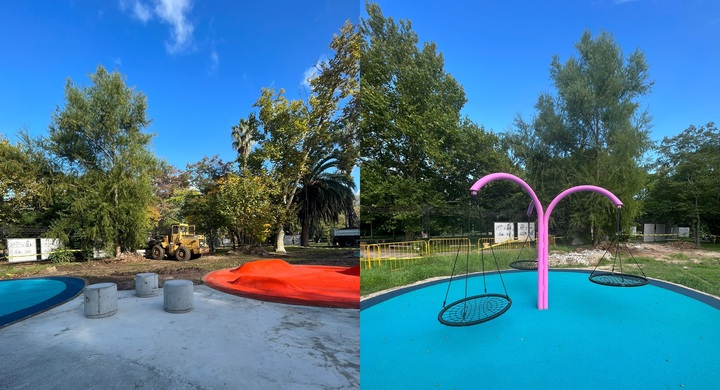
Paula Spinatelli oversaw the construction and managed the project, but she did not design the space itself. “The first thing I designed for the Foundation was a mobile stand for three inclusive hammocks (the circular, nest-like hammocks).” The idea behind this stand is to be able to move it to different locations and events, “for example, setting up a Foundation booth where children can have fun and adults can learn about these hammocks and their importance.” The designer noted that the stand resembles a pink tree, the Foundation’s signature color.
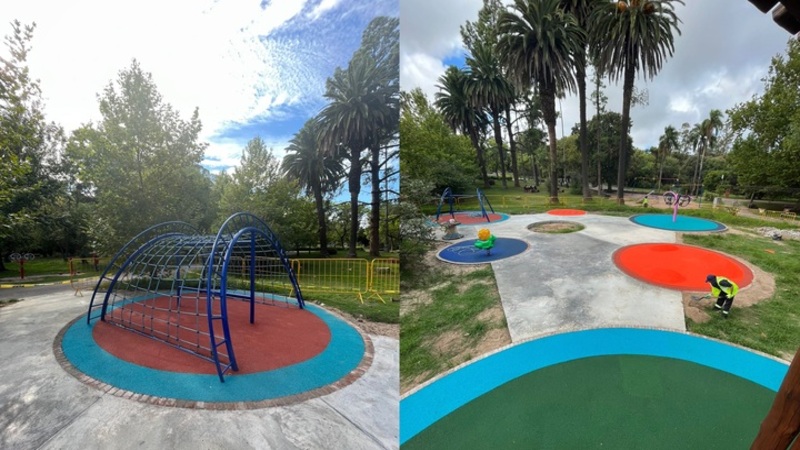
When designing the play structures themselves with accessibility in mind , it is important to remember that “a very enclosed, highly complex structure that a child in a wheelchair cannot approach” is already a limitation. So, games were designed to be “as simple as possible, navigable in different directions, easy to access, easy to climb, low-maintenance, and low-cost,” keeping in mind that they would be located in public spaces.
An adapted climbing structure was also designed at the Botanical Garden: they simply added a few extra centimeters in height—which even the child climbing it finds fun—so that children in wheelchairs—or children who don’t want to climb—can go underneath and keep playing, rather than being left out.
The message we want to spread is that if we can hang a regular hammock, why can't we hang an inclusive one?
“Setting aside the play equipment, it’s also very important—though not essential—that if the only thing that can be installed is an inclusive swing, we’d rather they install the swing, even if the ground isn’t suitable or there are no ramps, so that no child is denied the right to play,” explained the designer.
What does it mean to you, as a designer, to have created this space at the Botanical Garden?
When I joined the Foundation, I never imagined I’d be part of a project like this. Although I didn’t create the entire project, I designed some of the games featured in the production.
As a designer, you sometimes focus on designing the playground while someone else handles the rest of the project; but being able to get involved in making sure it’s accessible, that the materials are appropriate, that the benches in the plaza don’t block access, that there’s an “old” playground just a few meters from ours, and finding a way to connect them… It was an incredible experience that I never thought I’d get to do or that I’d be able to pull off, so I’m more than grateful to the Foundation.
How did your training at ORT help you take on this challenge?
It was the university that opened the door for me to be working where I am now. The Foundation wasn't posting a job opening; rather, the opportunity arose because I reached out to Nadia.
In college, I learned everything there is to know about game development, game assets, technical sheets, and a little bit about everything else.
Fabián, my boss, is the director of Kopel Sánchez, and I’ve been able to work on plaza projects in their buildings. Sometimes I need to know certain things about architecture and so on, which I’m able to handle thanks to the skills I learned in college—using 3D design software and the like. If I hadn’t had those opportunities to experiment with software and create projects during my studies, I don’t know if I’d be able to do this work today.
What are your hopes for the future?
For now, I plan to stay at the Jazmín Foundation, trying to spread this message of building an inclusive Uruguay. I want to keep working on this—creating spaces for everyone, improving people’s quality of life, not just putting up a swing; Sometimes I go to the Botanical Garden and sit down to work there while the workers and others are there, and a neighbor comes up to me to say how nice it is what they’re doing, that it’s just what the place needed. That’s when you start explaining why the swing is essential, and people ask you, “Can’t we replace the regular swings with inclusive ones?”