 They began with twelve stories from three countries, featuring “a handful of heroes,” as they’re introduced in the trailer. “Every day, and often anonymously, there are members of the community who work for the well-being of everyone, and especially for the most vulnerable—those who need help, understanding, and support. People who understand that community service and solidarity are a duty, and that in doing so, they seek no recognition other than the improved quality of life of their peers.” This is how Oscar Estévez, the series’ screenwriter and director, describes it. Since 2011, Estévez has also served as executive producer, alongside Pablo Scotellaro and Saúl Leal.
These heroes are at the heart of the documentary-style program, “to learn about their lives and their work; through their eyes, to gain a deeper understanding of the community as a whole, its strengths and weaknesses.”
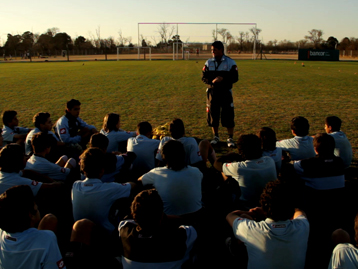
Gustavo Tano Spallina is a former professional soccer player who now runs six soup kitchens and teaches soccer to children living in informal settlements in his native Córdoba. Through the Córdoba Fútbol Foundation, they work with former players who have no health insurance or retirement benefits and cannot find work because they have spent their entire lives playing soccer; they provide them with psychological support and help them get back on their feet.
Gustavo is one of the heroes featured in this documentary series, which won an award in early October: it received a Rocky Mountain Southwest Chapter Emmy Award, the regional award covering the states of Arizona, New Mexico, Utah, Wyoming, and Central California. It was honored as the best human interest documentary program by the Academy of Television Arts & Sciences in the United States.
Produced by Mediapolis, TDA, and BYU International, the project was launched in 2008. Saúl Leal, director of BYU, and Pablo Scotellaro, director of the production company TDA, wanted to develop productions filmed in Latin America for the BYU University network. “One of those potential productions was *Héroes de la comunidad*. Saúl asked Pablo to put together a project, and Pablo asked Eduardo Hipogrosso (dean of the School of Communication and Design at Universidad ORT Uruguay) to recommend a student or alumnus to help develop the project and, if it came to fruition, to carry it out. Eduardo recommended me, and that’s how I got involved in the project,” said Estévez, a graduate of the Technical Program in Audiovisual Production. “During the second half of 2008, I put together the framework for what would later become Héroes de la comunidad. BYU University finally approved it in early 2009, and that’s when Montecarlo TV came on board as the production company.”
The first six episodes were filmed in 2010, all in Uruguay, and were co-produced by Mediapolis, the production company created for the project (Montecarlo and BYU).
There are now 18 episodes: six in Uruguay, six in Argentina, four in Paraguay, and two in Brazil. In December, the documentary series will premiere on BYU International for Latin America and the United States. In Uruguay, the broadcast rights are held by Montecarlo Televisión and Canal U. Estévez is confident that this award “will generate excitement about the series and, perhaps, serve as an incentive to sell it to other networks.”
Oscar Estévez summed up by saying that the stories of Community Heroes are inspiring. “I believe television needs to highlight the lives of people who see solidarity as a duty.”
https://www.youtube.com/watch?v=IGd2wrJ5b3s