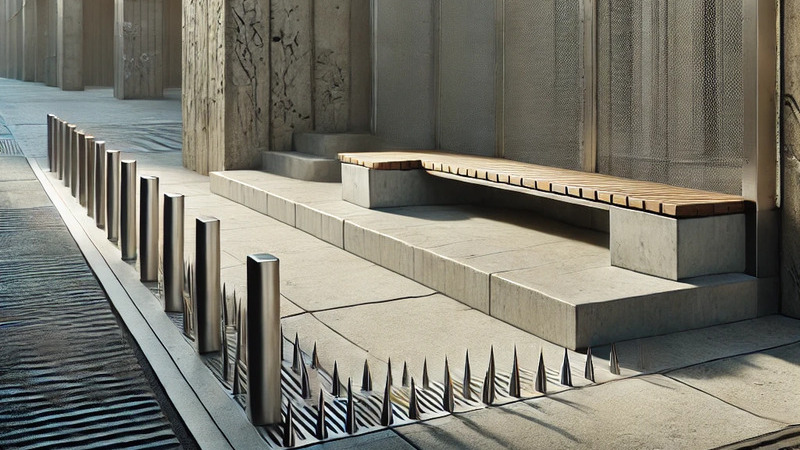
In a recent appearance on the show “Things in Their Place” on Radio Sarandí, Architect Maia Benevicius, academic coordinator of the professional development courses professional development the Faculty of Architecture of Universidad ORT Uruguay in Universidad ORT Uruguay, delved into the phenomenon of hostile architecture.
The intervention took place in the wake of a tragedy that occurred in Montevideo, where a young man died after tripping and falling onto sharp objects installed in a public space.
This case reignited the public debate on the impact of urban architecture and the urgent need to rethink the design of cities from a more human and inclusive perspective.
Hostile Architecture
Architect Benevicius defined hostile architecture as an urban design approach that uses physical elements to control or limit people’s behavior in public spaces. “It’s also called aggressive architecture or anti-loitering architecture, and I think that already says a lot about what it’s all about,” she explained. This type of architecture typically manifests itself through:
- Benches with dividers that make it impossible to sleep on them.
- Surfaces with spikes designed to prevent people from sitting or lying down.
- Uncomfortable furniture or physical barriers that limit the use of public space.
According to Benevicius, its roots can be traced back to social control strategies implemented in the mid-20th century, when the aesthetic and commercial order of cities was prioritized at the expense of inclusion and accessibility.
In this regard, the architect noted that “currently, in Montevideo and many other cities, this phenomenon has been on the rise,” however:
“It is essential to remember that public spaces, by definition, belong to everyone, which is why we need urban design that promotes inclusion, safety, and, of course, well-being.”
You might also be interested in reading: “How Artificial Intelligence Is Transforming Architecture”
The tragedy that sparked debate in Montevideo
The case of the young man who died near the Palermo neighborhood shocked the public and highlighted the lack of regulation regarding hostile architecture.
The Montevideo City Government responded to the public outcry by creating a working group with the aim of propose measures and regulations to regulate the use of items considered hostile and explore alternatives that promote safer and more equitable urban design.
https://www.youtube.com/watch?v=1AeWBiy8Ye0
This episode is an urgent call to rethink the role of public space, considering its function as a place for gathering and socializing.
Alternatives Around the World: Examples of Inclusive Cities
During her appearance on Radio Sarandí, Architect Benevicius highlighted specific examples of how other cities have addressed the issue of hostile architecture with innovative solutions:
- Amsterdam and Copenhagen: Adopted participatory processes in which local communities decide how public spaces are configured, ensuring that the needs of all social groups are met.
- Toronto: Redesigned its public benches, removing the “anti-sleeping” dividers and creating convertible furniture that can serve as temporary shelter in emergency situations.
- Helsinki: Prioritized providing housing to homeless people, reducing the need for hostile measures in public spaces.
- Paris: Transformed urban areas into community spaces, adding services such as drinking water and public restrooms, and promoting inclusion rather than exclusion.
These cases demonstrate that it is possible to address urban challenges through a human, participatory, and socially responsible.
- You might also be interested in reading: “Riken Yamamoto, the humanist architect and winner of the 2024 Pritzker Prize”
Living Together: The Role of Architecture in Social Inclusion
As explained in the article “Hostile Architecture: Challenges and Alternatives for Inclusive Urban Design”, published on the blog of the Faculty of Architecture at Universidad ORT Uruguay in Universidad ORT Uruguay, urban design has a direct impact on quality of life and social equity. Hostile architecture, although it seeks to control certain problems, tends to intensify exclusion and does not address the underlying causes of urban problems.
In response to this, inclusive urban design offers an alternative vision that prioritizes the creation of public spaces that are accessible, safe, and participatory.
As Danish architect and urban planner Jan Gehl states in Cities for People (2010), the key lies in restoring the human scale to citiesby designing environments that foster coexistence and social interaction, rather than excluding those who need these spaces the most, thereby further marginalizing the already marginalized.
In this context, the School of Architecture at the Universidad ORT Uruguay reaffirms its commitment to socially responsible architecture. Architect Maia Benevicius’s participation in this debate reflects the importance of training professionals capable of addressing the current challenges of urban planning and design.
Learn about the continuing education courses offered by the School of Architecture
Toward more inclusive and humane cities
This initiative invites us to reflect on the impact of hostile architecture and the need to rethink our cities. Through international examples and concrete proposals, it becomes clear that inclusive urban design is the key to building public spaces that respect and value diversity of people.
https://www.youtube.com/watch?v=zI_Rvnsq-3o
As Benevicius put it:
“It is essential to remember that public space, by definition, belongs to everyone. We need urban design that promotes inclusion, safety, and, of course, well-being.”
The Faculty of Architecture at Universidad ORT Uruguay in Universidad ORT Uruguay is committed to responsible and innovative remains the driving force behind training the architects who will lead the shift toward a more equitable and sustainable future.
Would you like to study at a university that promotes inclusive urban design and innovative solutions?
Learn more about the Architecture degree and start building a professional future that transforms our cities: