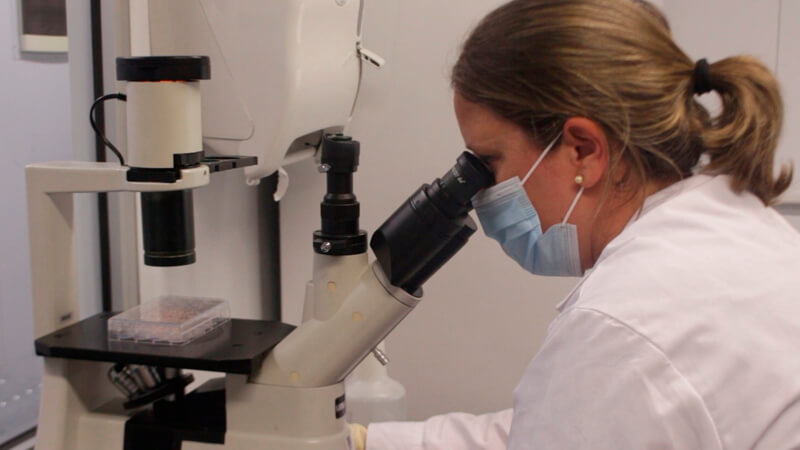
Just hours before the arrival in Uruguay of the first 192,000 doses of the COVID-19 vaccine, the doctor of biochemistry and professor of Biotechnology Engineering, and holder of a Bachelor’s Degree in Biotechnology at Universidad ORT Uruguay, answers some of the questions that have recently arisen in the public sphere regarding vaccines.
-
What is a vaccine?
In this video, Dr. Vanrell explains what a vaccine is and what it's used for.
https://www.youtube.com/watch?v=y7_Yn-1482Y
-
What are the different types of vaccines?
There are various types of vaccines that differ in composition.
In all cases, the ultimate goal is for the human body to be able to receive a portion of the virus in order to neutralize it.
According to Dr. Vanrell, a virus is a particle that contains its genomic material inside, which can be either DNA or RNA. In the case of the coronavirus, it is RNA.
“The virus has a protein shell that surrounds it, called a capsid, and on the outside it has an envelope—in the coronavirus it’s called a lipid envelope—from which some viral proteins protrude,” she explains.https://www.youtube.com/watch?v=6gqYbnCvD5w
-
What resources do scientists have at their disposal for developing vaccines?
How do scientists develop vaccines?
A professor in the Biotechnology program at ORT outlines the factors researchers take into account throughout the entire process of developing a vaccine.https://www.youtube.com/watch?v=aKKh7D5vfPQ
-
What is the vaccine development process like?
From the scientist’s determination of the vaccine’s composition to the certification of the results by the relevant regulatory agencies.
What stages must a vaccine go through before it can be administered on a large scale to combat a disease?
Dr. Vanrell discusses them in this video.https://www.youtube.com/watch?v=AUcDSPd2QQ8
-
Which stage of vaccine development takes the longest?
Ever since the first coronavirus vaccines became available, there has been widespread skepticism around the world about their effectiveness, given that the vaccine development process typically takes several years.
Dr. Vanrell, a biochemist, explains why the coronavirus vaccines were developed more quickly than usual.https://www.youtube.com/watch?v=JkX0XTUjcUQ
-
What happens to the vaccine when the virus mutates?
Throughout 2020, the media frequently reported that a new strain of the coronavirus had been discovered because the virus had mutated.
So what happens to the vaccines developed before the virus mutated? Do they stop being effective?https://www.youtube.com/watch?v=UIbvPtw76fM
-
What side effects can COVID-19 vaccines cause?
In this video, a professor in ORT’s biotechnology program discusses the side effects of some of the COVID-19 vaccines.
https://www.youtube.com/watch?v=eqitoASERe4
-
What training on vaccines do ORT biotechnology students receive?
In conclusion, Dr. Vanrell describes the curriculum for ORT’s biotechnology students in the areas of immunology and vaccines.
https://www.youtube.com/watch?v=q2m0DMLt5xo