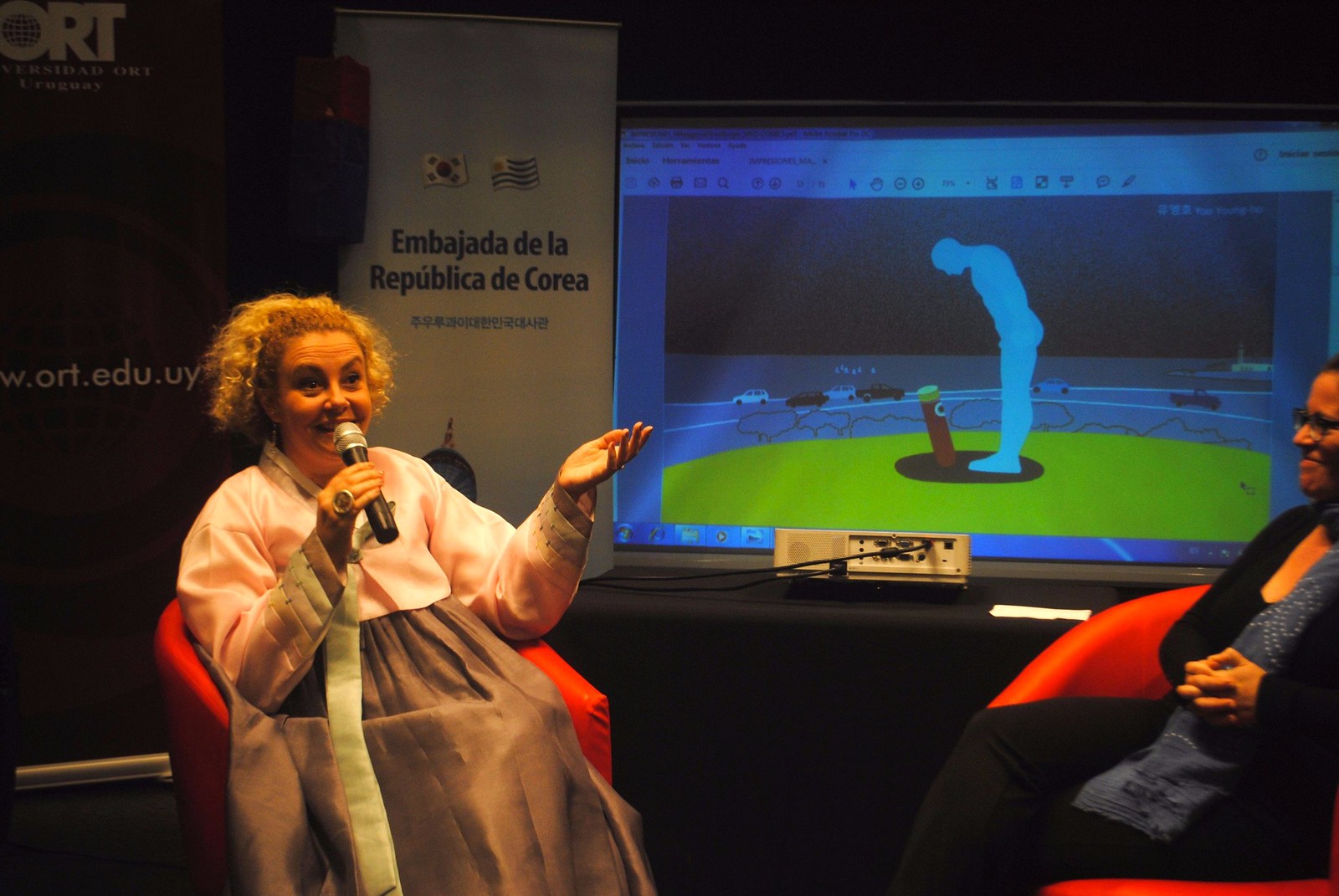
At the 15th edition of Montevideo Comics, she used her art to tell the story of how a Uruguayan woman learned about Korean customs and social norms, and how this, in turn, shaped her worldview. “It was a real culture shock,” she said.
María Eugenia Pérez Burger currently teaches at Universidad ORT Uruguay at the Korean Rey Sejong Institute, having received a scholarship to study in Korea several years ago. The experience had such a profound impact on her that, for her thesis for her subsequent Master’s degree in Visual Arts and Design, she drew on influences from Korean art. Her work is divided into two parts: on the one hand, a series of seven paintings titled “Impressions,” inspired by the Korean folk art known as Minhwa, but interpreted from a contemporary Western perspective; on the other hand, an audiovisual project that portrays the relationship between Uruguayan and Korean cultures.
“Impresiones” draws on various images and symbols of Korean culture; while these carry certain connotations for that country, Pérez, through his fresh perspective, imbues them with a different meaning. “They have a certain edge to them—not directed at Asia, but at what the West has done in the East, and how its very essence has been changing,” he said in reference to his paintings. Emphasizing the great harmony that reigns in Korean society, Pérez draws on elements such as the tiger, mountains, and birds, and in his compositions—which are based on Korean paintings—he gives this symbolism a different twist.
Her painting “Flowers and Birds” is based on an image frequently used in Korean wedding culture. While the specific details vary depending on the occasion, the composition always features two birds and flowers. In her work, Pérez depicted the relationships within the system using two crows alongside two carnivorous plants “that are hooking them into the system,” she said. This concept, according to the artist, applies not only to Korean culture but also to various other cultures.
Something similar occurs in her work “Studio Paintings.” This piece is based on a depiction of bookshelves and stationery—also part of Korean culture—but the artist replaces the elements typically found in such compositions with objects that define contemporary Western lifestyle: a cell phone, a television, plastic, Coca-Cola, potato chips, and others.
The second part of his thesis, a video that Pérez described as “a Korean-Uruguayan love story,” focuses on the human connection between these two very different cultures. It draws on the various experiences he had during his trip to Korea. Aspects such as respect for others and harmony fascinated Pérez during his stay in Korea, and continue to do so, but not everything was easy from the start. “Moving to the other side of the world was like a fall. It was a culture shock. I didn’t know anything about the language, and so I couldn’t take a bus or go to the supermarket,” he explained, emphasizing that it was difficult to adapt to a reality foreign to his own, but that he was able to do so and establish a good relationship with the people and their culture.
The video shows various aspects of a Westerner's interaction with Korea and its society. From how they use public transportation—waiting in line to board—to how they enjoy a day at the beach—avoiding direct sunlight and using floats in the water, all while being monitored by CCTV cameras at all times—to how they share a meal at a restaurant. The harmony that constantly seeks to preserve peace among people leads to a situation where even students do not make eye contact with their teacher.
To illustrate just how strange these customs appear to an outsider, Pérez depicts these moments through the eyes of a Westerner, showing how he perceives everything happening around him and how he participates in these events.
Through his art, Pérez sought to depict these very different ways of perceiving the world, which in turn lead to different ways of relating to one another, but he made it clear that his ideas apply to any kind of relationship. “If you want a relationship to flow and you try to make it happen, it works.”