It stems from an academic project completed as part of the degree program’s capstone project, where the student was able to apply the knowledge gained in the program along with new insights acquired during the process.
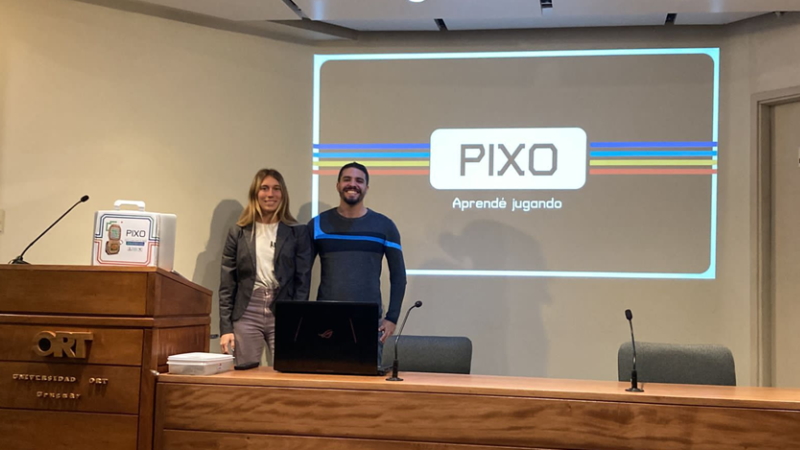
Valentina Pereyra discusses the process of creating PIXO, the added value of the project, how her academic background influenced her choice of topic, the challenges of entrepreneurship, the support provided by the CIE, and much more.
What is PIXO and how does it work?
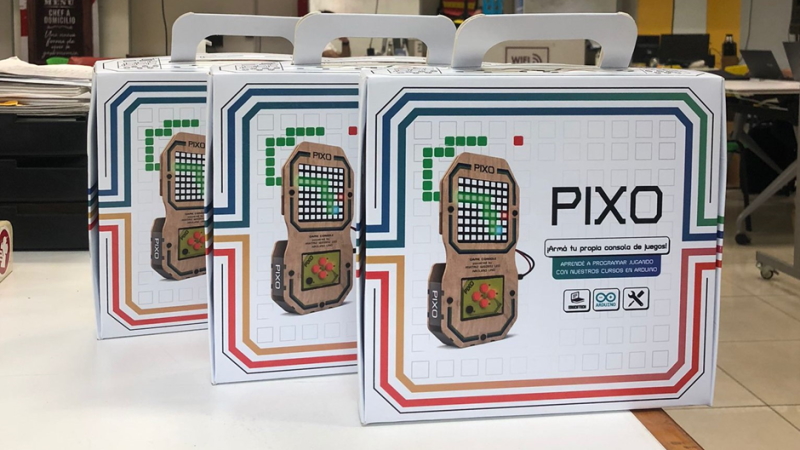
The PIXO learning kit allows children and teenagers to learn and understand the basics of programming and electronics while developing the skills to design and create video games.
This tool is ideal for educational institutions looking for a fun and innovative way to teach programming to their students. We also had self-taught young people in mind, which is why we developed a platform featuring more than 20 challenges. Step by step, we provide the tools they need to acquire the skills to create their own games.
The Importance of Programming for Children
Programming has become a vital life skill. If children are exposed to programming from an early age, they will be better equipped to understand and use technology in the future. This will give them a significant advantage as they advance in their careers.
If children are exposed to programming from an early age, they will be better able to understand and use technology in the future.
In addition, being familiar with programming by the time they graduate from high school will help them develop critical thinking skills and problem-solving abilities that will serve them well throughout their lives.
The Role of the Bachelor's Degree in Industrial Design in the Emergence of PIXO
The program provides you with many tools, from design and production to supplier management and presentation. I think the most important thing the program offers is the research component. I’m not a programmer, and I didn’t know much about electronics; I learned through online research and interviews with professionals. Throughout the program, you’re constantly faced with challenges that require you to conduct external research to arrive at the final product. I think that’s the most enjoyable part, and it’s also a very dynamic program.
Entrepreneurship and Its Educational Value
I feel both excitement and a sense of responsibility. For me, entering the education sector is a huge challenge. I enjoy constantly testing the kit with people of different ages and backgrounds to understand how each person absorbs the information. Producing and selling the kit is also a challenge. I’m starting to familiarize myself with factories and suppliers in China, the import process, and—most of all—selling to institutions.
It’s not easy to sell and explain such an innovative educational program, especially when most people don’t really understand what it’s all about. Fortunately, I have the help of Gonzalo Hernández, a partner at PIXO and a student pursuing a bachelor’s degree in Multimedia Design, who joined the project in May 2022 to give it a more educational focus—not just a recreational one. He developed the courses associated with the kit as well as the custom electronic components.
What does it take to take the plunge into entrepreneurship, and what advice would you give to someone just starting out in the world of entrepreneurship?
The most important thing is to believe in the idea; the road ahead is long and full of ups and downs, and if you don’t start out with confidence, you’ll give up at the first setback. It was also very important for me to share my project, to hear people’s opinions and advice, and to take their suggestions on how to improve it.
Entrepreneurs often worry that if we share our idea with someone, there’s a risk they’ll copy it, but we all have ideas—and turning one into reality is very difficult unless you’re truly passionate about your product. Joining an incubator was also incredibly helpful for me, as they helped me get the project off the ground and secure funding to keep growing.
In fact, through the CIE, PIXO received funding from ANDE and ANII, which was used to facilitate the sale of the product to various schools.
CIE's contribution to the project
I’m really glad I chose the CIE as an incubator for PIXO. What stands out most to me is its track record and the community—they’ve been in this field for a long time and know how to advise you on the best path to take, depending on your stage, from funding to growth. There’s also a community within the CIE that has developed over the years. I find it essential for getting advice on problems that arise along the way.
The Future of PIXO
From a business perspective, we are looking to partner with schools and academies that will give us access to a large user base. In addition, we will offer a B2C sales channel for those interested in developing their skills from home.
We are currently producing 100 kits that we hope to launch in January 2023, in time for the summer holidays, as well as to be included in the 2023 curriculum for schools and academies. We firmly believe that if we give children the opportunity to develop a habit of coding from a young age, it can help turn their hobby into a successful future career.